

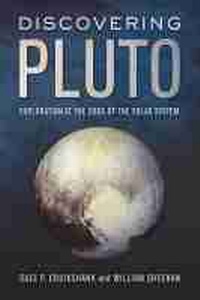
Discovering Pluto
Exploration at the Edge of the Solar System
Published on 28. February 2018
Book
Hardback
504 pages
978-0-8165-3431-9 (ISBN)
Description
Discovering Pluto is an authoritative account of the exploration of Pluto and its moons, from the first inklings of tentative knowledge through the exciting discoveries made during the flyby of the NASA research spacecraft New Horizons in July 2015. Co-author Dale P. Cruikshank was co-investigator on the New Horizons mission, while co-author William Sheehan is a noted historian of the solar system.
Telling the tale of Pluto's discovery, the authors recount the grand story of our unfolding knowledge of the outer solar system, from William Herschel's serendipitous discovery of Uranus in 1781, to the mathematical prediction in 1846 of Neptune's existence, to Percival Lowell's studies of the wayward motions of those giant planets leading to his prediction of another world farther out. Lowell's efforts led to Clyde Tombaugh's heroic search and discovery of Pluto-then a mere speck in the telescope-at Lowell Observatory in 1930.
Pluto was finally recognized as the premier body in the Kuiper Belt, the so-called third zone of our solar system. The first zone contains the terrestrial planets (Mercury through Mars) and the asteroid belt; the second, the gas-giant planets Jupiter through Neptune. The third zone, holding Pluto and the rest of the Kuiper Belt, is the largest and most populous region of the solar system.
Now well beyond Pluto, New Horizons will continue to wend its lonely way through the galaxy, but it is still transmitting data, even today. Its ultimate legacy may be to inspire future generations to uncover more secrets of Pluto, the solar system, and the universe.
Telling the tale of Pluto's discovery, the authors recount the grand story of our unfolding knowledge of the outer solar system, from William Herschel's serendipitous discovery of Uranus in 1781, to the mathematical prediction in 1846 of Neptune's existence, to Percival Lowell's studies of the wayward motions of those giant planets leading to his prediction of another world farther out. Lowell's efforts led to Clyde Tombaugh's heroic search and discovery of Pluto-then a mere speck in the telescope-at Lowell Observatory in 1930.
Pluto was finally recognized as the premier body in the Kuiper Belt, the so-called third zone of our solar system. The first zone contains the terrestrial planets (Mercury through Mars) and the asteroid belt; the second, the gas-giant planets Jupiter through Neptune. The third zone, holding Pluto and the rest of the Kuiper Belt, is the largest and most populous region of the solar system.
Now well beyond Pluto, New Horizons will continue to wend its lonely way through the galaxy, but it is still transmitting data, even today. Its ultimate legacy may be to inspire future generations to uncover more secrets of Pluto, the solar system, and the universe.
Reviews / Votes
A comprehensive and authoritative account of the exploration of Pluto and its moons, providing a ringside seat to the exciting discoveries made during the New Horizons flyby. Here in one place is everything you need to know about the Plutonian system."" - Bonnie J. Buratti, Jet Propulsion Laboratory, California Institute of Technology""Discovering Pluto offers a rare insider's view spanning the modern history of planetary science, from early telescopic observations through the recent spectacular New Horizons flyby of Pluto."" - Keith Noll, Planetary Scientis
More details
Language
English
Place of publication
Tucson
United States
Target group
Professional and scholarly
Illustrations
57 black & white illustrations, 8 colour illustrations, 5 tables
Dimensions
Height: 229 mm
Width: 152 mm
Thickness: 35 mm
Weight
819 gr
ISBN-13
978-0-8165-3431-9 (9780816534319)
Copyright in bibliographic data and cover images is held by Nielsen Book Services Limited or by the publishers or by their respective licensors: all rights reserved.
Schweitzer Classification
Persons
Dale P. Cruikshank is an astronomer and planetary scientist in the Astrophysics Branch at NASA Ames Research Center. His research specialties are spectroscopy and radiometry of planets and small bodies in the solar system, such as comets, asteroids, planetary satellites, dwarf planets, and other objects beyond Neptune. In 2006 he received the Kuiper Prize of the Division for Planetary Sciences.
William Sheehan is a psychiatrist and practicing clinician at Flagstaff Medical Center in Arizona, and an independent historian of astronomy. His many books include Planets and Perception, Worlds in the Sky, and The Planet Mars, also published by the University of Arizona Press. Asteroid No. 16037 was named in his honor.
William Sheehan is a psychiatrist and practicing clinician at Flagstaff Medical Center in Arizona, and an independent historian of astronomy. His many books include Planets and Perception, Worlds in the Sky, and The Planet Mars, also published by the University of Arizona Press. Asteroid No. 16037 was named in his honor.