

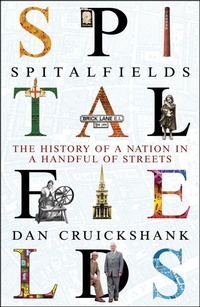
Spitalfields
The History of a Nation in a Handful of Streets
Published on 15. June 2017
Book
Paperback/Softback
784 pages
978-0-09-955909-2 (ISBN)
Description
SHORTLISTED FOR THE HESSELL-TILTMAN HISTORY PRIZE 2017
AN OBSERVER BOOK OF THE YEAR 2016
Religious strife, civil conflict, waves of immigration, the rise and fall of industry, great prosperity and grinding poverty - the handful of streets that constitute modern Spitalfields have witnessed all this and much more.
In Spitalfields, one of Britain's best-loved historians tells the stories of the streets he has lived in for four decades. Starting in Roman times and continuing right up to the present day, Cruickshank explains how Spitalfields' streets evolved, what people have lived there, and what lives they have led. En route, he discovers the tales of the Huguenot weavers who made Spitalfields their own after the Great Fire of London. He recounts the experiences of the first Jewish immigrants. He evokes the slum-ridden courts and alleys of Jack the Ripper's Spitalfields. And he describes the transformation of the Spitalfields he first encountered in the 1970s from a war-damaged collection of semi-derelict houses to the vibrant community it is today.
This is a fascinating evocation of one of London's most distinctive districts. At the same time, it is a history of England in miniature.
AN OBSERVER BOOK OF THE YEAR 2016
Religious strife, civil conflict, waves of immigration, the rise and fall of industry, great prosperity and grinding poverty - the handful of streets that constitute modern Spitalfields have witnessed all this and much more.
In Spitalfields, one of Britain's best-loved historians tells the stories of the streets he has lived in for four decades. Starting in Roman times and continuing right up to the present day, Cruickshank explains how Spitalfields' streets evolved, what people have lived there, and what lives they have led. En route, he discovers the tales of the Huguenot weavers who made Spitalfields their own after the Great Fire of London. He recounts the experiences of the first Jewish immigrants. He evokes the slum-ridden courts and alleys of Jack the Ripper's Spitalfields. And he describes the transformation of the Spitalfields he first encountered in the 1970s from a war-damaged collection of semi-derelict houses to the vibrant community it is today.
This is a fascinating evocation of one of London's most distinctive districts. At the same time, it is a history of England in miniature.
Reviews / Votes
Genial, erudite and companionable . . . this heroic and heartfelt book caps a career devoted to [Spitalfields'] heritage. * Spectator * With beguiling erudition, TV historian and local resident Cruickshank tells the story of Spitalfields from Roman times to today . . . This is people's history at its tastiest. * Sunday Express * A passionate, scholarly energy and involvement with every era of the district's long history come off Spitalfields' pages . . . Absorbing detail. * Times Literary Supplement * Cruickshank writes perceptively and honestly . . . As well as being a fascinating account of a unique area of London, Spitalfields is a timely warning that helps us to appreciate what the city and country risk losing. * Country Life * Dan Cruickshank bores into the rich history of Spitalfields, the area of east London where he has lived for decades. -- Rowan Moore, Best Books of 2016 * Observer * Dan Cruickshank has long been a resident of Elder Street in Spitalfields. In this elaborate chronicle of the district's past, he takes us on a historical tour that runs from the Romans to Tracy Emin . . . A love letter to a distinctive part of London that has always retained its own personality. * History Today * Cruickshank's history laments the City's encroachment on Spitalfields and the attendant growth there of estate agents, internet companies, fashion outlets and beardy hipster capitalists bent on having their slice of East End exotica. -- Best Books About London * Evening Standard * A delight to read . . . Teaches one how to use one's eyes more intelligently. -- Jean Seaton, Chair of Judges, PEN Hessell-Tiltman History Prize Particularly interesting is the story of Elder Street viewed through architectural sources, taxes and censuses. It acts as a microcosm showing the changes Britain faced over the centuries. * Who Do You Think You Are? Magazine * This is an elegy to a place changing beyond recognition . . . Cruickshank is an appealing, sympathetic writer. * The Times *More details
Language
English
Place of publication
London
United Kingdom
Publishing group
Cornerstone
Product notice
Paperback (UK-B)
Dimensions
Height: 200 mm
Width: 130 mm
Thickness: 55 mm
Weight
637 gr
ISBN-13
978-0-09-955909-2 (9780099559092)
Copyright in bibliographic data and cover images is held by Nielsen Book Services Limited or by the publishers or by their respective licensors: all rights reserved.
Schweitzer Classification
Other editions
Additional editions
E-Book
10/2016
Cornerstone Digital
€12.99
Available for download
Person
Dan Cruickshank is an architectural historian and television presenter. He is an Honorary Fellow of the Royal Institute of British Architects, and has sat on the Executive Committee of the Georgian Group, and the Architectural Panel of the National Trust. His previous work includes the BBC television programmes Civilisation Under Attack (2015) and At Home with the British (2016), and the books A History of Architecture in 100 Buildings (2015) and Spitalfields (2016). He lives in London.