

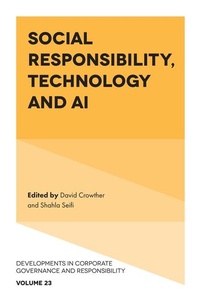
Social Responsibility, Technology and AI
Published on 18. November 2024
Book
Hardback
256 pages
978-1-83608-497-6 (ISBN)
Description
Artificial Intelligence (AI) has become one of the most talked about innovations of the present. There seems to be a general assumption that AI and technology of various forms can be used to achieve sustainability, but there is less discussion about how this can happen and whether there are both positives and negatives to technology and its use.
This edited collection builds on the ethical questions reminiscent of those raised by early fiction writing in relation to robotics, and AI's position within human endeavour. The chapters recognise the dangers as well as the applications which are appropriate and helpful.
Developments in Corporate Governance and Responsibility offers the latest research on topical issues by international experts and has practical relevance to business managers.
This edited collection builds on the ethical questions reminiscent of those raised by early fiction writing in relation to robotics, and AI's position within human endeavour. The chapters recognise the dangers as well as the applications which are appropriate and helpful.
Developments in Corporate Governance and Responsibility offers the latest research on topical issues by international experts and has practical relevance to business managers.
More details
Series
Language
English
Place of publication
Bingley
United Kingdom
Target group
Professional and scholarly
Dimensions
Height: 160 mm
Width: 237 mm
Thickness: 22 mm
Weight
494 gr
ISBN-13
978-1-83608-497-6 (9781836084976)
Copyright in bibliographic data and cover images is held by Nielsen Book Services Limited or by the publishers or by their respective licensors: all rights reserved.
Schweitzer Classification
Other editions
Additional editions
David Crowther | Shahla Seifi
Social Responsibility, Technology and AI
E-Book
11/2024
1st Edition
Emerald Publishing Limited
€200.99
Available for download
Persons
David Crowther is Professor of Corporate Social Responsibility at several universities including Bedfordshire university, UK, who previously worked in government and industry for twenty years, a career culminating in his role as divisional managing director of a multinational. In 2002 he established the Social Responsibility Research Network, an international body which now has several thousand members. His current research focuses on sustainability and governance in the modern environment.
Shahla Seifi is an engineer by training and worked at a senior level preparing standards for the national institute of Iran before moving to the UK. She now researches, writes, organises SRRNet activities (SRRNet.org) and runs her own consultancy.
Shahla Seifi is an engineer by training and worked at a senior level preparing standards for the national institute of Iran before moving to the UK. She now researches, writes, organises SRRNet activities (SRRNet.org) and runs her own consultancy.
Content
Part 1. Technology and sustainability
Chapter 1. Sustainable technologies for road maintenance and rehabilitation; Marius Gabriel Petrescu, Maria Tanase, and Teodor Dumitru
Chapter 2. B2B Marketing Rational Decision Using Big Data and AI Technology; Aysha A-Zayani and Muneer Al Mubarak
Chapter 3. Strategic Foresight and Business Analytics: A Systematic Exploration of Mediated Impacts on Organizational Resilience; Hiba AlSaidi and David Crowther
Chapter 4. Construction 4.0 Technologies: Uses and Challenges; Noor Al Mawlani and Muneer Al Mubarak
Part 2. Environmental issues and technology
Chapter 5. Green Growth Strategies: Exploring the Role of Environmental Taxation in Promoting Sustainable Development of Heavily Polluting Enterprises; Ningyu Zhai and Scarlett Ruopiao Zhang
Chapter 6. Technological Sustainability of Supply Chain Management in Food and Beverage Sector; Zaleekha Aman and Muneer Al Mubarak
Chapter 7. The history and future of climate change research - will novel technologies fall victim to denialism and conspiracy?; Mirela Panait, Razvan Ionescu, Iza Gigauri, and Lukman Raimi
Chapter 8. Internet of Things in Water Distribution Systems; Ahmed Ali Alkuwaiti and Muneer Al Mubarak
Part 3. Social challenges from technology
Chapter 9. Female Entrepreneurship Facing Artificial Intelligence in the European Union Countries; Aleksandra Gawel
Chapter 10. Understanding the location of women in science through feminist lens; Astha Jaiswal and Dinesh Kumar
Chapter 11. The Interplay of ICT and Environment in Small Island States; Verena Tandrayen-Ragoobur, Sheereen Fauzel, Nandikesh Juglal, and Bibi Nabeeha Jaunoo
Chapter 12. Two Facets of AI-Driven Applications for Sustainable Learning and Development: A Systematic Review of Tech-Entrepreneurial Benefits and Threats to Creative Learning; Lukman Raimi, Nurudeen Babatunde Bamiro, and Syamimi Ariff Lim
Chapter 1. Sustainable technologies for road maintenance and rehabilitation; Marius Gabriel Petrescu, Maria Tanase, and Teodor Dumitru
Chapter 2. B2B Marketing Rational Decision Using Big Data and AI Technology; Aysha A-Zayani and Muneer Al Mubarak
Chapter 3. Strategic Foresight and Business Analytics: A Systematic Exploration of Mediated Impacts on Organizational Resilience; Hiba AlSaidi and David Crowther
Chapter 4. Construction 4.0 Technologies: Uses and Challenges; Noor Al Mawlani and Muneer Al Mubarak
Part 2. Environmental issues and technology
Chapter 5. Green Growth Strategies: Exploring the Role of Environmental Taxation in Promoting Sustainable Development of Heavily Polluting Enterprises; Ningyu Zhai and Scarlett Ruopiao Zhang
Chapter 6. Technological Sustainability of Supply Chain Management in Food and Beverage Sector; Zaleekha Aman and Muneer Al Mubarak
Chapter 7. The history and future of climate change research - will novel technologies fall victim to denialism and conspiracy?; Mirela Panait, Razvan Ionescu, Iza Gigauri, and Lukman Raimi
Chapter 8. Internet of Things in Water Distribution Systems; Ahmed Ali Alkuwaiti and Muneer Al Mubarak
Part 3. Social challenges from technology
Chapter 9. Female Entrepreneurship Facing Artificial Intelligence in the European Union Countries; Aleksandra Gawel
Chapter 10. Understanding the location of women in science through feminist lens; Astha Jaiswal and Dinesh Kumar
Chapter 11. The Interplay of ICT and Environment in Small Island States; Verena Tandrayen-Ragoobur, Sheereen Fauzel, Nandikesh Juglal, and Bibi Nabeeha Jaunoo
Chapter 12. Two Facets of AI-Driven Applications for Sustainable Learning and Development: A Systematic Review of Tech-Entrepreneurial Benefits and Threats to Creative Learning; Lukman Raimi, Nurudeen Babatunde Bamiro, and Syamimi Ariff Lim