

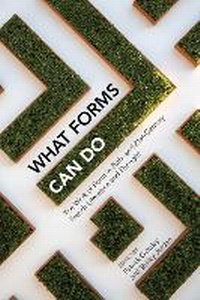
What Forms Can Do
The Work of Form in 20th- and 21st- Century French Literature and Thought
Published on 1. September 2022
Book
Paperback/Softback
342 pages
978-1-80207-740-7 (ISBN)
Description
This volume responds to important questions about the formal properties of literary texts and the agency of form. A central feature of twentieth- and twenty-first century French and Francophone writing has been the exploration of how cultural forms (literary, philosophical and visual) create distinctive semiotic environments and at the same time engage powerfully with external realities. How does form propose a bridge between the environment of the text and the world beyond? What kinds of formal innovations have authors devised in response to the complexity of that world? How do the formal properties of texts inflect our reading of them, and perhaps also our apprehension of the real? In addressing such questions as they apply to a wide corpus of texts, including the novel, life writing, the essay, travel writing, poetry and textual/visual experiments, the chapters in this volume offer new perspectives on a wide range of creative figures including Proust, Picasso, Breton, Bataille, Ponge, Guillevic, Certeau, Camus, Barthes, Perec, Roubaud, Chauvet, Savitzkaya, Eribon, Ernaux, Laurens and Akerman. Collectively, they renew the engagement with form that has been a key feature of French cultural production and of analysis in French studies.
Reviews / Votes
Reviews'This volume is of a very high calibre. It offers a broad cross-section of readings in French and Francophone Studies, bringing together a vibrant range of texts through a collective endeavor to rethink the concept and practice of literary form.'
Anna-Louise Milne, The University of London Institute in Paris
More details
Series
Language
English
Place of publication
Liverpool
United Kingdom
Illustrations
1 Illustrations, color
Dimensions
Height: 234 mm
Width: 156 mm
ISBN-13
978-1-80207-740-7 (9781802077407)
Copyright in bibliographic data and cover images is held by Nielsen Book Services Limited or by the publishers or by their respective licensors: all rights reserved.
Schweitzer Classification
Persons
Patrick Crowley is Senior Lecturer in French at University College Cork. Shirley Jordan is Professor of French Studies at the University of Newcastle and Co-Director of the Centre for Contemporary Women's Writing (CCWW) in the School of Advanced Studies, University of London.
Content
Table of Contents
Introduction: What Forms Can Do: The Work of Form in 20th- and 21st- Century French Literature and Thought.
Part 1: Interrogating Form
Chapter 1: Peter Read, 'Fixe par les cris des hirondelles au vol geometrique du desir' (Picasso, 7th June 1936): Patterns and Permutations in Picasso's Writing.
Chapter 2: Ann Jefferson, A Gaggle of Geese or Technical Rigour: Re-forming the Novel in 1940s France
Chapter 3: Diana Knight, 'Faire ceci ou faire cela?': Barthes and the Choice of Form
Chapter 4: Johnnie Gratton, The Eclipse of Form in Roland Barthes' La Chambre Claire
Chapter 5: Mairead Hanrahan, Going on, or Achieving Interruption: Jacques Roubaud's Quelque chose noir
Part 2: Form and Life Writing
Chapter 6: Gunnthorunn Gudmundsdottir, Narratives of Forgetting: Memory and Literary Form
Chapter 7: Shirley Jordan, The Time of our Lives: Repetition, Variation and Fragmentation in French Women's Life Writing
Chapter 8: Charles Forsdick, Vertical Travel, Listing and the Enumeration of the Everyday
Chapter 9: Patrick Crowley, Eugene Savitzkaya: Fictional Forms of Remembrance
Chapter 10: Ian Maclaclan, A Voice Takes Form: The Sounds of Autobiography in Louis-Rene des Forets's Poemes de Samuel Wood
Part 3: Form and Social Experience
Chapter 11: Eddie Hughes, Circuits of Re-appropriation: Accessing the Real in the Work of Didier Eribon
Chapter 12: Celia Britton, Metaphor, Parody and Madness: Two Readings of Marie Chauvet's Folie
Chapter 13: Alison Finch, Aesthetic Form and Social 'Form' in A la recherche du temps perdu: Proust on Taste
Chapter 14: Michael Lucey, 'La recherche que l'on peut dire formelle': Proust with Bourdieu
Part 4: Forms and Formless: World, Movement, Thought
Chapter 15: Emily McLaughlin, How To Think Like a Plant? Ponge, Jaccottet, Guillevic
Chapter 16: Patrick O'Donovan, Certeau's Landscapes: What can Images do?
Chapter 17: Eric Robertson, A la derive: Drifting in and out of Form in French Literature and Visual Art from Bataille to Bergvall
Chapter 18: Patrick ffrench, Convulsive Form: Benjamin, Bataille and the Innervated Body
Chapter 19: Michael Syrotinski, Form and energeia in the Work of Barbara Cassin (For M)
Introduction: What Forms Can Do: The Work of Form in 20th- and 21st- Century French Literature and Thought.
Part 1: Interrogating Form
Chapter 1: Peter Read, 'Fixe par les cris des hirondelles au vol geometrique du desir' (Picasso, 7th June 1936): Patterns and Permutations in Picasso's Writing.
Chapter 2: Ann Jefferson, A Gaggle of Geese or Technical Rigour: Re-forming the Novel in 1940s France
Chapter 3: Diana Knight, 'Faire ceci ou faire cela?': Barthes and the Choice of Form
Chapter 4: Johnnie Gratton, The Eclipse of Form in Roland Barthes' La Chambre Claire
Chapter 5: Mairead Hanrahan, Going on, or Achieving Interruption: Jacques Roubaud's Quelque chose noir
Part 2: Form and Life Writing
Chapter 6: Gunnthorunn Gudmundsdottir, Narratives of Forgetting: Memory and Literary Form
Chapter 7: Shirley Jordan, The Time of our Lives: Repetition, Variation and Fragmentation in French Women's Life Writing
Chapter 8: Charles Forsdick, Vertical Travel, Listing and the Enumeration of the Everyday
Chapter 9: Patrick Crowley, Eugene Savitzkaya: Fictional Forms of Remembrance
Chapter 10: Ian Maclaclan, A Voice Takes Form: The Sounds of Autobiography in Louis-Rene des Forets's Poemes de Samuel Wood
Part 3: Form and Social Experience
Chapter 11: Eddie Hughes, Circuits of Re-appropriation: Accessing the Real in the Work of Didier Eribon
Chapter 12: Celia Britton, Metaphor, Parody and Madness: Two Readings of Marie Chauvet's Folie
Chapter 13: Alison Finch, Aesthetic Form and Social 'Form' in A la recherche du temps perdu: Proust on Taste
Chapter 14: Michael Lucey, 'La recherche que l'on peut dire formelle': Proust with Bourdieu
Part 4: Forms and Formless: World, Movement, Thought
Chapter 15: Emily McLaughlin, How To Think Like a Plant? Ponge, Jaccottet, Guillevic
Chapter 16: Patrick O'Donovan, Certeau's Landscapes: What can Images do?
Chapter 17: Eric Robertson, A la derive: Drifting in and out of Form in French Literature and Visual Art from Bataille to Bergvall
Chapter 18: Patrick ffrench, Convulsive Form: Benjamin, Bataille and the Innervated Body
Chapter 19: Michael Syrotinski, Form and energeia in the Work of Barbara Cassin (For M)