

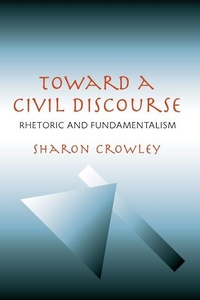
Toward a Civil Discourse
Rhetoric and Fundamentalism
Published on 15. March 2006
Book
Paperback/Softback
256 pages
978-0-8229-5923-6 (ISBN)
Description
Toward a Civil Discourse examines how, in the current political climate, Americans find it difficult to discuss civic issues frankly and openly with one another. Because America is dominated by two powerful discourses--liberalism and Christian fundamentalism, each of which paints a very different picture of America and its citizens' responsibilities toward their country-there is little common ground, and hence Americans avoid disagreement for fear of giving offence.
Sharon Crowley considers the ancient art of rhetoric as a solution to the problems of repetition and condemnation that pervade American public discourse. Crowley recalls the historic rhetorical concept of stasis--where advocates in a debate agree upon the point on which they disagree, thereby recognizing their opponent as a person with a viable position or belief. Most contemporary arguments do not reach stasis, and without it, Crowley states, a nonviolent resolution cannot occur.
Toward a Civil Discourse investigates the cultural factors that lead to the formation of beliefs, and how beliefs can develop into densely articulated systems and political activism. Crowley asserts that rhetorical invention (which includes appeals to values and the passions) is superior in some cases to liberal argument (which often limits its appeals to empirical fact and reasoning) in mediating disagreements where participants are primarily motivated by a moral or passionate commitment to beliefs.
Sharon Crowley examines numerous current issues and opposing views, and discusses the consequences to society when, more often than not, argumentative exchange does not occur. She underscores the urgency of developing a civil discourse, and through a review of historic rhetoric and its modern application, provides a foundation for such a discourse-whose ultimate goal, in the tradition of the ancients, is democratic discussion of civic issues.
Sharon Crowley considers the ancient art of rhetoric as a solution to the problems of repetition and condemnation that pervade American public discourse. Crowley recalls the historic rhetorical concept of stasis--where advocates in a debate agree upon the point on which they disagree, thereby recognizing their opponent as a person with a viable position or belief. Most contemporary arguments do not reach stasis, and without it, Crowley states, a nonviolent resolution cannot occur.
Toward a Civil Discourse investigates the cultural factors that lead to the formation of beliefs, and how beliefs can develop into densely articulated systems and political activism. Crowley asserts that rhetorical invention (which includes appeals to values and the passions) is superior in some cases to liberal argument (which often limits its appeals to empirical fact and reasoning) in mediating disagreements where participants are primarily motivated by a moral or passionate commitment to beliefs.
Sharon Crowley examines numerous current issues and opposing views, and discusses the consequences to society when, more often than not, argumentative exchange does not occur. She underscores the urgency of developing a civil discourse, and through a review of historic rhetoric and its modern application, provides a foundation for such a discourse-whose ultimate goal, in the tradition of the ancients, is democratic discussion of civic issues.
Reviews / Votes
In Toward a Civil Discourse, Sharon Crowley creatively rethinks the tools of ancient rhetorical invention in light of postmodern academic theory. With historical precision and theoretical perspicacity, she then incisively analyzes the current impasse in public deliberations between adherents of modern liberalism and Christian apocalyptism. This timely, original contribution to rhetorical studies and contemporary political debate offers a major new statement by one of the most important rhetoricians writing today. * Steven Mailloux, University of California, Irvine * A remarkable examination of affective citizenship's expansions and contractions. . . . An excellent study of the fundamentalist rhetoric that is gaining such powerful influence in American culture, [reaffirms] the power of rhetoric within the civic sphere. * <i> JAC</i> *More details
Series
Language
English
Place of publication
Pittsburgh PA
United States
Target group
College/higher education
Professional and scholarly
Product notice
Paperback (trade)
Illustrations
illustrations
Dimensions
Height: 228 mm
Width: 153 mm
Thickness: 15 mm
Weight
358 gr
ISBN-13
978-0-8229-5923-6 (9780822959236)
Copyright in bibliographic data and cover images is held by Nielsen Book Services Limited or by the publishers or by their respective licensors: all rights reserved.
Schweitzer Classification
Other editions
Additional editions
E-Book
04/2006
Princeton University Press
€53.99
Available for download
Person
Sharon Crowley is professor of English at Arizona State University. She is the author of Composition in the University, The Methodical Memory, and the textbook Ancient Rhetorics for Contemporary Students.