

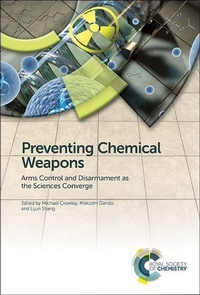
Preventing Chemical Weapons
Arms Control and Disarmament as the Sciences Converge
Published on 20. August 2018
Book
Hardback
666 pages
978-1-78262-649-7 (ISBN)
Description
The life and chemical sciences are in the midst of a period of rapid and revolutionary transformation that will undoubtedly bring societal benefits but also have potentially malign applications, notably in the development of chemical weapons. Such concerns are exacerbated by the unstable international security environment and the changing nature of armed conflict, which could fuel a desire by certain States to retain and use existing chemical weapons, as well as increase State interest in creating new weapons; whilst a broader range of actors may seek to employ diverse toxic chemicals as improvised weapons. Stark indications of the multi-faceted dangers we face can be seen in the chemical weapons attacks against civilians and combatants in Iraq and Syria, and also in more targeted chemical assassination operations in Malaysia and the UK.
Using a multi-disciplinary approach, and drawing upon an international group of experts, this book analyses current and likely near-future advances in relevant science and technology, assessing the risks of their misuse. The book examines the current capabilities, limitations and failures of the existing international arms control and disarmament architecture - notably the Chemical Weapons Convention - in preventing the development and use of chemical weapons. Through the employment of a novel Holistic Arms Control methodology, the authors also look beyond the bounds of such treaties, to explore the full range of international law, international agreements and regulatory mechanisms potentially applicable to weapons employing toxic chemical agents, in order to develop recommendations for more effective routes to combat their proliferation and misuse. A particular emphasis is given to the roles that chemical and life scientists, health professionals and wider informed activist civil society can play in protecting the prohibition against poison and chemical weapons; and in working with States to build effective and responsive measures to ensure that the rapid scientific and technological advances are safeguarded from hostile use and are instead employed for the benefit of us all.
Using a multi-disciplinary approach, and drawing upon an international group of experts, this book analyses current and likely near-future advances in relevant science and technology, assessing the risks of their misuse. The book examines the current capabilities, limitations and failures of the existing international arms control and disarmament architecture - notably the Chemical Weapons Convention - in preventing the development and use of chemical weapons. Through the employment of a novel Holistic Arms Control methodology, the authors also look beyond the bounds of such treaties, to explore the full range of international law, international agreements and regulatory mechanisms potentially applicable to weapons employing toxic chemical agents, in order to develop recommendations for more effective routes to combat their proliferation and misuse. A particular emphasis is given to the roles that chemical and life scientists, health professionals and wider informed activist civil society can play in protecting the prohibition against poison and chemical weapons; and in working with States to build effective and responsive measures to ensure that the rapid scientific and technological advances are safeguarded from hostile use and are instead employed for the benefit of us all.
Reviews / Votes
As a CBRN Professional I would highly recommend the text, especially chapters 3, 5-7, 10, 12, 14 & 15, to anyone new to the field of Chemical Warfare. As its content is relevant to anyone, who is looking to educate themselves in the field of chemical weapon non-proliferation. The book provides detailed sections on all the major international treatiesand regulations pertaining to control of chemical weapons. More importantly the authors impart a detailed understanding of how the changing security environment and advances in science & technology are likely to challenge the existing Chemical Weapons Convention (CWC) in future. * CBRNe World, October 2018, Page 71 * On the whole, the book addresses a very important issue for the present era in a systematic manner. The book is an easy read and makes a significant contribution towards understanding the issues of human-induced misuse of chemistry for war fighting and/or terrorism. * https://doi.org/10.1080/09700161.2019.1565188 * This timely volume, Preventing Chemical Weapons, is an excellent historical, academic, and policy-relevant examination of the ongoing threat of chemical and biological agents and weapons, the importance of two global treaties in abolishing two whole categories of weapons of mass destruction (WMD)-chemical and biological weapons-and the need for global attention to maintaining and strengthening implementation of these disarmament and nonproliferation regimes in the face of many and varied threats from non-state actors, recalcitrant states parties, national bureaucracies, criminal activities, and global lack of attention. I highly recommend a good read. * https://doi.org/10.1080/10736700.2019.1632044 *
More details
Language
English
Place of publication
Cambridge
United Kingdom
Target group
Professional and scholarly
Product notice
Unsewn / adhesive bound
Dimensions
Height: 240 mm
Width: 164 mm
Thickness: 43 mm
Weight
1148 gr
ISBN-13
978-1-78262-649-7 (9781782626497)
Copyright in bibliographic data and cover images is held by Nielsen Book Services Limited or by the publishers or by their respective licensors: all rights reserved.
Schweitzer Classification
Other editions
Additional editions
Michael Crowley | Malcolm Dando | Lijun Shang
Preventing Chemical Weapons
Arms Control and Disarmament as the Sciences Converge
E-Book
08/2018
1st Edition
Royal Society of Chemistry
€132.99
Available for download
Michael Crowley | Malcolm Dando | Lijun Shang
Preventing Chemical Weapons
Arms Control and Disarmament as the Sciences Converge
E-Book
08/2018
1st Edition
Royal Society of Chemistry
€132.99
Available for download
Persons
Professor Malcolm Dando trained originally as a biologist (BSc and PhD at St. Andrews University, Scotland). After post-doctoral studies in the United States (University of Michigan and University of Oregon) he held UK Ministry of Defence funded fellowships in Operational Research at the University of Sussex during the 1970s. Since then he has worked on arms control and disarmament, particularly on chemical and biological issues (DSc. University of Bradford). In recent years this work has been focused on awareness raising and education of life scientists regarding dual use and biosecurity, for example in the Royal Society Brain Waves module on Neuroscience, conflict and security and Neuroscience and the Future of Chemical-Biological Weapons, Palgrave, Macmillan, 2015.
Dr Michael Crowley is an Honorary Visiting Senior Research Fellow at the Division of Peace Studies and International Development of Bradford University, and is also Research Associate for the Omega Research Foundation. He has worked for 25 years on arms control, security and human rights issues, including with Amnesty International, the Arias Foundation, BASIC, as Coordinator of the Bradford Non-Lethal Weapons Research Project and as Executive Director of VERTIC. He has also previously acted as Chairperson of the Bio-weapons Prevention Project.
Dr Lijun Shang is an international lecturer in Medical Science at School of Chemistry and Biosciences, University of Bradford. He is also a senior academic visitor to Department of Physiology, Anatomy and Genetics, University of Oxford, and a visiting Professor to Northwest University, China. During the past two decades, his researches primarily focus on structural and functional studies on ion channel in health and diseases and their physical and mathematical interfaces. Recently this interest is developed onto evaluating the potential toxic effects of nanoparticles, including chemical agents, on human health and diseases, with particularly interests in understanding the underlying mechanism of these effects.
Dr Michael Crowley is an Honorary Visiting Senior Research Fellow at the Division of Peace Studies and International Development of Bradford University, and is also Research Associate for the Omega Research Foundation. He has worked for 25 years on arms control, security and human rights issues, including with Amnesty International, the Arias Foundation, BASIC, as Coordinator of the Bradford Non-Lethal Weapons Research Project and as Executive Director of VERTIC. He has also previously acted as Chairperson of the Bio-weapons Prevention Project.
Dr Lijun Shang is an international lecturer in Medical Science at School of Chemistry and Biosciences, University of Bradford. He is also a senior academic visitor to Department of Physiology, Anatomy and Genetics, University of Oxford, and a visiting Professor to Northwest University, China. During the past two decades, his researches primarily focus on structural and functional studies on ion channel in health and diseases and their physical and mathematical interfaces. Recently this interest is developed onto evaluating the potential toxic effects of nanoparticles, including chemical agents, on human health and diseases, with particularly interests in understanding the underlying mechanism of these effects.
Content
Introduction: Preventing the Re-emergence of Chemical Weapons;
The Changing Nature of the Chemical and Biological Weapons Threat;
The Chemical Weapons Convention - Past Success, Current Challenges;
The Biological and Toxin Weapons Convention;
United Nations Mechanisms to Combat the Development, Acquisition and Use of Chemical Weapons;
International Legal Constraints upon the Weaponization of Toxic Chemicals;
Convergence of Chemistry and Biology, and Nanotechnology;
Advances in Understanding Targets in the Central Nervous System (CNS);
Advances in the Targeted Delivery of Biochemical Agents;
The Future of Chemical Weapons: Advances in the Development of Anti-plant Agents;
The Future of Chemical Weapons: Advances in Anti-animal Agents;
Development and Hostile Use of Toxic Chemical Means of Delivery and Dispersal;
Advances in Poisoning Mechanisms, Biomarkers, and Drugs for the Prevention and Treatment of Traditional Chemical Weapons;
Current Challenges to Export Controls Related to Chemical Warfare Interdiction;
The Future of Chemical Weapons Convention - Out-dated Model of CWC 2.0;
Implications for the Biological and Toxin Weapons Convention;
Role of the Non-governmental Chemical Science Community in Combatting the Development, Proliferation, and Use of Chemical Weapons;
Role of the Non-governmental Life Science Community in Combatting the Development, Proliferation and Use of Chemical Weapons;
The Role of the Non-governmental Medical Community in Combatting the Development, Proliferation and Use of Chemical Weapons;
The Role of Civil Society in Combating the Development, Proliferation and Use of Chemical Weapons;
Conclusions and Recommendations
The Changing Nature of the Chemical and Biological Weapons Threat;
The Chemical Weapons Convention - Past Success, Current Challenges;
The Biological and Toxin Weapons Convention;
United Nations Mechanisms to Combat the Development, Acquisition and Use of Chemical Weapons;
International Legal Constraints upon the Weaponization of Toxic Chemicals;
Convergence of Chemistry and Biology, and Nanotechnology;
Advances in Understanding Targets in the Central Nervous System (CNS);
Advances in the Targeted Delivery of Biochemical Agents;
The Future of Chemical Weapons: Advances in the Development of Anti-plant Agents;
The Future of Chemical Weapons: Advances in Anti-animal Agents;
Development and Hostile Use of Toxic Chemical Means of Delivery and Dispersal;
Advances in Poisoning Mechanisms, Biomarkers, and Drugs for the Prevention and Treatment of Traditional Chemical Weapons;
Current Challenges to Export Controls Related to Chemical Warfare Interdiction;
The Future of Chemical Weapons Convention - Out-dated Model of CWC 2.0;
Implications for the Biological and Toxin Weapons Convention;
Role of the Non-governmental Chemical Science Community in Combatting the Development, Proliferation, and Use of Chemical Weapons;
Role of the Non-governmental Life Science Community in Combatting the Development, Proliferation and Use of Chemical Weapons;
The Role of the Non-governmental Medical Community in Combatting the Development, Proliferation and Use of Chemical Weapons;
The Role of Civil Society in Combating the Development, Proliferation and Use of Chemical Weapons;
Conclusions and Recommendations