

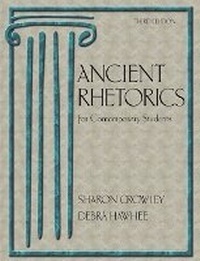
Ancient Rhetorics for Contemporary Students
3rd Edition
Published on 10. November 2003
Book
Hardback
480 pages
978-0-321-17276-1 (ISBN)
Description
Ancient Rhetorics for Contemporary Students revives the classical strategies of ancient Greek and Roman rhetoricians and adapts them to the needs of contemporary writers and speakers. This is a fresh interpretation of the ancient canons of composing: invention, arrangement, style, memory, and delivery. It shows that rhetoric, as it was practiced and taught by the ancients, was an intrinsic part of daily life and of communal discourse about current events. This book gives special emphasis to classic strategies of invention, devoting separate chapters to stasis theory, common and special topics, formal topics, ethos, pathos, extrinsic proofs, and Aristotelian means of reasoning. The authors' engaging discussion and their many contemporary examples of ancient rhetorical principles present rhetoric as a set of flexible, situational practices. This practical history draws the most relevant and useful concepts from ancient rhetorics and discusses, updates, and offers them for use in the contemporary composition classroom.
More details
Edition
3rd edition
Language
English
Place of publication
United States
Publishing group
Pearson Education (US)
Target group
Professional and scholarly
Dimensions
Height: 242 mm
Width: 184 mm
Thickness: 26 mm
Weight
903 gr
ISBN-13
978-0-321-17276-1 (9780321172761)
Copyright in bibliographic data and cover images is held by Nielsen Book Services Limited or by the publishers or by their respective licensors: all rights reserved.
Schweitzer Classification
Other editions
New editions
Sharon Crowley | Debra Hawhee
Ancient Rhetorics for Contemporary Students
Book
4th Edition
Pearson
€91.79
The article will not be published
Previous edition

Sharon Crowley | Debra Hawhee
Ancient Rhetorics for Contemporary Students
Book
08/1998
2nd Edition
Pearson
€57.13
Article exhausted; check for reprint
Content
Preface.
Acknowledgments.
1. Ancient Rhetorics: Their Differences and the Difference They Make.
INVENTION.
2. Kairos and the Rhetorical Situation: Seizing the Moment.
3. Stasis Theory: Asking the Right Questions.
4. The Common Topics and the Common Places: Finding the Available Means.
5. Logical Proof: Reasoning in Rhetoric.
6. Ethical Proof: Arguments from Character.
7. Pathetic Proof: Passionate Appeals.
8. Extrinsic Proofs: Arguments Waiting to Be Used.
ARRANGEMENT.
9. The Sophistic Topics: Define, Divide, and Conquer.
10. Arrangement: Getting It Together.
STYLE, MEMORY, AND DELIVERY.
11. Style: Composition and Ornament.
12. Memory: The Treasure-House of Invention.
13. Delivery: Attending to Eyes and Ears.
RHETORICAL EXERCISES.
14. Imitation: Achieving Copiousness.
15. The Progymnasmata, or Rhetorical Exercises.
Glossary of Terms.
Appendices.
Bibliography.
Index.
Acknowledgments.
1. Ancient Rhetorics: Their Differences and the Difference They Make.
INVENTION.
2. Kairos and the Rhetorical Situation: Seizing the Moment.
3. Stasis Theory: Asking the Right Questions.
4. The Common Topics and the Common Places: Finding the Available Means.
5. Logical Proof: Reasoning in Rhetoric.
6. Ethical Proof: Arguments from Character.
7. Pathetic Proof: Passionate Appeals.
8. Extrinsic Proofs: Arguments Waiting to Be Used.
ARRANGEMENT.
9. The Sophistic Topics: Define, Divide, and Conquer.
10. Arrangement: Getting It Together.
STYLE, MEMORY, AND DELIVERY.
11. Style: Composition and Ornament.
12. Memory: The Treasure-House of Invention.
13. Delivery: Attending to Eyes and Ears.
RHETORICAL EXERCISES.
14. Imitation: Achieving Copiousness.
15. The Progymnasmata, or Rhetorical Exercises.
Glossary of Terms.
Appendices.
Bibliography.
Index.