

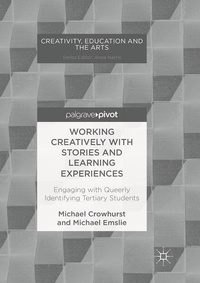
Working Creatively with Stories and Learning Experiences
Engaging with Queerly Identifying Tertiary Students
Published on 6. June 2019
Book
Paperback/Softback
XIII, 100 pages
978-3-319-88837-8 (ISBN)
Description
Stories are a valuable vehicle for practitioners in research, education, human services and the arts to enable individual and cultural change. The authors describe and deploy a variety of methods that can be used by teachers, researchers, artists, youth and community workers, and other professionals to analyse stories in ways that can promote learning and wellbeing and enhance professional practice. Offering a concise and user-friendly assemblage of techniques on how to creatively engage with stories, the authors explore and exemplify these techniques through the narratives of Queerly Identifying Tertiary Students. This practical and innovative volume will appeal to readers, researchers and practitioners alike.
More details
Series
Edition
Softcover reprint of the original 1st ed. 2018
Language
English
Place of publication
Cham
Switzerland
Publishing group
Springer International Publishing
Target group
Professional and scholarly
Illustrations
6 s/w Abbildungen
XIII, 100 p. 6 illus.
Dimensions
Height: 210 mm
Width: 148 mm
Thickness: 7 mm
Weight
162 gr
ISBN-13
978-3-319-88837-8 (9783319888378)
DOI
10.1007/978-3-319-69754-3
Schweitzer Classification
Other editions
Additional editions
Michael Crowhurst | Michael Emslie
Working Creatively with Stories and Learning Experiences
Engaging with Queerly Identifying Tertiary Students
Book
02/2018
Palgrave Macmillan
€48.14
Shipment within 10-15 days
Persons
Michael Crowhurst is Lecturer in Education at RMIT University, Australia. Michael Emslie is Lecturer in Youth Work at RMIT University, Australia.
Content
Chapter 1. Introduction.- Troubling Invitation 1. Coherence.- Chapter 2. Discourse Analysis.- Troubling Invitation 2. Knowing From?.- Chapter 3. Performative Analysis.- Troubling Invitation 3. Knowing 2 Ways.- Chapter 4. Assemblage as Analysis.- Troubling Invitation 4. Knowing Drawing on Others.- Chapter 5. Analysis to Identify Contradictions.- Troubling Invitation 5. Comfort and Discomfort.- Chapter 6. Reading Aloud as Generative.- Troubling Invitation 6. Return to What is Cohering.- Chapter 7. Conclusion.