

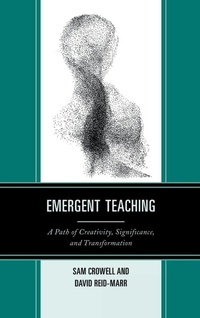
Emergent Teaching
A Path of Creativity, Significance, and Transformation
Published on 10. January 2013
Book
Hardback
168 pages
978-1-4758-0254-2 (ISBN)
Description
Emergent Teaching inspires teachers to teach with more spontaneity and creativity within an educational environment that is highly constrained. It demonstrates, through descriptive stories, creative strategies and provides an intellectual foundation for emergent teaching. The authors show how teachers can relate subject matter to students' lives and experience. They illustrate rituals and processes that help establish a caring learning community. Finally, the book applies the theories of complexity and chaos while reaffirming the natural wisdom that teachers possess within themselves. The authors have chosen a narrative format that "models" rather than "tells," and encourages readers to connect to their own stories and experiences.
The book is consistent with the theoretical understandings and research in the complexity sciences but takes a narrative approach, giving examples and illustrations of ideas through stories, myths, and parables that act as metaphors and illustrations. Key topics and practices embedded in these stories include:
teaching the whole person strategies for creative teaching new understandings of processmeaning-centered learningbuilding community in the classroomstrengthening the student/teacher relationship project-based learning using art and nature in teaching embodied learningincorporating story and narrative in teachingrites of passageembracing the unpredictable, uncharted spaces in teaching
The book is consistent with the theoretical understandings and research in the complexity sciences but takes a narrative approach, giving examples and illustrations of ideas through stories, myths, and parables that act as metaphors and illustrations. Key topics and practices embedded in these stories include:
teaching the whole person strategies for creative teaching new understandings of processmeaning-centered learningbuilding community in the classroomstrengthening the student/teacher relationship project-based learning using art and nature in teaching embodied learningincorporating story and narrative in teachingrites of passageembracing the unpredictable, uncharted spaces in teaching
Reviews / Votes
As states adopt common core standards and school districts ponder scripted curriculum that allegedly ensures that such standards are met, some classroom teachers have sought alternate routes. Emergent Teaching results from teachers' understanding that they can influence but cannot control what occurs in the classroom. Instead, Crowell and Reid-Marr assert that although teachers may anticipate certain patterns, classroom practice largely involves assisting learners to discover personal significance and creating a sense of belonging. Organized into ten chapters, the book defines emergent teaching and then examines some central tenets of the approach, including the experience of non-separation, event-centric teaching, non-linear instruction, the emergence of understanding, and the roles of play and joy in the classroom. Within these contexts, Crowell and Reid-Marr explore how teachers may encourage creativity, build relevance, and link emergence to the curriculum and other holistic concerns. Clearly written and full of useful examples of emergent teaching in action, the book is a great complement to A. S. Neill and Albert Lamb's Summerhill School (1994) or Maxine Greene's Releasing the Imagination. Summing Up: Highly recommended. All readership levels. * Choice Reviews * Crowell and Reid- Marr present accessible conversations, reflections and stories that guide the reader through a transdisciplinary approach to teaching. Teachers are offered strategies for emergent teaching that can transform their learning worlds. . . .This work affirms and advances our understanding of transformative education. By interweaving the new sciences, the importance of non-linearity, process, and creativity, Crowell and Reid-Marr offer a significant responsive holistic approach to education that addresses the whole person. . . .The clear style and easily understood ideas make the book suitable for a wide audience, from undergraduates to academics and extends our perspectives to implement transformative learning theory into educational practice. Crowell and Reid- Marr embody and model what it means to be spiritual, mindful, inclusive, creative, critical, and collaborative. * Journal of Transformative Learning * This book is a conversation, a curriculum conversation among Sam, an educator with an interest in the new sciences, holistic education, and spirituality, and David, a trained artist and ordained Zen monk, and the students they have worked with and learned from over the years. From these conversations emerge creative insights into teaching, learning, living. Reading this book will transform one's own insights into all three. -- Wm. Doll, Univ. of British Columbia, Co-Founder of AERA, Chaos and Complexity SIG In a universe increasingly shown to be radically interconnected and dynamic, education has largely remained disconnected and plodding. Drawing from the 'new sciences' and extensive teaching encounters, Emergent Teaching provides a philosophically astute and eminently practical hope for teaching as holistic, structured improvisation. This nuanced, wise, and intimate work, punctuated with compelling first-hand accounts of transformative teaching, serves as a potent invitation into what vibrant teaching can be. -- Tobin Hart, Professor of Psychology, Author of: The Secret Spiritual World of Children and From Information to Transformation: Education for the Evolution of Consciousness The concepts of emergent curriculum and emergent teaching have been around for years but have remained elusive. Crowell and Reid-Marr's book at last brings clarity to emergent teaching in manner that teachers will find helpful. The book is filled with stories and vignettes that bring emergent teaching to life. The ideas presented are linked to the new sciences so that underlying the practices that are described is a strong theoretical base. This book is a very welcome addition to the literature on holistic education. -- Dr. Jack Miller, professor of curriculum, teaching, and learning, University of Toronto; author of <i>The Holistic Curriculum<i> Many educators have referred to teaching as an art, very few have actually penetrated that question, let alone show what such teaching looks like in practice. Emergent Teaching: A Path of Creativity, Significance, and Transformation treats this topic with a clarity born of a deep understanding of systems thinking and process, one that continuously allows the original insights of their students to emerge. This book succeeds both in articulating the theory and showing how to radically enrich education. -- Renate and Geoffrey Caine, authors of "Natural Learning for a Connected World: Education, Technology, and the Human Brain"More details
Language
English
Place of publication
United States
Publishing group
Bloomsbury Publishing Plc
Target group
Professional and scholarly
Dimensions
Height: 235 mm
Width: 157 mm
Thickness: 14 mm
Weight
398 gr
ISBN-13
978-1-4758-0254-2 (9781475802542)
Copyright in bibliographic data and cover images is held by Nielsen Book Services Limited or by the publishers or by their respective licensors: all rights reserved.
Schweitzer Classification
Other editions
Additional editions
Sam Crowell | David Reid-Marr
Emergent Teaching
A Path of Creativity, Significance, and Transformation
E-Book
01/2013
1st Edition
Rowman & Littlefield Education
€38.49
Available for download
Persons
Sam Crowell is professor of education at California State University, San Bernardino and founder and co-director of the MA in Holistic and Integrative Education. The program has been recognized nationally as a model of transformative learning in a study funded by the Fetzer Foundation and published in the Journal for Transformative Education. The program has produced five educators who have been recognized as teacher-of-the-year, which just ten cohorts having graduated.
David Reid-Marr is an adjunct professor in the MA in Holistic and Integrative Education at California State University, San Bernardino and teaches full time at the Idyllwild Arts Academy, a highly regarded high school for the arts.
David Reid-Marr is an adjunct professor in the MA in Holistic and Integrative Education at California State University, San Bernardino and teaches full time at the Idyllwild Arts Academy, a highly regarded high school for the arts.
Content
Preface
Acknowledgments
Introduction
1What Is Emergent Teaching?
2Indra's Net: Non-Separation as the Foundation for Emergent Teaching
3Process From An Emergent Perspective: Event-Centric Teaching
4The Shape of a Snake: Non-linearity and Emergence
5Fostering a Learning State of Mind: Play, Joy, and Irreverence
6Creativity: The Ceaseless Imperative
7Aunt Kath Serves Tea: Ritual and Emergence
8In the World - Teaching What Really Matters
9When the Curriculum Disappears - A Holistic Perspective
10The Path to Emergent Teaching in Classrooms and Schools
Epilogue
References
Acknowledgments
Introduction
1What Is Emergent Teaching?
2Indra's Net: Non-Separation as the Foundation for Emergent Teaching
3Process From An Emergent Perspective: Event-Centric Teaching
4The Shape of a Snake: Non-linearity and Emergence
5Fostering a Learning State of Mind: Play, Joy, and Irreverence
6Creativity: The Ceaseless Imperative
7Aunt Kath Serves Tea: Ritual and Emergence
8In the World - Teaching What Really Matters
9When the Curriculum Disappears - A Holistic Perspective
10The Path to Emergent Teaching in Classrooms and Schools
Epilogue
References