

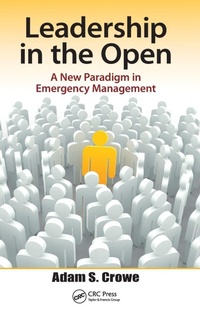
Leadership in the Open
A New Paradigm in Emergency Management
1st Edition
Published on 29. May 2013
Book
Hardback
328 pages
978-1-4665-5823-6 (ISBN)
Description
As a relatively young field, emergency management has already undergone considerable evolution and change. And now that Web 2.0 technologies and social media sites such as Facebook and Twitter have become inherently ingrained in all facets of our lives, emergency managers must once again re-evaluate best practices and standardized approaches.
Providing a roadmap for twenty-first century emergency management best practices, Leadership in the Open: A New Paradigm in Emergency Management examines public expectations relative to the use of communication and Web 2.0 technologies for emergency management activities. It covers current technologies along with the public's demand for transparency and ever-increasing need for instant information and updates.
The book is divided into three sections that focus on the fundamentals of social media, the potential effects of its strategic use in disaster management, and the attitude of engagement that is effective for community commitment. Coverage includes efficiency, magnification, humility, creativity, ethics, the tension of changing public expectations, and long-standing best practices within the emergency management community.
This book builds on the author's bestseller, Disasters 2.0: The Application of Social Media Systems for Modern Emergency Management, by looking at an emergency manager's role not simply by job function, but on what the public demands. Filled with extensive real-world examples, this is an ideal guide for leaders in emergency management, first-response, and business continuity-as well as advanced level students preparing to enter the field.
Providing a roadmap for twenty-first century emergency management best practices, Leadership in the Open: A New Paradigm in Emergency Management examines public expectations relative to the use of communication and Web 2.0 technologies for emergency management activities. It covers current technologies along with the public's demand for transparency and ever-increasing need for instant information and updates.
The book is divided into three sections that focus on the fundamentals of social media, the potential effects of its strategic use in disaster management, and the attitude of engagement that is effective for community commitment. Coverage includes efficiency, magnification, humility, creativity, ethics, the tension of changing public expectations, and long-standing best practices within the emergency management community.
This book builds on the author's bestseller, Disasters 2.0: The Application of Social Media Systems for Modern Emergency Management, by looking at an emergency manager's role not simply by job function, but on what the public demands. Filled with extensive real-world examples, this is an ideal guide for leaders in emergency management, first-response, and business continuity-as well as advanced level students preparing to enter the field.
More details
Edition
.
Language
English
Place of publication
Bosa Roca
United States
Publishing group
Taylor & Francis Inc
Target group
Professional and scholarly
Academic and Professional Practice & Development
Illustrations
60 s/w Abbildungen, 1 s/w Tabelle
1 Tables, black and white; 60 Illustrations, black and white
Dimensions
Height: 240 mm
Width: 161 mm
Thickness: 22 mm
Weight
658 gr
ISBN-13
978-1-4665-5823-6 (9781466558236)
Copyright in bibliographic data and cover images is held by Nielsen Book Services Limited or by the publishers or by their respective licensors: all rights reserved.
Schweitzer Classification
Other editions
Additional editions
E-Book
05/2013
1st Edition
CRC Press
€205.99
Available for download
E-Book
05/2013
1st Edition
CRC Press
€205.99
Available for download
Person
Adam Crowe
Content
The Rise of Social Media and Open Government. Changing expectations. Transparency. Instantaneous. Entrepreneurism. The Effects of Leading through Engaged Social Media: Efficiency, Collaboration, and Magnification. Efficiency and Effectiveness. Magnification. Collaboration. Attitude and Engagement. Humility. Creativity and Design. Ethics and Character.