

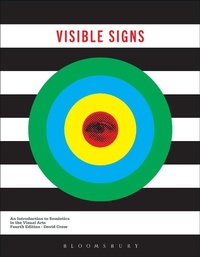
Visible Signs
An Introduction to Semiotics in the Visual Arts
4th Edition
Published on 11. August 2022
Book
Paperback/Softback
192 pages
978-1-350-16493-2 (ISBN)
Description
Basic semiotic theories are taught in most art schools as part of a contextual studies program, but many students find it difficult to understand how these ideas might impact on their own practice. Visible Signs tackles this problem by introducing key theories and concepts, such as signs and signifiers, and language and speech, within the framework of visual communication.
Each chapter provides an overview of a particular facet of semiotic theory, with inspiring examples from graphic design, typography, illustration, advertising and art to illustrate the ideas discussed in the text. Creative exercises at the end of the book will help exemplify these ideas through practical application.
The fourth edition of Visible Signs includes new imagery and updated exercises, as well as coverage of propaganda, diversity in 'neutral' communication (like emojis), and issues related to social media representation.
Each chapter provides an overview of a particular facet of semiotic theory, with inspiring examples from graphic design, typography, illustration, advertising and art to illustrate the ideas discussed in the text. Creative exercises at the end of the book will help exemplify these ideas through practical application.
The fourth edition of Visible Signs includes new imagery and updated exercises, as well as coverage of propaganda, diversity in 'neutral' communication (like emojis), and issues related to social media representation.
More details
Edition
4th edition
Language
English
Place of publication
London
United Kingdom
Publishing group
Bloomsbury Publishing PLC
Target group
College/higher education
Illustrations
200 colour illus
Dimensions
Height: 268 mm
Width: 206 mm
Thickness: 12 mm
Weight
648 gr
ISBN-13
978-1-350-16493-2 (9781350164932)
Copyright in bibliographic data and cover images is held by Nielsen Book Services Limited or by the publishers or by their respective licensors: all rights reserved.
Schweitzer Classification
Other editions
Additional editions
E-Book
08/2022
4th Edition
Bloomsbury Visual Arts
€40.99
Available for download
E-Book
08/2022
4th Edition
Bloomsbury Visual Arts
€40.99
Available for download
Person
David Crow, until his sudden death in 2022, was Pro Vice-Chancellor and Head of Camberwell, Chelsea and Wimbledon Colleges of Arts, University of the Arts, London, UK.
Content
Introduction
Chapter 1: Components. What is Theory?; Agreement; Portfolio; Exercises.
Chapter 2: How Meaning is Formed. Categories of Sign; Value; Portfolio; Exercises.
Chapter 3: Reading the Sign: The Reader; Convention and Motivation; Portfolio; Exercises.
Chapter 4: Text and Image: Digital and Analogue Codes; Advertising Writing; Portfolio; Exercises.
Chapter 5: Official and Unofficial Language: Habitus; The Production of Legitimate Language; The Competition for Cultural Legitimacy; Unofficial Language; Portfolio; Exercises.
Chapter 6: Politics of Semiotics: fake news, propaganda, diversity in 'neutral' communication (like emojis); Portfolio; Exercises.
Chapter 7: Junk and Culture: Dirt and Taboo; Rubbish Theory; Rubbish as a Resource; Portfolio; Exercises.
Chapter 8: Open Work: Information and Meaning; Openness and the Visual Arts; Openness and Information; Form and Openness; Portfolio; Exercises.
Glossary
Bibliography
Index
Chapter 1: Components. What is Theory?; Agreement; Portfolio; Exercises.
Chapter 2: How Meaning is Formed. Categories of Sign; Value; Portfolio; Exercises.
Chapter 3: Reading the Sign: The Reader; Convention and Motivation; Portfolio; Exercises.
Chapter 4: Text and Image: Digital and Analogue Codes; Advertising Writing; Portfolio; Exercises.
Chapter 5: Official and Unofficial Language: Habitus; The Production of Legitimate Language; The Competition for Cultural Legitimacy; Unofficial Language; Portfolio; Exercises.
Chapter 6: Politics of Semiotics: fake news, propaganda, diversity in 'neutral' communication (like emojis); Portfolio; Exercises.
Chapter 7: Junk and Culture: Dirt and Taboo; Rubbish Theory; Rubbish as a Resource; Portfolio; Exercises.
Chapter 8: Open Work: Information and Meaning; Openness and the Visual Arts; Openness and Information; Form and Openness; Portfolio; Exercises.
Glossary
Bibliography
Index