

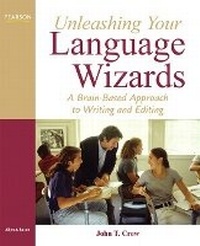
Unleashing Your Language Wizards
A Brain-Based Approach to Effective Editing and Writing
Published on 21. January 2010
Book
Paperback/Softback
216 pages
978-0-13-702003-4 (ISBN)
Description
John T. Crow
Unleashing Your Language Wizards: A Brain-Based Approach to Writing and Editing, First Edition
Unleashing Your Language Wizards breaks new ground by presenting a research-based, active-learning approach to teaching lasting sentence management skills that taps into students' natural learning abilities. To guide teachers in grades 3-12 to effective teach editing and writing, this book introduces the basic principles, specific examples, and sample activities--all of which teach the most important language concepts from a variety of different angles and approaches--to help students conquer their written language issues. It focuses on three areas of knowledge-referred to as Wizards-that all students must possess to communicate effectively: Grammar Wizards, Sentence Wizards, and Rhetorical Wizards.
"[The book] positively shines, as it helps to frame issues that are so important to address in the grammar/writing classroom but that are difficult to explain without clear pathways laid out...the more ways to get students physically engaged and mentally engaged in grammar learning, the better-the activities here seem designed well to engage students and provide them with good practice in the concepts...the author lays [everything] out in a methodical way that gets to the heart of [learning grammar]." - Jennifer Powers, Green Mountain College
"The content and process to teaching grammar explicitly from a brain-based approach is without exception, timely, in light of the recent recognition of the type of students who make up the achievement gap in the Untied States...This is excellent information to consider pedagogically. [The book] will generate much discussion on how teachers can make...[grammar] strategies more interesting and engaging...for English learners." - Catherine Elise Barrett, University of North Carolina - Chapel Hill
John T. Crow is a professional development consultant focused on applied linguistics and ESL. His thirty years classroom experience give him a unique perspective on teaching language and composition that he shares with educators across the country.
Unleashing Your Language Wizards: A Brain-Based Approach to Writing and Editing, First Edition
Unleashing Your Language Wizards breaks new ground by presenting a research-based, active-learning approach to teaching lasting sentence management skills that taps into students' natural learning abilities. To guide teachers in grades 3-12 to effective teach editing and writing, this book introduces the basic principles, specific examples, and sample activities--all of which teach the most important language concepts from a variety of different angles and approaches--to help students conquer their written language issues. It focuses on three areas of knowledge-referred to as Wizards-that all students must possess to communicate effectively: Grammar Wizards, Sentence Wizards, and Rhetorical Wizards.
"[The book] positively shines, as it helps to frame issues that are so important to address in the grammar/writing classroom but that are difficult to explain without clear pathways laid out...the more ways to get students physically engaged and mentally engaged in grammar learning, the better-the activities here seem designed well to engage students and provide them with good practice in the concepts...the author lays [everything] out in a methodical way that gets to the heart of [learning grammar]." - Jennifer Powers, Green Mountain College
"The content and process to teaching grammar explicitly from a brain-based approach is without exception, timely, in light of the recent recognition of the type of students who make up the achievement gap in the Untied States...This is excellent information to consider pedagogically. [The book] will generate much discussion on how teachers can make...[grammar] strategies more interesting and engaging...for English learners." - Catherine Elise Barrett, University of North Carolina - Chapel Hill
John T. Crow is a professional development consultant focused on applied linguistics and ESL. His thirty years classroom experience give him a unique perspective on teaching language and composition that he shares with educators across the country.
Reviews / Votes
"I like the way the author begins the chapters with a true/false quiz, the answers to which follow in the body of the chapter-it's a nice way to focus the reading, as well as to remind [readers] constantly of the myths surrounding grammar and writing." - Jennifer Powers, assistant professor of education, Green Mountain College"[The book] positively shines, as it helps to frame issues that are so important to address in the grammar/writing classroom but that are difficult to explain without clear pathways laid out...the more ways to get students physically engaged and mentally engaged in grammar learning, the better-the activities here seem designed well to engage students and provide them with good practice in the concepts...the author lays [everything] out in a methodical way that gets to the heart of [learning grammar]." --Jennifer Powers, Green Mountain College
"The content and process to teaching grammar explicitly from a brain-based approach is without exception, timely, in light of the recent recognition of the type of students who make up the achievement gap in the Untied States...This is excellent information to consider pedagogically. [The book] will generate much discussion on how teachers can make...[grammar] strategies more interesting and engaging...for English learners." - Catherine Elise Barrett, University of North Carolina - Chapel Hill
More details
Language
English
Place of publication
United States
Publishing group
Pearson Education (US)
Target group
Professional and scholarly
Dimensions
Height: 230 mm
Width: 186 mm
Thickness: 10 mm
Weight
356 gr
ISBN-13
978-0-13-702003-4 (9780137020034)
Copyright in bibliographic data and cover images is held by Nielsen Book Services Limited or by the publishers or by their respective licensors: all rights reserved.
Schweitzer Classification
Person
John Crow's background in applied linguistics, ESL, and thirty years of classroom experience combine to give him a unique perspective on teaching language and composition. He lives with his wife in Winter Haven, Florida, where he works as a professional development consultant.
Content
Table of Contents
Acknowledgements and Dedication x List of Tables xiii List of Illustrations xv Preface: Introduction & Overview xvii Section 1: The Grammar Wizard Chapter 1: Background PC? 2 Processional Caterpillars 4 A Classroom Example 5 Student Reactions 7 What Is Grammar? 8 Traditional Grammar 11 The Grammar Wizard 11 What Students Already Know and Don't Know 12 To Teach or Not to Teach 13 Discussion Questions 15 Chapter 2: Meet Your Grammar Wizard Native vs. Non-Native 18 English Speaker Competencies 19 Meet Your Grammar Wizard 20 Word List Demonstration 21 Chunking 23 Phrase Building Demonstration 27 Colorless Green Ideas Demonstration 29 Movement Demonstration 30 Letter Scrambling Demonstration 31 Reversal Demonstration 32 Where Is My Grammar Wizard? 33 Discussion Questions 33 Chapter 3: Brain-Based Learning and TGP Traditional Grammar and Traditional Grammar Pedagogy 38 TGP-Historically Speaking 38 Brain-Based Learning 40 Types of Memory 42 Your Grammar Wizard 44 Natural vs. Rote Learning 45 The Natural Learning Process 46 Depth of Processing 50 Methods of Presentation 51 Natural Learning and TGP 52 Brain-Based Learning Tenets and TGP 53 Moving On 54 Discussion Questions 54 Chapter 4: The Grammar Wizard Approach Grammar Wizard Basics 68 Wrapping Up 77 Discussion Questions 78 Section 2: Using the Grammar Wizard Chapter 5: Grammar Wizard Tests What Are Grammar Wizard Tests? 86 How Do I Present Grammar Wizard Tests? 87 Parts of Speech 89 Nouns 90 Verbs 90 Adjectives 91 Adverbs 91 Pronouns 92 Prepositions 96 Possessives 98 Recursiveness and Elaboration 102 Discussion Questions 106 Chapter 6: Grammar Wizard Activities Introduction 118 Brain-Based Checklist 119 Body Grammar 120 Tag Questions 124 Yes-No Questions 127 Manipulatives 130 Index Cards-Possessive 131 Noun Phrase Building 133 Reading Rods Sentence-Construction Kit (R) 136 Velcro Punctuation 137 Games Based on Existing Games 138 Grammar Charades 138 Mad Libs 139 Grammar Jeopardy 139 Hollywood Squares or Who Wants to Be a Millionaire? 139 Discussion Questions 140 Chapter 7: Grammar Wizard Toolbox Introduction 149 The Joshua Tree Syndrome 152 High Yield Strategies 153 Participle Phrases 154 Gerund Phrases 161 Appositive Phrases 164 Infinitive Phrases 168 Parallelism 169 Nominative Absolute 175 Adjectives Out of Order 178 Inclusive Activities 180 The I Am Poem 181 Mini-Revisions 182 Literary Goldmines 184 Discussion Questions 185 Chapter 8: Punctuation Introduction 193 Traditional Comma Explanations 195 Voice Commas and Voice Periods 196 Voice Commas & Introductory Elements 198 Voice Periods: Recognizing Comma Splices and Run-Ons 201 Other Commas 203 Series Commas 203 Adjective Commas 204 Essential-Non-essential Commas 205 Contrary Commas 206 Commas between Clauses 207 Serial Semi-Colons 207 Colons 208 Hyphens 210 Apostrophes 211 Dashes and Parentheses 212 Discussion Questions 212 Section 3: The Sentence Wizard Chapter 9: Bridges Introduction 224 Recognizing Sentence Boundaries 226 Recognizing Incomplete Sentences 228 Joining Sentences "Legally"-Bridges 230 Step 1-Connectors 231 Step 2-Bridges and Non-Bridges 232 Step 3-Center Bridges (Coordinating Conjunctions) 234 Step 4-Center Bridges (Continued) 235 Step 5-Swinging Bridges (Subordinating Conjunctions) 236 Step 6-Floating Connectors (Conjunctive Adverbs) 239 Step 7: Floating Connectors (Conjunctive Adverbs) 240 Summary 242 Terminology 242 Recursiveness and Elaboration 244 Exercises 244 Graphic Representations 245 Literature 245 Student Writing 246 Bridge Commas 246 Discussion Questions 248 Chapter 10: Sentence Fluency Sentence Fluency Definition 261 Sentence Wizards Revisited 262 The Christensen Perspective 266 Sentence Beginners 268 Recursiveness and Elaboration 272 Sentence Interrupters 275 Sentence Expanders 280 Sentence Length 288 Discussion Questions 290 Section 4: The Rhetorical Wizard Chapter 11: Rhetorical Choices-Mechanics and Word Choice Introduction 301 Registers 303 Rhetorical Choices 307 Punctuation 307 The Rhetorical Comma 307 Semi-Colons 309 Dashes and Parentheses 309 Word Choice 312 Confusing Word Pairs 314 Slang or Regionalisms 316 Misused Words 317 Overly Fancy Words 318 Discussion Questions 319 Chapter 12: Rhetorical Choices-Structure Given vs. New Information 322 Movement 324 Participle Phrases 324 Appositives 325 Swinging Bridge Clauses (Subordinate Clauses) 326 Fronted Elements 327 Active vs. Passive Voice 329 Banning Passives? 330 Primary Uses 330 Sentence Length 333 Intentional Fragments 335 Voice 337 Reading and Writing 340 Discussion Questions 341 Glossary 345 Works Cited 349
Acknowledgements and Dedication x List of Tables xiii List of Illustrations xv Preface: Introduction & Overview xvii Section 1: The Grammar Wizard Chapter 1: Background PC? 2 Processional Caterpillars 4 A Classroom Example 5 Student Reactions 7 What Is Grammar? 8 Traditional Grammar 11 The Grammar Wizard 11 What Students Already Know and Don't Know 12 To Teach or Not to Teach 13 Discussion Questions 15 Chapter 2: Meet Your Grammar Wizard Native vs. Non-Native 18 English Speaker Competencies 19 Meet Your Grammar Wizard 20 Word List Demonstration 21 Chunking 23 Phrase Building Demonstration 27 Colorless Green Ideas Demonstration 29 Movement Demonstration 30 Letter Scrambling Demonstration 31 Reversal Demonstration 32 Where Is My Grammar Wizard? 33 Discussion Questions 33 Chapter 3: Brain-Based Learning and TGP Traditional Grammar and Traditional Grammar Pedagogy 38 TGP-Historically Speaking 38 Brain-Based Learning 40 Types of Memory 42 Your Grammar Wizard 44 Natural vs. Rote Learning 45 The Natural Learning Process 46 Depth of Processing 50 Methods of Presentation 51 Natural Learning and TGP 52 Brain-Based Learning Tenets and TGP 53 Moving On 54 Discussion Questions 54 Chapter 4: The Grammar Wizard Approach Grammar Wizard Basics 68 Wrapping Up 77 Discussion Questions 78 Section 2: Using the Grammar Wizard Chapter 5: Grammar Wizard Tests What Are Grammar Wizard Tests? 86 How Do I Present Grammar Wizard Tests? 87 Parts of Speech 89 Nouns 90 Verbs 90 Adjectives 91 Adverbs 91 Pronouns 92 Prepositions 96 Possessives 98 Recursiveness and Elaboration 102 Discussion Questions 106 Chapter 6: Grammar Wizard Activities Introduction 118 Brain-Based Checklist 119 Body Grammar 120 Tag Questions 124 Yes-No Questions 127 Manipulatives 130 Index Cards-Possessive 131 Noun Phrase Building 133 Reading Rods Sentence-Construction Kit (R) 136 Velcro Punctuation 137 Games Based on Existing Games 138 Grammar Charades 138 Mad Libs 139 Grammar Jeopardy 139 Hollywood Squares or Who Wants to Be a Millionaire? 139 Discussion Questions 140 Chapter 7: Grammar Wizard Toolbox Introduction 149 The Joshua Tree Syndrome 152 High Yield Strategies 153 Participle Phrases 154 Gerund Phrases 161 Appositive Phrases 164 Infinitive Phrases 168 Parallelism 169 Nominative Absolute 175 Adjectives Out of Order 178 Inclusive Activities 180 The I Am Poem 181 Mini-Revisions 182 Literary Goldmines 184 Discussion Questions 185 Chapter 8: Punctuation Introduction 193 Traditional Comma Explanations 195 Voice Commas and Voice Periods 196 Voice Commas & Introductory Elements 198 Voice Periods: Recognizing Comma Splices and Run-Ons 201 Other Commas 203 Series Commas 203 Adjective Commas 204 Essential-Non-essential Commas 205 Contrary Commas 206 Commas between Clauses 207 Serial Semi-Colons 207 Colons 208 Hyphens 210 Apostrophes 211 Dashes and Parentheses 212 Discussion Questions 212 Section 3: The Sentence Wizard Chapter 9: Bridges Introduction 224 Recognizing Sentence Boundaries 226 Recognizing Incomplete Sentences 228 Joining Sentences "Legally"-Bridges 230 Step 1-Connectors 231 Step 2-Bridges and Non-Bridges 232 Step 3-Center Bridges (Coordinating Conjunctions) 234 Step 4-Center Bridges (Continued) 235 Step 5-Swinging Bridges (Subordinating Conjunctions) 236 Step 6-Floating Connectors (Conjunctive Adverbs) 239 Step 7: Floating Connectors (Conjunctive Adverbs) 240 Summary 242 Terminology 242 Recursiveness and Elaboration 244 Exercises 244 Graphic Representations 245 Literature 245 Student Writing 246 Bridge Commas 246 Discussion Questions 248 Chapter 10: Sentence Fluency Sentence Fluency Definition 261 Sentence Wizards Revisited 262 The Christensen Perspective 266 Sentence Beginners 268 Recursiveness and Elaboration 272 Sentence Interrupters 275 Sentence Expanders 280 Sentence Length 288 Discussion Questions 290 Section 4: The Rhetorical Wizard Chapter 11: Rhetorical Choices-Mechanics and Word Choice Introduction 301 Registers 303 Rhetorical Choices 307 Punctuation 307 The Rhetorical Comma 307 Semi-Colons 309 Dashes and Parentheses 309 Word Choice 312 Confusing Word Pairs 314 Slang or Regionalisms 316 Misused Words 317 Overly Fancy Words 318 Discussion Questions 319 Chapter 12: Rhetorical Choices-Structure Given vs. New Information 322 Movement 324 Participle Phrases 324 Appositives 325 Swinging Bridge Clauses (Subordinate Clauses) 326 Fronted Elements 327 Active vs. Passive Voice 329 Banning Passives? 330 Primary Uses 330 Sentence Length 333 Intentional Fragments 335 Voice 337 Reading and Writing 340 Discussion Questions 341 Glossary 345 Works Cited 349