

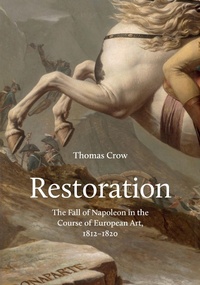
Restoration
The Fall of Napoleon in the Course of European Art, 1812-1820
Published on 13. November 2018
Book
Hardback
208 pages
978-0-691-18164-6 (ISBN)
Description
How social upheavals after the collapse of the French Empire shaped the lives and work of artists in early nineteenth-century Europe
As the French Empire collapsed between 1812 and 1815, artists throughout Europe were left uncertain and adrift. The final abdication of Emperor Napoleon, clearing the way for a restored monarchy, profoundly unsettled prevailing national, religious, and social boundaries. In Restoration, Thomas Crow combines a sweeping view of European art centers-Rome, Paris, London, Madrid, Brussels, and Vienna-with a close-up look at pivotal artists, including Antonio Canova, Jacques-Louis David, Theodore Gericault, Francisco Goya, Jean-Auguste-Dominique Ingres, Thomas Lawrence, and forgotten but meteoric painters Francois-Joseph Navez and Antoine Jean-Baptiste Thomas. Whether directly or indirectly, all were joined in a newly international network, from which changing artistic priorities and possibilities emerged out of the ruins of the old.
Crow examines how artists of this period faced dramatic circumstances, from political condemnation and difficult diplomatic missions to a catastrophic episode of climate change. Navigating ever-changing pressures, they invented creative ways of incorporating critical events and significant historical actors into fresh artistic works. Crow discusses, among many topics, David's art and influence during exile, Gericault's odyssey through outcast Rome, Ingres's drive to reconcile religious art with contemporary mentalities, the titled victors over Napoleon all sitting for portraits by Lawrence, and the campaign to restore art objects expropriated by the French from Italy, prefiguring the restitution controversies of our own time.
Beautifully illustrated, Restoration explores how cataclysmic social and political transformations in nineteenth-century Europe reshaped artists' lives and careers with far-reaching consequences.
Published in association with the Center for Advanced Study in the Visual Arts, National Gallery of Art, Washington, DC
As the French Empire collapsed between 1812 and 1815, artists throughout Europe were left uncertain and adrift. The final abdication of Emperor Napoleon, clearing the way for a restored monarchy, profoundly unsettled prevailing national, religious, and social boundaries. In Restoration, Thomas Crow combines a sweeping view of European art centers-Rome, Paris, London, Madrid, Brussels, and Vienna-with a close-up look at pivotal artists, including Antonio Canova, Jacques-Louis David, Theodore Gericault, Francisco Goya, Jean-Auguste-Dominique Ingres, Thomas Lawrence, and forgotten but meteoric painters Francois-Joseph Navez and Antoine Jean-Baptiste Thomas. Whether directly or indirectly, all were joined in a newly international network, from which changing artistic priorities and possibilities emerged out of the ruins of the old.
Crow examines how artists of this period faced dramatic circumstances, from political condemnation and difficult diplomatic missions to a catastrophic episode of climate change. Navigating ever-changing pressures, they invented creative ways of incorporating critical events and significant historical actors into fresh artistic works. Crow discusses, among many topics, David's art and influence during exile, Gericault's odyssey through outcast Rome, Ingres's drive to reconcile religious art with contemporary mentalities, the titled victors over Napoleon all sitting for portraits by Lawrence, and the campaign to restore art objects expropriated by the French from Italy, prefiguring the restitution controversies of our own time.
Beautifully illustrated, Restoration explores how cataclysmic social and political transformations in nineteenth-century Europe reshaped artists' lives and careers with far-reaching consequences.
Published in association with the Center for Advanced Study in the Visual Arts, National Gallery of Art, Washington, DC
Reviews / Votes
"Winner of the Silver Medal, Laura Shannon Prize in Contemporary European Studies, Nanovic Institute, University of Notre Dame" "[A] handsomely illustrated and profoundly revealing and stimulating book."---Michael Prodger, Literary Review "A slender, handsomely produced volume on the art of the restoration period. . . . The depth and breadth of [Crow's] learning is stupendous."---Tim Blanning, Art Newspaper "Restoration is a welcome addition to the literature on art after the collapse of the French Empire."---A. L. Palmer, Choice ReviewsMore details
Series
Language
English
Place of publication
New Jersey
United States
Product notice
Trade binding
Illustrations
160 color + 12 b/w illus.
Dimensions
Height: 264 mm
Width: 189 mm
Thickness: 22 mm
Weight
861 gr
ISBN-13
978-0-691-18164-6 (9780691181646)
Copyright in bibliographic data and cover images is held by Nielsen Book Services Limited or by the publishers or by their respective licensors: all rights reserved.
Schweitzer Classification
Other editions
Additional editions
E-Book
10/2023
1st Edition
Princeton University Press
€45.99
Available for download
Person
Thomas Crow is the Rosalie Solow Professor of Modern Art at the Institute of Fine Arts, New York University. His many books include Emulation: David, Drouais, and Girodet in the Art of Revolutionary France; The Long March of Pop: Art, Music, and Design 1930-1995; No Idols: The Missing Theology of Art; and The Artist in the Counterculture: Bruce Conner to Mike Kelley and Other Tales from the Edge (Princeton).