

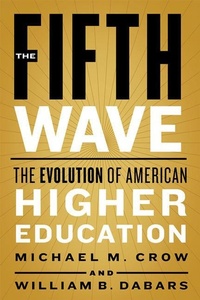
The Fifth Wave
The Evolution of American Higher Education
Will be published approx. on 9. June 2020
Book
Hardback
496 pages
978-1-4214-3802-3 (ISBN)
Description
Out of the crises of American higher education emerges a new class of large-scale public universities designed to accelerate social change through broad access to world-class knowledge production and cutting-edge technological innovation.
America's research universities lead the world in discovery, creativity, and innovation-but are captive to a set of design constraints that no longer aligns with the changing needs of society. Their commitment to discovery and innovation, which is carried out largely in isolation from the socioeconomic challenges faced by most Americans, threatens to impede the capacity of these institutions to contribute decisively and consistently to the collective good. The global preeminence of our leading institutions, moreover, does not correlate with overall excellence in American higher education. Sadly, admissions practices that flatly exclude the majority of academically qualified applicants are now the norm in our leading universities, both public and private.
In The Fifth Wave, Michael M. Crow and William B. Dabars argue that colleges and universities need to be comprehensively redesigned in order to educate millions more qualified students while leveraging the complementarities between discovery and accessibility. Building on the themes of their prior collaboration, Designing the New American University, this book examines the historical development of American higher education-the first four waves-and describes the emerging standard of institutions that will transform the field. What must emerge in this Fifth Wave of universities, Crow and Dabars posit, are institutions that are responsive to the needs of students, focused on access, embedded in their regions, and committed to solving global problems.
The Fifth Wave in American higher education, Crow and Dabars write, comprises an emerging league of colleges and universities that aspires to accelerate positive social outcomes through the seamless integration of world-class knowledge production with cutting-edge technological innovation. This set of institutions is dedicated to the advancement of accessibility to the broadest possible demographic that is representative of the socioeconomic and intellectual diversity of our nation. Recognizing the fact that both cooperation and competition between universities is essential if higher education hopes to truly serve the needs of the nation, Fifth Wave schools like Arizona State University are already beginning to spearhead a network spanning academia, business and industry, government agencies and laboratories, and civil society organizations.
Drawing from a variety of disciplines, including design, economics, public policy, organizational theory, science and technology studies, sociology, and even cognitive psychology and epistemology, The Fifth Wave is a must-read for anyone concerned with the future of higher education in our society.
America's research universities lead the world in discovery, creativity, and innovation-but are captive to a set of design constraints that no longer aligns with the changing needs of society. Their commitment to discovery and innovation, which is carried out largely in isolation from the socioeconomic challenges faced by most Americans, threatens to impede the capacity of these institutions to contribute decisively and consistently to the collective good. The global preeminence of our leading institutions, moreover, does not correlate with overall excellence in American higher education. Sadly, admissions practices that flatly exclude the majority of academically qualified applicants are now the norm in our leading universities, both public and private.
In The Fifth Wave, Michael M. Crow and William B. Dabars argue that colleges and universities need to be comprehensively redesigned in order to educate millions more qualified students while leveraging the complementarities between discovery and accessibility. Building on the themes of their prior collaboration, Designing the New American University, this book examines the historical development of American higher education-the first four waves-and describes the emerging standard of institutions that will transform the field. What must emerge in this Fifth Wave of universities, Crow and Dabars posit, are institutions that are responsive to the needs of students, focused on access, embedded in their regions, and committed to solving global problems.
The Fifth Wave in American higher education, Crow and Dabars write, comprises an emerging league of colleges and universities that aspires to accelerate positive social outcomes through the seamless integration of world-class knowledge production with cutting-edge technological innovation. This set of institutions is dedicated to the advancement of accessibility to the broadest possible demographic that is representative of the socioeconomic and intellectual diversity of our nation. Recognizing the fact that both cooperation and competition between universities is essential if higher education hopes to truly serve the needs of the nation, Fifth Wave schools like Arizona State University are already beginning to spearhead a network spanning academia, business and industry, government agencies and laboratories, and civil society organizations.
Drawing from a variety of disciplines, including design, economics, public policy, organizational theory, science and technology studies, sociology, and even cognitive psychology and epistemology, The Fifth Wave is a must-read for anyone concerned with the future of higher education in our society.
Reviews / Votes
Michael M. Crow is the mad scientist of magnifying college matriculation . . . as president of one of our largest and most innovative universities, Arizona State, Crow has had some remarkable results.-Washington Post
More details
Language
English
Place of publication
Baltimore, MD
United States
Product notice
sewn/stitched
Cloth over boards
Illustrations
16 Kurvendiagramme
16 Graphs
Dimensions
Height: 234 mm
Width: 157 mm
Thickness: 41 mm
Weight
792 gr
ISBN-13
978-1-4214-3802-3 (9781421438023)
DOI
10.1353/book.73164
Copyright in bibliographic data and cover images is held by Nielsen Book Services Limited or by the publishers or by their respective licensors: all rights reserved.
Schweitzer Classification
Other editions
Additional editions
E-Book
06/2020
Johns Hopkins University Press
€31.99
Available for download
Persons
Michael M. Crow has served as the president of Arizona State University since 2002. He was formerly the executive vice provost at Columbia University and a professor of science and technology policy. William B. Dabars is the senior director of research for the New American University in the Office of the President and an associate research professor in the School for the Future of Innovation in Society at Arizona State University. Crow and Dabars are the coauthors of Designing the New American University.
Content
Preface
Acknowledgments
Introduction: Toward New Models for American Colleges and Universities
1 The Emergence of the Fifth Wave in American Higher Education
2 A Prototype for a Fifth Wave University
3 Boutique Production Strategies and Appropriate Scale
4 Some Historical Perspective on the Fifth Wave
5 Toward a Theoretical and Conceptual Framework for the Fifth Wave
6 Designing Fifth Wave Knowledge Enterprises
7 Some Comparative Perspective on Accessibility and Excellence
Conclusion: Toward Frameworks for Universal Learning
Selected Bibliography
Index
Acknowledgments
Introduction: Toward New Models for American Colleges and Universities
1 The Emergence of the Fifth Wave in American Higher Education
2 A Prototype for a Fifth Wave University
3 Boutique Production Strategies and Appropriate Scale
4 Some Historical Perspective on the Fifth Wave
5 Toward a Theoretical and Conceptual Framework for the Fifth Wave
6 Designing Fifth Wave Knowledge Enterprises
7 Some Comparative Perspective on Accessibility and Excellence
Conclusion: Toward Frameworks for Universal Learning
Selected Bibliography
Index