

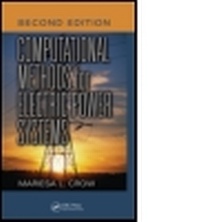
Computational Methods for Electric Power Systems, Second Edition
2nd Edition
Published on 17. August 2009
Book
Hardback
304 pages
978-1-4200-8660-7 (ISBN)
Description
Improve Compensation Strategies for Package Shortcomings
In today's deregulated environment, the nation's electric power network is forced to operate in a manner for which it was not designed. As a result, precision system analysis is essential to predict and continually update network operating status, estimate current power flows and bus voltages, determine stability limits, and minimize costs.
Computational Methods for Electric Power Systems is an introductory overview of computational methods used for analytical studies in power systems and other engineering and scientific fields. As power systems increasingly operate under stressed conditions, techniques such as computer simulation remain integral to control and security assessment. This volume analyzes the algorithms used in commercial analysis packages and presents salient examples of their implementation that are simple and thorough enough to be reproduced easily. Most of the examples were produced using MATLAB (R) language.
Presents General Theory Applicable to Different Systems
Commercial packages routinely fail or give erroneous results when used to simulate stressed systems, and understanding their underlying numerical algorithms is imperative to correctly interpret their results. This edition paints a broad picture of the methods used in such packages but omits extraneous detail. It includes new chapters that address function approximation and finite element analysis, in addition to new sections on:
Generalized Minimal Residual (GMRES) methods
Numerical differentiation
Secant method
Homotopy and continuation methods
Power method for computing dominant eigenvalues
Singular-value decomposition and pseudoinverses
Matrix pencil method
This book will enable users to make better choices and improve their grasp of the situations in which methods may fail-instilling greater confidence in the use of commercial packages.
In today's deregulated environment, the nation's electric power network is forced to operate in a manner for which it was not designed. As a result, precision system analysis is essential to predict and continually update network operating status, estimate current power flows and bus voltages, determine stability limits, and minimize costs.
Computational Methods for Electric Power Systems is an introductory overview of computational methods used for analytical studies in power systems and other engineering and scientific fields. As power systems increasingly operate under stressed conditions, techniques such as computer simulation remain integral to control and security assessment. This volume analyzes the algorithms used in commercial analysis packages and presents salient examples of their implementation that are simple and thorough enough to be reproduced easily. Most of the examples were produced using MATLAB (R) language.
Presents General Theory Applicable to Different Systems
Commercial packages routinely fail or give erroneous results when used to simulate stressed systems, and understanding their underlying numerical algorithms is imperative to correctly interpret their results. This edition paints a broad picture of the methods used in such packages but omits extraneous detail. It includes new chapters that address function approximation and finite element analysis, in addition to new sections on:
Generalized Minimal Residual (GMRES) methods
Numerical differentiation
Secant method
Homotopy and continuation methods
Power method for computing dominant eigenvalues
Singular-value decomposition and pseudoinverses
Matrix pencil method
This book will enable users to make better choices and improve their grasp of the situations in which methods may fail-instilling greater confidence in the use of commercial packages.
Reviews / Votes
"This is good resource material for a graduate student preparing for a qualifying exam"-- IEEE Power & Energy Magazine
More details
Series
Edition
2nd New edition
Language
English
Place of publication
Bosa Roca
United States
Publishing group
Taylor & Francis Inc
Target group
College/higher education
Undergraduate and graduate students in software development, power engineering, power electronics, circuits and devices, and VLSI.
Edition type
New edition
Product notice
Paper over boards
Illustrations
85 s/w Abbildungen
700-800 equations; 85 Illustrations, black and white
Dimensions
Height: 235 mm
Width: 156 mm
Weight
544 gr
ISBN-13
978-1-4200-8660-7 (9781420086607)
Copyright in bibliographic data and cover images is held by Nielsen Book Services Limited or by the publishers or by their respective licensors: all rights reserved.
Schweitzer Classification
Other editions
New editions
Mariesa L. Crow
Computational Methods for Electric Power Systems
Book
11/2015
3rd Edition
CRC Press
€215.41
Shipment within 15-20 days
Additional editions
Mariesa L. Crow
Computational Methods for Electric Power Systems
Book
01/2018
2nd Edition
CRC Press
€94.27
The article will not be published
Mariesa L. Crow
Computational Methods for Electric Power Systems
E-Book
08/2009
2nd Edition
CRC Press
€106.99
Available for download
Mariesa L. Crow
Computational Methods for Electric Power Systems
E-Book
08/2009
2nd Edition
CRC Press
€106.99
Available for download
Previous edition

Mariesa L. Crow
Computational Methods for Electric Power Systems
Book
12/2002
1st Edition
CRC Press
€89.12
Article exhausted; check for reprint
Person
Dr. Mariesa Crow is a professor of electrical engineering at Missouri University of Science and Technology in Rolla. She is director of the Energy Research and Development Center. Her areas of research include: computer-aided analysis of power systems dynamics and security analysis, voltage stability, computational algorithms for analyzing stressed, non-linear, non-continuous systems. Power-electronic applications in bulk power systems (FACTS), and parameter estimation.
Content
Introduction
The Solution of Linear Systems
Gaussian Elimination
LU Factorization
Condition Numbers and Error Propagation
Relaxation Methods
Conjugate Gradient Methods
Generalized Minimal Residual Algorithm (GMRES)
Systems of Nonlinear Equations
Fixed Point Iteration
Newton-Raphson Iteration
Continuation Methods
Secant Method
Numerical Differentiation
Power System Applications
Sparse Matrix Solution Techniques
Storage Methods
Sparse Matrix Representation
Ordering Schemes
Power System Applications
Numerical Integration
One-Step Methods
Multistep Methods
Accuracy and Error Analysis
Numerical Stability Analysis
Stiff Systems
Step-Size Selection
Differential-Algebraic Equations
Power System Applications
Optimization
Least Squares State Estimation
Linear Programming
Nonlinear Programming
Power System Applications
Eigenvalue Problems
The Power Method
The QR Algorithm
Arnoldi Methods
Singular Value Decomposition
Modal Identification
Power System Applications
The Solution of Linear Systems
Gaussian Elimination
LU Factorization
Condition Numbers and Error Propagation
Relaxation Methods
Conjugate Gradient Methods
Generalized Minimal Residual Algorithm (GMRES)
Systems of Nonlinear Equations
Fixed Point Iteration
Newton-Raphson Iteration
Continuation Methods
Secant Method
Numerical Differentiation
Power System Applications
Sparse Matrix Solution Techniques
Storage Methods
Sparse Matrix Representation
Ordering Schemes
Power System Applications
Numerical Integration
One-Step Methods
Multistep Methods
Accuracy and Error Analysis
Numerical Stability Analysis
Stiff Systems
Step-Size Selection
Differential-Algebraic Equations
Power System Applications
Optimization
Least Squares State Estimation
Linear Programming
Nonlinear Programming
Power System Applications
Eigenvalue Problems
The Power Method
The QR Algorithm
Arnoldi Methods
Singular Value Decomposition
Modal Identification
Power System Applications