

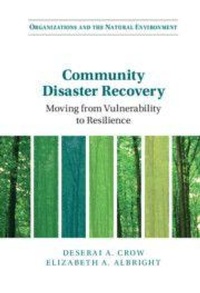
Community Disaster Recovery
Moving from Vulnerability to Resilience
Published on 21. March 2024
Book
Paperback/Softback
300 pages
978-1-009-05437-9 (ISBN)
Description
Disasters can serve as focusing events that increase agenda attention related to issues of disaster response, recovery, and preparedness. Increased agenda attention can lead to policy changes and organisational learning. The degree and type of learning that occurs within a government organization after a disaster may matter to policy outcomes related to individual, household, and community-level risks and resilience. Local governments are the first line of disaster response but also bear the burden of performing long-term disaster recovery and planning for future events. Crow and Albright present the first framework for understanding if, how, and to what effect communities and local governments learn after a disaster strikes. Drawing from analyses conducted over a five-year period following extreme flooding in Colorado, USA, Community Disaster Recovery: Moving from Vulnerability to Resilience presents a framework of community-level learning after disaster and the factors that catalyse policy change towards resilience.
Reviews / Votes
'After a disaster, residents and local governments often struggle to figure out a way towards holistic recovery, policy change, and learning. Based on extensive qualitative and quantitative data and rooted in hope, Crow and Albright focus on the flood-hit Colorado areas of Denver, Larimer, and Weld, to analyze when communities actually learn lessons following a shock. A deeply researched, important guide for decision makers and students alike.' Daniel P. Aldrich, Professor, Northeastern University, and author of Building Resilience and Black Wave 'Understanding community-level learning in the wake of disaster is essential to strengthen disaster resilience. In this authoritative book, Crow and Albright provides a rich and insightful framework for analyzing learning and dynamics of community resilience after major disaster events. This is an important reference for both scholars and practitioners with an interest in how communities use experience from disruptive disasters to build resilience for the future.' Daniel Nohrstedt, Professor in Political Science, Uppsala University '... timely, rigorous, and applicable to multiple disciplines ... Highly recommended.' E. J. Delaney, ChoiceMore details
Series
Language
English
Place of publication
Cambridge
United Kingdom
Target group
Professional and scholarly
Product notice
Paperback (trade)
Illustrations
Worked examples or Exercises
Dimensions
Height: 229 mm
Width: 152 mm
Thickness: 16 mm
Weight
438 gr
ISBN-13
978-1-009-05437-9 (9781009054379)
Copyright in bibliographic data and cover images is held by Nielsen Book Services Limited or by the publishers or by their respective licensors: all rights reserved.
Schweitzer Classification
Other editions
Additional editions
Deserai A. Crow | Elizabeth A. Albright
Community Disaster Recovery
Moving from Vulnerability to Resilience
Book
10/2021
Cambridge University Press
€140.90
Shipment within 15-20 days
Deserai A. Crow | Elizabeth A. Albright
Community Disaster Recovery
Moving from Vulnerability to Resilience
E-Book
10/2021
Cambridge University Press
€31.99
Available for download
Persons
Dr Deserai A. Crow is an Associate Professor and researches local and state-level environmental policy, often focusing on crisis and disaster recovery and risk mitigation in local communities and natural resource agencies. Deserai's crisis and disaster work includes National Science Foundation funded work on disaster recovery, COVID-19 risk perceptions and behaviors as influenced by state-level policies, and environmental justice outcomes associated with local control of oil and gas regulations.
Content
Section I. Introduction; 1. Introduction to Disasters, Change, and Community-Level Resilience; 2. Colorado's 2013 Floods: The Disaster that Primed Community-Level Learning; Section II. Damage and Resources; 3. Disaster Damage, Severity, and Extent; 4. Pre-Disaster Capacity and Post-Disaster Resources for Recovery; Section III. Individual Beliefs; 5. Worldviews, Risk Perceptions, and Causal Beliefs: How Individuals Experience Disasters; 6. Trust in Government and Support for Policy Action; Section IV. Individual & Group Engagement; 7. Stakeholder Engagement and Community-Level Disaster Recovery towards Resilience; 8. Intergovernmental Relationships and Successful Disaster Recovery and Learning; Section V. Connections, Conclusions and Recommendations; 9. A Framework for Understanding Community-Level Learning in the Aftermath of Disaster; 10. Examining Community-Scale Disaster Recovery and Resilience Beyond Colorado; 11. Conclusions, Recommendations, and Future Directions.