

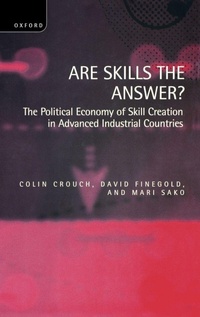
Are Skills the Answer?
The Political Economy of Skill Creation in Advanced Industrial Countries
Published on 11. February 1999
Book
Hardback
296 pages
978-0-19-829438-2 (ISBN)
Description
This study of the problems confronting institutions for the creation of occupational skills in seven advanced industrialized countries contributes to two different areas of debate. The first is the study of the diversity of institutional forms taken by modern capitalism, and the difficulties currently surrounding the survival of that diversity. Most discussions of this theme analyse economic institutions and governance in general. The authors of this book are more specific, focusing on the key area of skill creation.
The second theme is that of vocational education and training in its own right. While sharing the consensus that the advanced countries must secure competitive advantage in a global economy by developing highly skilled work-forces, the authors draw attention to certain awkward aspects of this approach that are often glossed over in general debate:
The employment-generating power of improvements in skill levels is limited: employment policy cannot depend fully on education policies
While the acquisition of skills has become a major public need, there is increasing dependence for their provision on individual firms, which can have no responsibility for general needs, with government action being restricted to residual care for the unemployed rather than contributing at the leading edge of advanced skills policy.
The authors argue that public agencies must find new ways of working with the business sector, acquiring expertise and authority through such means as supporting skills standards and taking the lead in the certification of employers as trainers. There must also be reconsideration of the former role of public-service employment as a provider of secure if poorly paid employment for low-productivity workers.
The countries covered are France, Germany, Italy, Japan, Sweden, the UK and the USA.
The second theme is that of vocational education and training in its own right. While sharing the consensus that the advanced countries must secure competitive advantage in a global economy by developing highly skilled work-forces, the authors draw attention to certain awkward aspects of this approach that are often glossed over in general debate:
The employment-generating power of improvements in skill levels is limited: employment policy cannot depend fully on education policies
While the acquisition of skills has become a major public need, there is increasing dependence for their provision on individual firms, which can have no responsibility for general needs, with government action being restricted to residual care for the unemployed rather than contributing at the leading edge of advanced skills policy.
The authors argue that public agencies must find new ways of working with the business sector, acquiring expertise and authority through such means as supporting skills standards and taking the lead in the certification of employers as trainers. There must also be reconsideration of the former role of public-service employment as a provider of secure if poorly paid employment for low-productivity workers.
The countries covered are France, Germany, Italy, Japan, Sweden, the UK and the USA.
More details
Language
English
Place of publication
Oxford
United Kingdom
Target group
Professional and scholarly
Illustrations
2 figures, 20 tables
Dimensions
Height: 240 mm
Width: 161 mm
Thickness: 21 mm
Weight
611 gr
ISBN-13
978-0-19-829438-2 (9780198294382)
Copyright in bibliographic data and cover images is held by Nielsen Book Services Limited or by the publishers or by their respective licensors: all rights reserved.
Schweitzer Classification
Other editions
Additional editions
Colin Crouch | David Finegold | Mari Sako
Are Skills the Answer?
The Political Economy of Skill Creation in Advanced Industrial Countries
Book
03/2001
Oxford University Press
€135.90
Shipment within 15-20 days
Colin Crouch | David Finegold | Mari Sako
Are Skills the Answer?
The Political Economy of Skill Creation in Advanced Industrial Countries
E-Book
02/1999
1st Edition
Oxford University Press
€356.81
Available for download
Persons
Colin Crouch is a Delegate and author of several books published by OUP; Mari Sako is Professor of International Business as the Said Business School, Oxford
Author
Professor of Sociology, European University Institute; and FellowProfessor of Sociology, European University Institute; and Fellow, Trinity College, Oxford
Professor, School of Business AdministrationProfessor, School of Business Administration, University of Southern California, Los Angeles
Professor of International BusinessProfessor of International Business, Said Business School, University of Oxford
Content
1. The Dispiriting Search for the Learning Society ; 2. Employment and Employment Skills ; 3. The Skill Implications of Changing Patterns of Trade ; 4. The State and Skill Creation: Inevitable Failure? ; 5. Corporatist Organizations and the Problems of Rigidity ; 6. Local Agencies for Skill Creation ; 7. Markets and Corporate Hierarchies ; 8. Conclusions and Policy Implications