

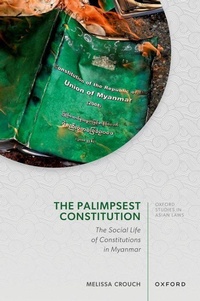
The Palimpsest Constitution
The Social Life of Constitutions in Myanmar
Published on 23. October 2025
Book
Hardback
336 pages
978-0-19-895688-4 (ISBN)
Description
Since the mid-20th century, many postcolonial states have engaged in multiple constitution-making exercises, with the turnover in written constitutions often due to coups or internal conflict. Conversely, people have resisted authoritarian rule through alternative constitution-making. The reality that most countries have had numerous official and unofficial constitutional texts begs the question: How do past constitutions matter in the present?
This volume explores the social life of constitutional legacies, or how past constitutions matter. Using the case of Myanmar, Professor Crouch demonstrates that constitutions are a palimpsest of past texts, ideas, and practices, an accumulation of contested legacies. Through constitutional ethnography, it traces Burma/Myanmar's modern constitutional history from the late colonial era through its postcolonial, socialist, and military regimes.
The Palimpsest Constitution captures the idea that contemporary debates about constitutional reform are informed by the contested legacies of the past. In Myanmar, the military insists on the endurance of its 2008 Constitution while pro-civilian actors resist military rule through alternative constitution-making endeavours. Offering a sociological view of constitutional endurance, the book demonstrates how the social life of constitutions is central to the struggle for constitutional democracy and civilian rule in Myanmar.
This volume explores the social life of constitutional legacies, or how past constitutions matter. Using the case of Myanmar, Professor Crouch demonstrates that constitutions are a palimpsest of past texts, ideas, and practices, an accumulation of contested legacies. Through constitutional ethnography, it traces Burma/Myanmar's modern constitutional history from the late colonial era through its postcolonial, socialist, and military regimes.
The Palimpsest Constitution captures the idea that contemporary debates about constitutional reform are informed by the contested legacies of the past. In Myanmar, the military insists on the endurance of its 2008 Constitution while pro-civilian actors resist military rule through alternative constitution-making endeavours. Offering a sociological view of constitutional endurance, the book demonstrates how the social life of constitutions is central to the struggle for constitutional democracy and civilian rule in Myanmar.
Reviews / Votes
In this persuasive and timely assessment of the fragility and endurance of constitutions, Crouch writes with clarity and passion about the social life of constitutions in Burma/Myanmar. Her sweeping history exposes the continuities of power and violence across colonial, democratic, and authoritarian regimes, successfully placing the Global South at the center of broad debates about constitutional politics. * Lauren Benton, Barton M. Biggs Professor of History and Professor of Law, Yale University * In this detailed history of the feints and parries of constitution drafting in Myanmar, Professor Crouch shows how past constitutions circulate not only in present constitutional debate but also in social memory, political mobilization, public commemoration, legal professionalism, resistance, and social control--even book selling--making this account instructive for sociolegal scholars and ethnographers of post-coloniality and authoritarian rule. Clear and engaging writing and thoughtful thematic organization make the work accessible to readers beyond regional specialists and legal comparativists. Her fieldwork narrative adds further value, especially for ethnographers of law. * Carol J. Greenhouse, Arthur Marks, Professor of Anthropology Emeritus, Princeton University * Melissa Crouch has written a remarkable book-thoughtful, honest, and deeply grounded in the lived experiences of the people of Myanmar. Her concept of the palimpsest constitution helps us understand how legal ideas are layered, repurposed, and at times weaponized-revealing how the past continues to shape the present in ways that are both subtle and stark. Rather than offering easy answers, Crouch explores how history, law, and politics intertwine in Myanmars long struggle for democracy. Her storytelling is vivid and personal, particularly in her reflections on the life and loss of U Ko Ni, a courageous lawyer who gave voice to the hope of a better future. The Palimpsest Constitution is essential reading for anyone seeking to understand how law operates-not only in courtrooms, but in peoples lives, memories, and acts of resistance. * Thant Myint-U, historian and author, Honorary Fellow of Trinity College at the University of Cambridge *More details
Series
Language
English
Place of publication
Oxford
United Kingdom
Target group
Professional and scholarly
Product notice
sewn/stitched
Cloth over boards
Dimensions
Height: 229 mm
Width: 155 mm
Thickness: 28 mm
Weight
726 gr
ISBN-13
978-0-19-895688-4 (9780198956884)
Copyright in bibliographic data and cover images is held by Nielsen Book Services Limited or by the publishers or by their respective licensors: all rights reserved.
Schweitzer Classification
Person
Melissa Crouch is professor in the Faculty of Law & Justice at the University of New South Wales, Sydney, Australia.
Content
1: Introduction
Part I. The Palimpsest Constitution under Colonial Rule
2: Laying the Foundations of Constitutional Legacies: War, Occupation, and Law
3: Resisting the Legacies of Imposed Constitution-making: Codification, Martial Law, and Executive Safeguards
Part II. The Palimpsest Constitution in the Post-colony
4: Subverting Colonial Constitutional Legacies: Independence, Social Democracy, and a Coup
5: Contesting the Postcolonial Constitution: Religion, Federalism, and Anti-constitutional Crimes
6: Rejecting the Postcolonial Constitution: Socialist Legality, the Party, and People's Duties
7: Scripting New Constitutional Legacies: Military Constitution-makers, Resistance, and Reform
Part III. The Palimpsest Constitution between the Military and the Courts
8: Coopting the Legacy of the Writs: The Supreme Court, Rights, and Judicial Independence
9: Repurposing Legacies of Judicial Review: The Constitutional Tribunal, the Military, and the Coup
10: Conclusion
Appendix 1: Constitutional Ethnography
Appendix 2: List of Characters
Part I. The Palimpsest Constitution under Colonial Rule
2: Laying the Foundations of Constitutional Legacies: War, Occupation, and Law
3: Resisting the Legacies of Imposed Constitution-making: Codification, Martial Law, and Executive Safeguards
Part II. The Palimpsest Constitution in the Post-colony
4: Subverting Colonial Constitutional Legacies: Independence, Social Democracy, and a Coup
5: Contesting the Postcolonial Constitution: Religion, Federalism, and Anti-constitutional Crimes
6: Rejecting the Postcolonial Constitution: Socialist Legality, the Party, and People's Duties
7: Scripting New Constitutional Legacies: Military Constitution-makers, Resistance, and Reform
Part III. The Palimpsest Constitution between the Military and the Courts
8: Coopting the Legacy of the Writs: The Supreme Court, Rights, and Judicial Independence
9: Repurposing Legacies of Judicial Review: The Constitutional Tribunal, the Military, and the Coup
10: Conclusion
Appendix 1: Constitutional Ethnography
Appendix 2: List of Characters