

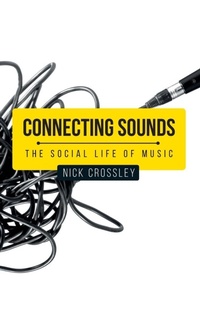
Connecting Sounds
The Social Life of Music
Published on 17. March 2019
Book
Hardback
224 pages
978-1-5261-2601-6 (ISBN)
Description
Nick Crossley argues that music is a form of social interaction, interwoven in the fabric of society and in constant interplay with its other threads. Musical interactions are often also economic interactions, for example, and sometimes political interactions. They can be forms of identity work, for both individuals and collectives, contributing to the reproduction or bridging of social divisions. As such music both shapes and is shaped by the wider network of relations and interactions making up our societies at their local, national and global levels.
Successive chapters of the book track and explore these interplays, in each case combining a critical consideration of existing literature with the development of an original, 'relational' approach to music sociology. The result is a grand sociological vision of music that captures not only music's context but 'the music itself'. The book extends the project begun in Crossley's earlier work on punk and post-punk 'music worlds', revisiting this concept and the network ideas that underpin it, whilst broadening its focus through a consideration of wider music forms and the meanings that music has for its participants. -- .
Successive chapters of the book track and explore these interplays, in each case combining a critical consideration of existing literature with the development of an original, 'relational' approach to music sociology. The result is a grand sociological vision of music that captures not only music's context but 'the music itself'. The book extends the project begun in Crossley's earlier work on punk and post-punk 'music worlds', revisiting this concept and the network ideas that underpin it, whilst broadening its focus through a consideration of wider music forms and the meanings that music has for its participants. -- .
Reviews / Votes
'Focusing primarily on popular music, Crossley (sociology, Univ. of Manchester, UK) provides an in-depth study of music's place in the social world. In investigating this matter, he shows the relationship to be far more complex than people involved with music might suppose. He explores his concept of what he terms "music worlds," drawing on and critiquing ideas from fields such as relational sociology and semiotics as well as music-specific fields. He makes significant use of Christopher Small's term "musicking" as he seeks to define music and explain how various types of music function in, influence, and are influenced by society. The nine chapters provide detailed discussions of topics such as music as social interaction, music's economic aspects, definitions of mainstream and alternative music, social networking involving music, meaning in music, societal forces influencing musical taste, and societal diversity and politics in musical genres. Although Crossley names musical artists and pieces of music in his discussions, he does not provide musical analysis. This scholarly and meticulously documented work is best suited to specialists in sociology, sociology of music, and cultural studies.' (Reprinted with permission from Choice Reviews. All rights reserved. Copyright by the American Library Association.)D. Arnold, University of North Texas -- .
More details
Language
English
Place of publication
Manchester
United Kingdom
Target group
College/higher education
Professional and scholarly
Illustrations
8 black & white illustrations
Dimensions
Height: 240 mm
Width: 161 mm
Thickness: 17 mm
Weight
499 gr
ISBN-13
978-1-5261-2601-6 (9781526126016)
Copyright in bibliographic data and cover images is held by Nielsen Book Services Limited or by the publishers or by their respective licensors: all rights reserved.
Schweitzer Classification
Other editions
Additional editions
E-Book
12/2019
1st Edition
Manchester University Press
€55.99
Available for download
E-Book
12/2019
1st Edition
Manchester University Press
from
€55.99
Available for download
Person
Nick Crossley is Professor of Sociology and co-founder/co-director of the Mitchell Centre for Social Network Analysis at the University of Manchester -- .
Content
1 Introduction
2 Music as Social Interaction: Embedded, Embodied and Multivalent
3 Economic Interactions: Capitalism, Industry and the Mainstream
4 Mainstream and Beyond: The Musical Universe and its Worlds
5 Musicking Networks: Nodes, Ties and Worlds
6 Semiotic Interactions: Meaning, Communication and Affect
7 Practical Interactions: Use, Taste, Identity
8 Division, Inequality and Taste: Musicking in Social Space
9 Political Interactions: Publics, Protest and the Avant-Garde
Discography
Bibliography -- .
2 Music as Social Interaction: Embedded, Embodied and Multivalent
3 Economic Interactions: Capitalism, Industry and the Mainstream
4 Mainstream and Beyond: The Musical Universe and its Worlds
5 Musicking Networks: Nodes, Ties and Worlds
6 Semiotic Interactions: Meaning, Communication and Affect
7 Practical Interactions: Use, Taste, Identity
8 Division, Inequality and Taste: Musicking in Social Space
9 Political Interactions: Publics, Protest and the Avant-Garde
Discography
Bibliography -- .