

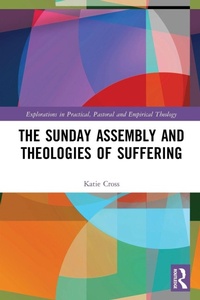
The Sunday Assembly and Theologies of Suffering
1st Edition
Published on 29. April 2022
Book
Paperback/Softback
160 pages
978-0-367-53565-0 (ISBN)
Description
This book draws on a study of the Sunday Assembly- a "godless congregation"- to reflect on how the Church might better deal with suffering, lament and theodicy. Against a backdrop of a shifting attitudes towards religion, humans are now better connected than ever before. It is no exaggeration to suggest that we carry the suffering of the world in our pockets. In the midst of these intersecting issues, the Sunday Assembly provides insight into how meaning-making in times of trauma and crisis is changing.
Drawing on practical theology and using ethnographic tools of investigation, this book includes findings from interviews and observation with the Sunday Assembly in London and Edinburgh. It explores the Sunday Assembly's philosophy of "celebrating life," and what this means in practice. At times, this emphasis on celebration can result in situations where suffering is "passed over," or only briefly acknowledged. In response, this book considers a similar tendency within white Protestant churches to avoid explicit discussion of difficult issues.
This book challenges churches to consider how they might resist the avoidance of suffering through the practice of lament.The insights provided by this book will be of particular interest to scholars of Religious Studies, Practical Theology, Secularism and Atheism/Non-religion.
Drawing on practical theology and using ethnographic tools of investigation, this book includes findings from interviews and observation with the Sunday Assembly in London and Edinburgh. It explores the Sunday Assembly's philosophy of "celebrating life," and what this means in practice. At times, this emphasis on celebration can result in situations where suffering is "passed over," or only briefly acknowledged. In response, this book considers a similar tendency within white Protestant churches to avoid explicit discussion of difficult issues.
This book challenges churches to consider how they might resist the avoidance of suffering through the practice of lament.The insights provided by this book will be of particular interest to scholars of Religious Studies, Practical Theology, Secularism and Atheism/Non-religion.
Reviews / Votes
Katie Cross skilfully integrates ethnography and practical theological reflection in a fascinating study of how a particular community makes sense of profound and challenging life-events. It deserves to become a standard work of reference for those interested in understanding the dynamics of contemporary spirituality. - Elaine Graham, Grosvenor Research Professor of Practical Theology, University of Chester, UK.Much has been said about the decline of religion and the relevance of secular means of fulfilling needs that were once considered the domain of religion. One interesting manifestation of the practice of secular spirituality are the Sunday Assembly communities. These apparently "godless congregations" claim to embody ways of being that bring about community, morality and understanding without the need for God. But what do these communities actually look like? What do they do? Who participates in them? How do they deal with the big questions of suffering, death and evil? These are the kinds of questions that Katie Cross pushes into in this fascinating and important ethnographic exploration. Importantly, and unlike other studies that have focused on such communities, she asks the question: How do we understand them theologically? The book suggests that thinking clearly about the secular is a vital theological task. This book is an excellent example of contemporary practical theology by an important emerging scholar - Rev. Professor John Swinton, Professor in Practical Theology and Pastoral Care, School of Divinity, History and Philosophy, King's College University of Aberdeen, UK
In this astute study, Katie Cross offers a ground-breaking portrait of the "Sunday Assembly," displaying compassionate sensitivity and keen insight into the movement's strengths, while noting the difficult aspects of life that it regularly "passes over." Offering rich qualitative research, a rigorous critique of theodicy, and a careful approach to suffering, this book reveals Cross to be an emerging leader in practical theology and the study of contemporary spiritual communities. - Christopher C. Brittain, Dean of Divinity and Margaret E. Fleck Chair in Anglican Studies, Trinity College in the University of Toronto, Canada
More details
Series
Language
English
Place of publication
London
United Kingdom
Publishing group
Taylor & Francis Ltd
Target group
College/higher education
Professional and scholarly
Postgraduate, Professional, and Undergraduate
Dimensions
Height: 234 mm
Width: 156 mm
Thickness: 9 mm
Weight
257 gr
ISBN-13
978-0-367-53565-0 (9780367535650)
Copyright in bibliographic data and cover images is held by Nielsen Book Services Limited or by the publishers or by their respective licensors: all rights reserved.
Schweitzer Classification
Other editions
Additional editions
Katie Cross
The Sunday Assembly and Theologies of Suffering
Book
07/2020
1st Edition
Routledge
€205.80
Shipment within 15-20 days
Katie Cross
The Sunday Assembly and Theologies of Suffering
E-Book
07/2020
1st Edition
Routledge
€60.49
Available for download
Katie Cross
The Sunday Assembly and Theologies of Suffering
E-Book
07/2020
1st Edition
Routledge
€60.49
Available for download
Person
Katie Cross is Christ's College Fellow in Practical Theology at the University of Aberdeen, Scotland.
Content
Acknowledgements; Introduction; 1 Theological roots: The evils of theodicy; 2 Temperate atheism: The philosophical basis of the Sunday Assembly; 3 "Live Better, Help Often, Wonder More": The Sunday Assembly; 4 The theologian and the atheist church: Fieldwork at the Sunday Assembly; 5 "Celebrating life, passing over suffering": How the Sunday Assembly responds to adversity; 6 "Pause a while": Middle space, Holy Saturday, and theological "holding" of suffering; 7 Creating a culture of lament: How the Church can resist "passing over" suffering; Conclusion