

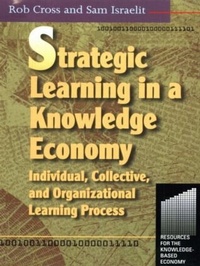
Strategic Learning in a Knowledge Economy
Individual, Collective and Organizational Learning Processes
1st Edition
Published on 2. March 2000
Book
Paperback/Softback
368 pages
978-0-7506-7223-8 (ISBN)
Description
Strategic Learning in a Knowledge Economy defines unique and powerful ways that organizations can foster learning at the individual, group and organizational levels, a capability critical to both strategic objectives and business performance. The book explains how individuals and organizations learn, clarifying cognitive and social aspects of the topic. Readers will understand how learning enables organizations and individuals to better create, assimilate, and transfer knowledge.
Strategic Learning in a Knowledge Economy helps managers create individual and collective processes that maximize the quality of the knowledge created and learned and ensures this knowledge is effectively used. The book appropriately redefines the frequently narrow and technology-oriented view of learning and explains how an effective learning strategy ensures that a broad base of employees learn and implement vital organizational lessons. Strategic Learning in a Knowledge Economy features focused discussions of organizational core competencies, learning and innovation, communities of practice, assessing organizational learning capabilities, and other important learning topics.
This authoritative compendium helps readers master organizational issues crucial in today's knowledge economy by:
Strategic Learning in a Knowledge Economy helps managers create individual and collective processes that maximize the quality of the knowledge created and learned and ensures this knowledge is effectively used. The book appropriately redefines the frequently narrow and technology-oriented view of learning and explains how an effective learning strategy ensures that a broad base of employees learn and implement vital organizational lessons. Strategic Learning in a Knowledge Economy features focused discussions of organizational core competencies, learning and innovation, communities of practice, assessing organizational learning capabilities, and other important learning topics.
This authoritative compendium helps readers master organizational issues crucial in today's knowledge economy by:
More details
Language
English
Place of publication
Oxford
United Kingdom
Publishing group
Taylor & Francis Ltd
Target group
Professional and scholarly
Professional Practice & Development
Dimensions
Height: 234 mm
Width: 156 mm
Weight
680 gr
ISBN-13
978-0-7506-7223-8 (9780750672238)
Copyright in bibliographic data and cover images is held by Nielsen Book Services Limited or by the publishers or by their respective licensors: all rights reserved.
Schweitzer Classification
Other editions
Additional editions
Robert L. Cross | Sam Israelit
Strategic Learning in a Knowledge Economy
Book
07/2017
1st Edition
Routledge
€282.26
Shipment within 10-20 days
Robert L. Cross | Sam Israelit
Strategic Learning in a Knowledge Economy
E-Book
11/2009
1st Edition
Routledge
€69.99
Available for download
Robert L. Cross | Sam Israelit
Strategic Learning in a Knowledge Economy
E-Book
11/2009
1st Edition
Routledge
€69.99
Available for download
Persons
L. Cross Robert, B. Israelit Jr Spson
Content
Knowledge-based Strategy to Guide Learning; Part 1 The Core Competence of the Corporation *, C. K. Prahalad and, and Gary Hamel; Part 2 A Competence Perspective on Strategic Learning and Knowledge Management *, Ron Sanchez, Aime Heene; Part 3 Organizational Level Learning; Part 4 Absorptive Capacity: A New Perspective- on Learning and Innovation *, M. Cohen Wesely, A. Levinthal Daniel; Part 5 Feeding Organizational Memory: Improving on Knowledge Management's Promise to Business Performancet, Cross Rob, Lloyd Baird; Part 6 The Factory as a Learning Laboratory, Leonard-Barton* Dorothy; Part 7 Understanding Organizations as Learning Systems; Part 8 Community; Part 9 Organizational Learning and Communities-of-Practice: Toward a Unified View of Working, Learning, and Innovation *; Part 10 Legitimate Peripheral Participation in Communities of Practice *; Part 11 Team Level; Part 12 From Action Learning to Learning from Action: Implementing the after Action Review; Part 13 Learning from Mistakes Is Easier Said than Done: Group and Organizational Influences on the Detection and Correction of Human Error *; Part 14 Taking Flight: Dialogue, Collective Thinking, and Organizational Learning; Part 15 Teams as Learners: A Research-based Model of Team Learning *; Part 16 Individual Level; Part 17 Teaching Smart People How to Learn *; Part 18 Learning from Experience Through Reflection; Part 19 The Process of Experiential Learning *;