

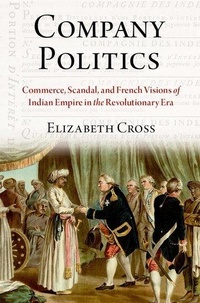
Company Politics
Commerce, Scandal, and French Visions of Indian Empire in the Revolutionary Era
Published on 26. July 2023
Book
Hardback
312 pages
978-0-19-765375-3 (ISBN)
Description
In the wake of the Seven Years' War and the consolidation of British power on the subcontinent, the French monarchy chartered a new East India Company. The Nouvelle Compagnie des Indes was an attempt to maintain French diplomatic and financial credit among European rivals and trading partners within a region integral to the broader imperial economy. Reimagining French power as subsisting through an informal empire of trade, instead of a territorial empire of conquest, officials and intellectuals sought to remake the trading company as a private, "purely commercial" actor, rather than a sovereign company-state.
Company Politics offers a new interpretation of political economy, imperialism, and the history of the corporation during the late Old Regime and the French Revolution. Despite its reputation for speculation, corruption, and scandal, Elizabeth Cross argues that the "New Company" emerged from the unique circumstances France faced in India as a weakened imperial power vis a vis the expanding British East India Company. Seeking to control the Company for their own purposes, French government officials, theorists, and private financial actors clashed over differing notions of political economy, debt, and imperial power for Europe and the Indian Ocean world. In doing so, they envisioned new alignments between state and market, challenged the legitimacy of the Old Regime's economic and imperial policies, and sought to revolutionize the underlying corporation itself through progressive demands of corporate self-governance. Thus, the New Company should be seen as an innovative capitalist actor in its own right, not a mere derivative of its Anglo-Dutch competitors.
A valuable contribution to scholarship on capitalism, empire, and globalization, Company Politics uses the Company's history to present the Revolutionary Era as one of dynamic economic ideologies, practices, and experimentation, rather than only one of crisis and decline.
Company Politics offers a new interpretation of political economy, imperialism, and the history of the corporation during the late Old Regime and the French Revolution. Despite its reputation for speculation, corruption, and scandal, Elizabeth Cross argues that the "New Company" emerged from the unique circumstances France faced in India as a weakened imperial power vis a vis the expanding British East India Company. Seeking to control the Company for their own purposes, French government officials, theorists, and private financial actors clashed over differing notions of political economy, debt, and imperial power for Europe and the Indian Ocean world. In doing so, they envisioned new alignments between state and market, challenged the legitimacy of the Old Regime's economic and imperial policies, and sought to revolutionize the underlying corporation itself through progressive demands of corporate self-governance. Thus, the New Company should be seen as an innovative capitalist actor in its own right, not a mere derivative of its Anglo-Dutch competitors.
A valuable contribution to scholarship on capitalism, empire, and globalization, Company Politics uses the Company's history to present the Revolutionary Era as one of dynamic economic ideologies, practices, and experimentation, rather than only one of crisis and decline.
Reviews / Votes
From the Seven Years' War through the Revolution of 1789, the history of the French East India Company is a tangle of corruption, reformist illusions, and imperial ambitions. Company Politics offers a commanding interpretation of this episode that explains the curious durability of the much-reviled trading companies, and company states, well into the nineteenth century. Elizabeth Cross is a skilled researcher, a discerning interpreter of politics, and an urbane writer. * Paul Cheney, University of Chicago * Company Politics offers an arresting account of how the Third French East India Company came to embody a new type of global trading corporation, one divested of sovereign attributes and relying instead on economic power to project royal influence abroad. This book adds a critical new perspective to the growing literature on the dynamic relationship between imperial governance and political economy in the final decades of the eighteenth century. * Rafe Blaufarb, author of The Great Demarcation: The French Revolution and the Invention of Modern Property * This superb study of the last French East India Company examines the final decades of the old regime French empire in India, making clear the geopolitical and economic possibilities it still appeared to present. Following the company into the 1790s, when it was at the center of the French Revolution's greatest corruption scandal, Cross examines how revolutionary republicanism destabilized the patrimonial norms that underpinned the absolutist order. Comprehensively researched, deeply conceptualized, and a pleasure to read. * John Shovlin, author of Trading with the Enemy: Britain, France, and the 18th-Century Quest for a Peaceful World Order * Company Politics is written with remarkable fluency, combining meticulous empirical research with nuanced yet authoritative analysis. Cross makes sense of France's New East India Company as a remedy-a concoction of trade-offs and contradictions, commerce and state, war and peace-prescribed to heal the wound of France's painful loss to the British in India. She guides us with ease and assurance from metropolitan debates and disputes, from old regime to new, across a great gap to the lived realities of France's disparate trading posts in India. This is an invaluable study of continuity underpinning revolutionary change that deepens our understanding of French commercial and imperial strategy in Asia far beyond the period it addresses. * Natasha Pairaudeau, author of Mobile Citizens: French Indians in Indochina, 1858-1954 * In this fine-grained study, Cross (Georgetown Univ.) provides a valuable addition to understanding the complexities and forces that shaped the Compagnie des Indes,...readers gain insight into how European politics played out in India and, conversely, how imperialist efforts in India reverberated through Europe and impacted events that shaped the modern world. * Choice * The book is a fascinating study of the ideas and debates surrounding the Compagnie des Indes since the 1660s. The thread that binds the stories of each of the company's three incarnations is the historically complex relationship between a commercial company, trade monopoly, and sovereign politics. * Ghulam A. Nadri, American Historical Review * Company Politicsbelongs on the bookshelf of anyone interested in the political and economic effects of globalization, the porous boundaries between public and private interest, and the many afterlives of "failed" imperial experiments. * Gregory Mole, History: Reviews of New Books * This is a wonderful book. The clarity of its prose and argument, its archival richness, and its command over the secondary literature make for a truly enjoyable read. It is also a timely book. It comes at a time of fierce political clashes about capitalism, protectionism, and neoliberalism, at a moment when the "political" is returning to "political economy" with a vengeance, and when the historical foundations of western capitalism have become a matter of scholarly and public debate, ranging from the legacies of slavery to the origins of inequality. * Felicia Gottmann, H-France Review * Company Politics weaves deftly between an economic history of [...] and a political and diplomatic history [...] tracing the arc of the New Company's rise and fall in six short but richly documented and indeed quite dense chapters. [It] makes a welcome contribution to the literature on French overseas corporate efforts in an evidently neglected corner of the eighteenth century. * Abhishek Kaicker, Eighteenth-Century Studies *More details
Language
English
Place of publication
New York
United States
Target group
Professional and scholarly
Product notice
sewn/stitched
Cloth over boards
Illustrations
29 black and white illustrations
Dimensions
Height: 244 mm
Width: 163 mm
Thickness: 29 mm
Weight
562 gr
ISBN-13
978-0-19-765375-3 (9780197653753)
Copyright in bibliographic data and cover images is held by Nielsen Book Services Limited or by the publishers or by their respective licensors: all rights reserved.
Schweitzer Classification
Other editions
Additional editions

Elizabeth Cross
Company Politics
Commerce, Scandal, and French Visions of Indian Empire in the Revolutionary Era
E-Book
05/2023
OUP eBook
€35.49
Available for download

Elizabeth Cross
Company Politics
Commerce, Scandal, and French Visions of Indian Empire in the Revolutionary Era
E-Book
05/2023
OUP eBook
€35.49
Available for download
Person
Elizabeth Cross is Assistant Professor of History at Georgetown University.
Content
Acknowledgments
Timeline of the Compagnies des Indes
Introduction
Chapter 1 The Company's Two Bodies
Chapter 2 The Revolution of India
Chapter 3 Diplomatic Intentions
Chapter 4 Between the Colossus and the Tiger
Chapter 5 Discredit
Chapter 6 Revolutionary Regeneration
Chapter 7 Notes on a Scandal
Conclusion
Appendix
Notes
Bibliography
Index
Timeline of the Compagnies des Indes
Introduction
Chapter 1 The Company's Two Bodies
Chapter 2 The Revolution of India
Chapter 3 Diplomatic Intentions
Chapter 4 Between the Colossus and the Tiger
Chapter 5 Discredit
Chapter 6 Revolutionary Regeneration
Chapter 7 Notes on a Scandal
Conclusion
Appendix
Notes
Bibliography
Index