

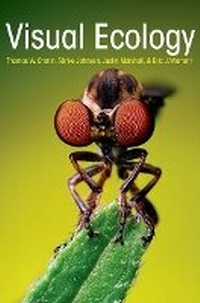
Visual Ecology
Published on 10. August 2014
Book
Hardback
432 pages
978-0-691-15184-7 (ISBN)
Description
Visual ecology is the study of how animals use visual systems to meet their ecological needs, how these systems have evolved, and how they are specialized for particular visual tasks. Visual Ecology provides the first up-to-date synthesis of the field to appear in more than three decades. Featuring some 225 illustrations, including more than 140 in color, spread throughout the text, this comprehensive and accessible book begins by discussing the basic properties of light and the optical environment. It then looks at how photoreceptors intercept light and convert it to usable biological signals, how the pigments and cells of vision vary among animals, and how the properties of these components affect a given receptor's sensitivity to light. The book goes on to examine how eyes and photoreceptors become specialized for an array of visual tasks, such as navigation, evading prey, mate choice, and communication. A timely and much-needed resource for students and researchers alike, Visual Ecology also includes a glossary and a wealth of examples drawn from the full diversity of visual systems.
* The most up-to-date overview of visual ecology available* Features some 225 illustrations, including more than 140 in color, spread throughout the text* Guides readers from the basic physics of light to the role of visual systems in animal behavior* Includes a glossary and a wealth of real-world examples
* The most up-to-date overview of visual ecology available* Features some 225 illustrations, including more than 140 in color, spread throughout the text* Guides readers from the basic physics of light to the role of visual systems in animal behavior* Includes a glossary and a wealth of real-world examples
Reviews / Votes
Winner of the 2015 PROSE Award in Textbook/Biological & Life Sciences, Association of American Publishers "[A] beautiful textbook: aesthetically formatted, clearly written, and with many carefully-chosen (and beautiful to look at!) data images that support the concepts presented in each chapter. This is a wonderful resource for grad students and medical students who want a deeper understanding of vision, advanced undergrads as well as well as the curious (educated) layperson."--Grrrl Scientist "A lovely, splendid book... A superb resource that will serve the field well for years to come, I suspect that I could read this book another 20 times and learn something new with each reading. This book will undoubtedly become required reading for all incoming graduate students in this field. I highly recommend this book for anyone interested in how non-human animals see their surroundings."--Rebecca C. Fuller, Ecology "One of the most brilliant textbooks written during the last years."--Brigitte Schoenemann, Anatomy & PhysiologyMore details
Language
English
Place of publication
New Jersey
United States
Target group
College/higher education
Professional and scholarly
Product notice
Trade binding
Illustrations
144 color illus. 21 halftones. 60 line illus. 1 table.
Dimensions
Height: 254 mm
Width: 178 mm
Weight
1256 gr
ISBN-13
978-0-691-15184-7 (9780691151847)
Copyright in bibliographic data and cover images is held by Nielsen Book Services Limited or by the publishers or by their respective licensors: all rights reserved.
Schweitzer Classification
Other editions
Additional editions
Thomas W. Cronin | Sönke Johnsen | Justin Marshall
Visual Ecology
E-Book
08/2014
1st Edition
Princeton University Press
from
€161.95
Available for download
Persons
Thomas W. Cronin is professor of biological sciences at the University of Maryland, Baltimore County. Sonke Johnsen is professor of biology at Duke University. N. Justin Marshall is professor of biomedical sciences at the University of Queensland in Australia. Eric J. Warrant is professor of zoology at Lund University in Sweden.
Content
List of Illustrations ix Preface xix 1 Introduction 1 2 Light and the Optical Environment 10 3 Visual Pigments and Photoreceptors 37 4 The Optical Building Blocks of Eyes 66 5 The Eye Designs of the Animal Kingdom 91 6 Spatial Vision 116 7 Color Vision 146 8 Polarization Vision 178 9 Vision in Attenuating Media 206 10 Motion Vision and Eye Movements 232 11 Vision in Dim Light 262 12 Visual Orientation and Navigation 289 13 Signals and Camoufl age 313 Glossary 345 References 355 General Index 383 Index of Names 401