

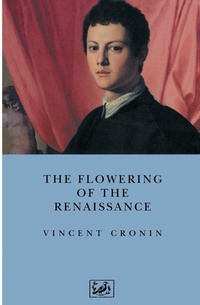
The Flowering of the Renaissance
Published on 10. September 1992
Book
Paperback/Softback
336 pages
978-0-7126-9884-9 (ISBN)
Description
Following the collapse of Medici rule in fifteenth-century Florence, the centre of Renaissance activity moved first to Rome and finally to Venice. In the Rome of Julius II and Leo X which Michelangelo remodelled and beautified, in the Venice of Titian and Tintoretto and Palladio, the Renaissance reached the height of its splendour, not only in the visual arts but also in the theatre, history, biography, epic poetry and music.
Reviews / Votes
An evocative picture of Rome at the turn of the sixteenth century... the account of Michelangelo is particularly memorable. At the same time Mr Cronin places the Renaissance firmly in its historical, political and religious setting... The book is beautifully written, and in his discussion of such artists as Titian and Giorgione Cronin shows a rare talent for describing and dissecting paintings. * Observer * It is Mr Cronin's outstanding achievement to have given this truly chaotic period a form which makes it intelligible - but without distorting its meaningthrough over-simplification. * Daily Telegraph *More details
Language
English
Place of publication
London
United Kingdom
Publishing group
Vintage
Illustrations
1
Dimensions
Height: 234 mm
Width: 153 mm
Thickness: 22 mm
Weight
614 gr
ISBN-13
978-0-7126-9884-9 (9780712698849)
Copyright in bibliographic data and cover images is held by Nielsen Book Services Limited or by the publishers or by their respective licensors: all rights reserved.
Schweitzer Classification
Other editions
Additional editions
Vincent Cronin
The Flowering of the Renaissance
E-Book
06/2011
1st Edition
Vintage Digital
€12.99
Available for download
Person
Vincent Cronin was educated at Ampleforth College, Harvard University, and Trinity College, Oxford, from which he graduated with honours in 1947. In addition to being a recipient of a W.H. Heinemann Award (1955) and a Rockefeller Foundation Award (1958), Cronin is a fellow of the Royal Society of Literature. His works have been widely translated into European languages. He died in January 2011, aged 86.