

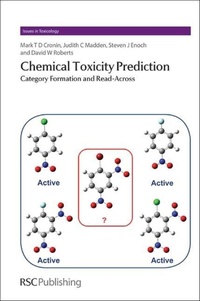
Chemical Toxicity Prediction
Category Formation and Read-Across
Published on 4. September 2013
Book
Hardback
191 pages
978-1-84973-384-7 (ISBN)
Description
The aim of this book is to provide the scientific background to using the formation of chemical categories, or groups, of molecules to allow for read-across i.e. the prediction of toxicity from chemical structure. It covers the scientific basis for this approach to toxicity prediction including the methods to group compounds (structural analogues and / or similarity, mechanism of action) and the tools to achieve this. The approaches to perform read-across within a chemical category are also described.
Chemical Toxicity Prediction provides concise practical guidance for those wishing to apply these methods (in risk / hazard assessment) and will be illustrated with case studies. This is the first book that addresses the concept of category formation and read-across for toxicity prediction specifically. This topic has really taken off in the past few years due to concerns over dealing with the REACH legislation and also due to the availability of the OECD (Q)SAR Toolbox. Much (lengthy and complex) guidance is available on category formation e.g. from the OECD and, to a lesser extent, the European Chemicals Agency but there is no one single source of information that covers all techniques in a concise user-friendly format.
Chemical Toxicity Prediction provides concise practical guidance for those wishing to apply these methods (in risk / hazard assessment) and will be illustrated with case studies. This is the first book that addresses the concept of category formation and read-across for toxicity prediction specifically. This topic has really taken off in the past few years due to concerns over dealing with the REACH legislation and also due to the availability of the OECD (Q)SAR Toolbox. Much (lengthy and complex) guidance is available on category formation e.g. from the OECD and, to a lesser extent, the European Chemicals Agency but there is no one single source of information that covers all techniques in a concise user-friendly format.
More details
Series
Language
English
Place of publication
Cambridge
United Kingdom
Target group
Professional and scholarly
Product notice
Unsewn / adhesive bound
Dimensions
Height: 242 mm
Width: 164 mm
Thickness: 20 mm
Weight
485 gr
ISBN-13
978-1-84973-384-7 (9781849733847)
Copyright in bibliographic data and cover images is held by Nielsen Book Services Limited or by the publishers or by their respective licensors: all rights reserved.
Schweitzer Classification
Other editions
Additional editions
Mark Cronin | Judith Madden | Steven Enoch
Chemical Toxicity Prediction
Category Formation and Read-Across
E-Book
10/2013
1st Edition
Royal Society of Chemistry
€159.99
Available for download
Persons
Mark Cronin is a Professor of Predictive Toxicology at Liverpool John Moores University, and has over 20 years of experience in the development of in silico approaches to predict toxicity including the use of QSAR, and read-across. He has published three books and over 160 papers in these areas. Judith Madden is a reader in Molecular Design at Liverpool John Moores University and has over 15 years experience in the application of QSAR and in silico techniques to predict the ADMET properties of xenobiotics. She has published one book and over 40 papers in these areas. Steven Enoch is a Post-Doctoral Research Fellow in Predictive Toxicology at Liverpool John Moores University. He is internationally recognised for his research in mechanistic categorisation for toxicology.
Content
Preface;
Introduction;
Approaches for Grouping Chemicals and Forming Chemical Categories;
Tools for Grouping Chemicals and Forming Chemical Categories;
Practicalities of Developing Robust Categories and Performing Read-Across;
Case Studies;
Conclusions;
Index
Introduction;
Approaches for Grouping Chemicals and Forming Chemical Categories;
Tools for Grouping Chemicals and Forming Chemical Categories;
Practicalities of Developing Robust Categories and Performing Read-Across;
Case Studies;
Conclusions;
Index