

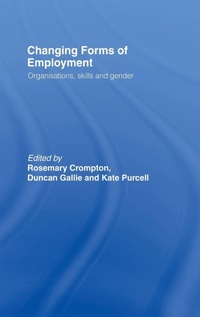
Changing Forms of Employment
Organizations, Skills and Gender
Published on 4. April 1996
Book
Hardback
294 pages
978-0-415-13371-5 (ISBN)
Description
During the last two decades there has been widespread evidence of change in specific aspects of employing organizations, employment and employment related institutions.
Changing Forms of Employment looks at the underlying trends which generate pressures towards a fundamental reshaping of social institutions in three ways: changes in the organization of production, particularly those associated with the growth of service dominated economics; the effects of technological change, particularly those associated with Information Technology; the erosion of the 'male breadwinner' (or single earner) model of employment and household.
These trends have resulted in strains and ruptures in the organization and regulation of employment, and related institutions including trade unions, employers, and households. The task of the next decade is to both reconstruct relationships, and to renew institutions.
Changing Forms of Employment looks at the underlying trends which generate pressures towards a fundamental reshaping of social institutions in three ways: changes in the organization of production, particularly those associated with the growth of service dominated economics; the effects of technological change, particularly those associated with Information Technology; the erosion of the 'male breadwinner' (or single earner) model of employment and household.
These trends have resulted in strains and ruptures in the organization and regulation of employment, and related institutions including trade unions, employers, and households. The task of the next decade is to both reconstruct relationships, and to renew institutions.
More details
Language
English
Place of publication
London
United Kingdom
Publishing group
Taylor & Francis Ltd
Target group
College/higher education
Professional and scholarly
Product notice
sewn/stitched
Cloth over boards
Dimensions
Height: 241 mm
Width: 162 mm
Thickness: 27 mm
Weight
649 gr
ISBN-13
978-0-415-13371-5 (9780415133715)
Copyright in bibliographic data and cover images is held by Nielsen Book Services Limited or by the publishers or by their respective licensors: all rights reserved.
Schweitzer Classification
Other editions
Additional editions
Rosemary Crompton | Duncan Gallie | Kate Purcell
Changing Forms of Employment
Organizations, Skills and Gender
E-Book
03/2002
Routledge
€33.99
Available for download
Rosemary Crompton | Duncan Gallie | Kate Purcell
Changing Forms of Employment
Organizations, Skills and Gender
E-Book
03/2002
Routledge
€33.99
Available for download
Rosemary Crompton | Duncan Gallie | Kate Purcell
Changing Forms of Employment
Organizations, Skills and Gender
Book
04/1996
Routledge
€39.20
Shipment within 15-20 days
Persons
Rosemary Crompton is Professor of Sociology at the University of Leicester. Duncan Gallie is Official Fellow at Nuffield College, the University of Oxford. Kate Purcell is Principal Research Fellow at the Institute of Employment Research, the University of Warwick.
Content
1 WORK, ECONOMIC RESTRUCTURING AND SOCIAL REGULATION Part I Regulation, deregulation and corporations 2 THE LABOUR MARKET OUTLOOK AND THE OUTLOOK FOR LABOUR MARKET ANALYSIS 3 TOWARDS THE TRANSNATIONAL COMPANY? The global structure and organisation of multinational Firms 4 FRAGMENTS OF INDUSTRY AND EMPLOYMENT Contract service work and the shift towards precarious Employment 5 THE SOCIAL ORDER OF THE SHIP IN A GLOBALISED LABOUR MARKET FOR SEAFARERS Part II The recomposition of skills and employment 6 THE SOCIAL CONSTITUTION OF LABOUR MARKETS Why skills cannot be commodities 7 SKILL, GENDER AND THE QUALITY OF EMPLOYMENT 8 SEGMENTATION AND INEQUALITY IN THE NURSING WORKFORCE Re-evaluating the evaluation of skills 9 WORK ORGANISATION, SKILLS DEVELOPMENT AND UTILISATION OF ENGINEERS A British-Japanese comparison Part III Change in gender relations 10 CHECKING OUT AND CASHING UP The prospects and paradoxes of regulating part-time work in Europe 11 THE TRAILING WIFE: A DECLINING BREED? Careers, geographical mobility and household conflict in Britain 1970-89 12 WOMEN AND MEN MANAGERS Careers and equal opportunities