

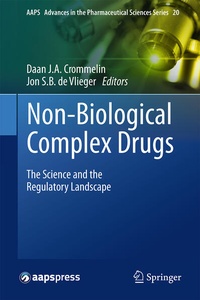
Non-Biological Complex Drugs
Description
More details
Other editions
Additional editions
Persons
Prof. Daan Crommelin is emeritus-professor at the Department of Pharmaceutics at Utrecht University. Until December 2011 he was scientific director of the Dutch Top Institute Pharma in Leiden. He is adjunct professor at the Department of Pharmaceutics and Pharmaceutical Chemistry at the University of Utah. Crommelin is co-founder of OctoPlus, a Leiden based company specialized in the development of pharmaceutical (mainly protein based) product formulations and advanced drug delivery systems. He published extensively and is on the editorial board of 10+ peer reviewed journals in the pharmaceutical sciences.
Dr. Jon de Vlieger, obtained his doctoral degree in bio analytical chemistry from the VU University in Amsterdam. He is currently involved in the strategy department of the Dutch Top Institute Pharma, a not-for-profit organization catalyzing the development of medicines by establishing partnerships and actively managing research programs. For TI Pharma he coordinates several international public private partnerships, including the Non Biological Complex Drugs Working Group, an international network of scientific and clinical experts from academia, industry and regulatory bodies, with expertise in many aspects of the development and evaluation of NBCDs.
Content
Introduction: Defining the position of Non-Biological Complex Drugs.- Polymeric micelles.- Liposomes: the science and the regulatory landscape.- Glatiramoids.- Iron carbohydrate complexes: characteristics and regulatory challenges.- Drug Nanocrystals.- Analytical methods for determining the size (distribution) in parenternal dispersions.- NBCD Pharmacokinetics and Bioanalytical Methods to Measure Drug Release.- Low Molecular Weight Heparins, Biological Drugs close to Non-Biological Complex Drugs.- Nanoparticle Albumin-Bound Anticancer Agents.- The EU regulatory landscape of Non-Biological Complex Drugs.- What did we learn? What can we expect in the future? Concluding remarks and outstanding issues.