

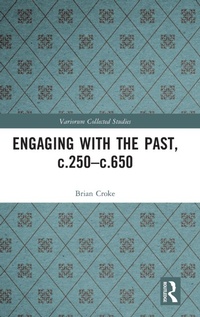
Engaging with the Past, c.250-c.650
1st Edition
Published on 18. April 2023
Book
Hardback
226 pages
978-1-032-23480-9 (ISBN)
Description
Between c.250 and c.650, the way the past was seen, recorded and interpreted for a contemporary audience changed fundamentally. Only since the 1970s have the key elements of this historiographical revolution become clear, with the recasting of the period, across both east and west, as 'late antiquity'. Historiography, however, has struggled to find its place in this new scholarly world. No longer is decline and fall the natural explanatory model for cultural and literary developments, but continuity and transformation. In addition, the emergence of 'late antiquity' coincided with a methodological challenge arising from the 'linguistic turn' which impacted on history writing in all eras.
This book is focussed on the development of modern understanding of how the ways of seeing and recording the past changed in the course of adjusting to emerging social, religious and cultural developments over the period from c.250 to c.650. Its overriding theme is how modern historiography has adapted over the past half century to engaging with the past between c.250 and c.650.
Now, as explained in this book, the newly dominant historiographical genres (chronicles, epitomes, church histories) are seen as the preferred modes of telling the story of the past, rather than being considered rudimentary and naive.
This book is focussed on the development of modern understanding of how the ways of seeing and recording the past changed in the course of adjusting to emerging social, religious and cultural developments over the period from c.250 to c.650. Its overriding theme is how modern historiography has adapted over the past half century to engaging with the past between c.250 and c.650.
Now, as explained in this book, the newly dominant historiographical genres (chronicles, epitomes, church histories) are seen as the preferred modes of telling the story of the past, rather than being considered rudimentary and naive.
More details
Series
Language
English
Place of publication
London
United Kingdom
Publishing group
Taylor & Francis Ltd
Target group
College/higher education
Professional and scholarly
Academic, Postgraduate, and Undergraduate Advanced
Dimensions
Height: 240 mm
Width: 161 mm
Thickness: 17 mm
Weight
523 gr
ISBN-13
978-1-032-23480-9 (9781032234809)
Copyright in bibliographic data and cover images is held by Nielsen Book Services Limited or by the publishers or by their respective licensors: all rights reserved.
Schweitzer Classification
Other editions
Additional editions
Brian Croke
Engaging with the Past, c.250-c.650
Book
11/2024
1st Edition
Routledge
€63.60
Shipment within 10-20 days
Brian Croke
Engaging with the Past, c.250-c.650
E-Book
04/2023
1st Edition
Routledge
€55.49
Available for download
Brian Croke
Engaging with the Past, c.250-c.650
E-Book
04/2023
1st Edition
Routledge
€55.49
Available for download
Person
Brian Croke is an Honorary Associate in Ancient History at the University of Sydney and an expert adviser in education. He is the author of over 100 articles on various aspects of ancient, Byzantine and modern history and historiography, as well as education, and a range of books including The Chronicle of Marcellinus (1995), Christian Chronicles and Byzantine History (1992), Count Marcellinus (2001), Roman Emperors in Context (2021) and Flashpoint Hagia Sophia (2022).
Content
Introduction: Organising History and Historiography / 1. Reflecting on an Historiographical Half-Century, 1970-2020 (previously unpublished) / 2. Historiography in Late Antiquity: An Overview, originally published in History and Historians in Late Antiquity (1983), 1-12. / 3. Latin Historiography in the Barbarian Kingdoms, originally published in Greek and Roman Historiography in Late Antiquity: Fourth to Sixth Century A.D. (2003), 349-389. / 4. Historiography, originally published in The Oxford Handbook of Late Antiquity (2012), 405-436. / 5. Tradition and Originality in Photius' Historical Reading, originally published in Byzantine Narrative (2006), 59-70. / 6. Uncovering Byzantium's Historiographical Audience, originally published in Byzantine History as Literature (2010), 23-51. / 7. Momigliano's Historiographical Contribution, c. 250-c.650 (previously unpublished) / Bibliography