

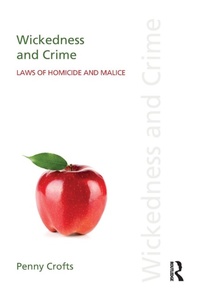
Wickedness and Crime
Laws of Homicide and Malice
1st Edition
Published on 22. May 2015
Book
Paperback/Softback
304 pages
978-1-138-91511-4 (ISBN)
Description
The criminal legal system defines and authoritatively enacts the boundaries of permissible and impermissible behaviour, with a focus on that which is prohibited or transgressive. Wickedness and Crime: Laws of Homicide and Malice seeks to expose the ways in which criminal law communicates and sanctions particular models of wickedness. This book illuminates the intimate relationship of crime and definitions of wrongdoing. A central contention of the book is that if a criminal legal system empty of normative content is undesirable and implausible, then we must think critically about the types of models of wickedness that are communicated by criminal legal doctrine.
Through historical and contemporary analysis of the legal concept of malice, Penny Crofts examines the types of models of wickedness that are established through criminal legal doctrine. The book draws upon literature, philosophy and jurisprudence to place wickedness at the centre of an account of criminal law. Arguing that the current dominant idea of wickedness communicated in criminal law lacks nuance and clarity, this book examines the implications in terms of the legal subject, social responsibility and the jurisdiction of the legal system. Through historical accounts of malice the book provides resources to enrich a contemporary jurisprudence of blaming.
A fascinating contribution to the study of law, this book will interest criminal legal scholars who seek a deeper understanding of the complexity of the relationship between law and morality. The book also provides a resource for legal theorists and philosophers of wickedness, supplying a sustained example and analysis of the implications of types of models of culpability.
Through historical and contemporary analysis of the legal concept of malice, Penny Crofts examines the types of models of wickedness that are established through criminal legal doctrine. The book draws upon literature, philosophy and jurisprudence to place wickedness at the centre of an account of criminal law. Arguing that the current dominant idea of wickedness communicated in criminal law lacks nuance and clarity, this book examines the implications in terms of the legal subject, social responsibility and the jurisdiction of the legal system. Through historical accounts of malice the book provides resources to enrich a contemporary jurisprudence of blaming.
A fascinating contribution to the study of law, this book will interest criminal legal scholars who seek a deeper understanding of the complexity of the relationship between law and morality. The book also provides a resource for legal theorists and philosophers of wickedness, supplying a sustained example and analysis of the implications of types of models of culpability.
More details
Series
Language
English
Place of publication
London
United Kingdom
Publishing group
Taylor & Francis Ltd
Target group
College/higher education
Professional and scholarly
General, Postgraduate, Professional, and Undergraduate
Dimensions
Height: 234 mm
Width: 156 mm
Thickness: 16 mm
Weight
465 gr
ISBN-13
978-1-138-91511-4 (9781138915114)
Copyright in bibliographic data and cover images is held by Nielsen Book Services Limited or by the publishers or by their respective licensors: all rights reserved.
Schweitzer Classification
Other editions
Additional editions

E-Book
10/2013
1st Edition
Routledge
€64.49
Available for download

E-Book
10/2013
1st Edition
Routledge
€64.49
Available for download
Book
08/2013
1st Edition
Routledge
€232.10
Shipment within 15-20 days
Person
Content
Chapter 1. Introduction; Chapter 2. Medieval Malice: disorder and purity of heart; Chapter 3. The poisoned apple of malice; Chapter 4. Sir James Fitzjames Stephen's monstrous malice; Chapter 5. The Malevolent outlaw of law; Chapter 6. The negligence of Lavender; Chapter 7. Conclusion