

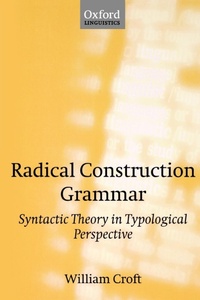
Radical Construction Grammar
Syntactic Theory in Typological Perspective
Published on 25. October 2001
Book
Paperback/Softback
448 pages
978-0-19-829954-7 (ISBN)
Description
Radical Construction Grammar presents a profound critique of syntactic theory and argumentation, and offers a genuinely new approach to syntax based on the fact of grammatical diversity. Recent syntactic theories are essentially formal models for the representation of grammatical knowledge and posit complex syntactic structures in the analysis of sentences. The result has been a endless cycle of new and revised theories of syntactic representation.
Radical Construction Grammar argues that this approach to syntax is incompatible with the grammatical variation found within and across languages. This book defends three fundamental theses: (i) constructions are the primitive units of syntactic representation, and grammatical categories are defined by constructions, not the other way around; (ii) the only syntactic structures are the part-whole relations between a construction and the syntactic elements that make it up; (iii) not only are grammatical categories construction-specific, but constructions are language-specific. In other words, syntactic structure is almost entirely language-specific; attempts to find a universal formal model are doomed to failure.
Radical Construction Grammar integrates concepts from typological theory and construction grammar to uncover the genuine universals of grammar. Constructions are represented as complex symbolic units pairing form and meaning. The semantic map model of typological theory is used to map category distributions on a largely universal conceptual space. Universals of grammar are found in the mapping of meaning onto form. Systematic patterns of grammatical variation provide evidence for the topography of conceptual space, which in turn reflects the geography of the human mind.
Radical Construction Grammar argues that this approach to syntax is incompatible with the grammatical variation found within and across languages. This book defends three fundamental theses: (i) constructions are the primitive units of syntactic representation, and grammatical categories are defined by constructions, not the other way around; (ii) the only syntactic structures are the part-whole relations between a construction and the syntactic elements that make it up; (iii) not only are grammatical categories construction-specific, but constructions are language-specific. In other words, syntactic structure is almost entirely language-specific; attempts to find a universal formal model are doomed to failure.
Radical Construction Grammar integrates concepts from typological theory and construction grammar to uncover the genuine universals of grammar. Constructions are represented as complex symbolic units pairing form and meaning. The semantic map model of typological theory is used to map category distributions on a largely universal conceptual space. Universals of grammar are found in the mapping of meaning onto form. Systematic patterns of grammatical variation provide evidence for the topography of conceptual space, which in turn reflects the geography of the human mind.
Reviews / Votes
An important and original work by one of the world's leading linguistic theorists. Radical Construction Grammar presents a profound critique of syntactic theory, offers a new approach to syntax, and uncovers the real universals of grammar. It will particularly interest those concerned with theories of grammar and language typology, and with mind/language relations. * Folia Linguistica *More details
Language
English
Place of publication
Oxford
United Kingdom
Target group
Professional and scholarly
Illustrations
numerous figures and tables
Dimensions
Height: 234 mm
Width: 156 mm
Thickness: 25 mm
Weight
673 gr
ISBN-13
978-0-19-829954-7 (9780198299547)
Copyright in bibliographic data and cover images is held by Nielsen Book Services Limited or by the publishers or by their respective licensors: all rights reserved.
Schweitzer Classification
Other editions
Additional editions
Book
10/2001
Oxford University Press
€398.50
Shipment within 15-20 days
Person
William Croft received his Ph.D. in linguistics at Stanford University in 1986. His publications includeTypology and Universals (1990), Syntactic Categories and Grammatical Relations (1991), Studies in Typology and Diachrony (coedited with Keith Denning and Suzanne Kemmer, 1990), Explaining Language Change: An Evolutionary Approach (2000), and a large number of scholarly articles. His current research areas include syntax, semantics, typology, and historical linguistics. Forthcoming books include Cognitive Linguistics (with D. Alan Cruse) and Verbs: Aspect and Argument Structure.
Content
1. SYNTACTIC ARGUMENTATION AND RADICAL CONSTRUCTION GRAMMAR ; 2. Parts of Speech ; 3. Syntactic Categories and Semantic Relativity ; 4. Grammatical Relations/Syntactic Roles ; 5. DEPENDENCY, CONSTITUENCY, AND LINEAR ORDER ; 6. A Radical Approach to Syntactic Relations ; 7. Heads, Complements, and Adjuncts ; 8. THE VOICE CONTINUUM ; 9. The Coordination-Subordination Continuum ; 10. Syntactic Theory and the Theory of Language