

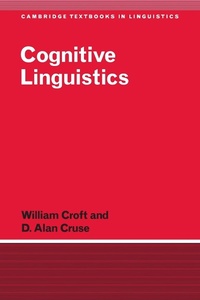
Cognitive Linguistics
Published on 22. January 2004
Book
Paperback/Softback
374 pages
978-0-521-66770-8 (ISBN)
Description
Cognitive Linguistics argues that language is governed by general cognitive principles, rather than by a special-purpose language module. This introductory textbook surveys the field of cognitive linguistics as a distinct area of study, presenting its theoretical foundations and the arguments supporting it. Clearly organised and accessibly written, it provides a useful introduction to the relationship between language and cognitive processing in the human brain. It covers the main topics likely to be encountered in a course or seminar, and provides a synthesis of study and research in this fast-growing field of linguistics. The authors begin by explaining the conceptual structures and cognitive processes governing linguistic representation and behaviour, and go on to explore cognitive approaches to lexical semantics, as well as syntactic representation and analysis, focusing on the closely related frameworks of cognitive grammar and construction grammar. This much-needed introduction will be welcomed by students in linguistics and cognitive science.
More details
Series
Language
English
Place of publication
Cambridge
United Kingdom
Target group
Professional and scholarly
College/higher education
Product notice
Paperback (trade)
Illustrations
3 Tables, unspecified
Dimensions
Height: 229 mm
Width: 152 mm
Thickness: 21 mm
Weight
541 gr
ISBN-13
978-0-521-66770-8 (9780521667708)
Copyright in bibliographic data and cover images is held by Nielsen Book Services Limited or by the publishers or by their respective licensors: all rights reserved.
Schweitzer Classification
Other editions
Additional editions
William Croft | D. Alan Cruse
Cognitive Linguistics
Book
01/2004
Cambridge University Press
€159.40
Shipment within 15-20 days
Persons
D. Alan Cruse is Senior Lecturer in the School of English and Linguistics, University of Manchester. William Croft is Professor of Linguistics at the University of Manchester.
Content
1. Introduction: what is cognitive linguistics?; Part I. A Conceptual Approach to Linguistic Analysis: 2. Frames, domains, spaces: the organisation of conceptual structure; 3. Conceptualization and construal operations; 4. Categories, concepts and meanings; Part II. Cognitive Approaches to Lexical Semantics: 5. Polysemy: the construal of sense boundaries; 6. A dynamic construal approach to sense relations I: hyponymy and metonymy; 7. A dynamic construal approach to sense relations II: antonymy and complementarity; 8. Metaphor; Part III. Cognitive Approaches to Grammatical Form: 9. From idioms to construction grammar; 10. An overview of construction grammars; 11. The usage-based model; 12. Conclusion: cognitive linguistics and beyond.