

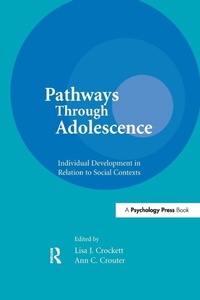
Pathways Through Adolescence
individual Development in Relation To Social Contexts
1st Edition
Published on 2. September 2016
Book
Paperback/Softback
286 pages
978-1-138-97798-3 (ISBN)
Description
Adolescent researchers are increasingly aware that they must examine development both across time and across context. To do so, however, requires new conceptualizations and methodological approaches to the study of development, including attention to the pathways young people choose in adolescence and follow into adulthood. This volume assembles work by key researchers in the field who are struggling to understand how developmental trajectories are constructed and maintained throughout the adolescent period.
A complete understanding of developmental pathways requires the recognition that adolescents' social contexts--family, school, neighborhood, and/or peer group--are important influences on the choices they make at this developmental period. Researchers have traditionally studied contexts in isolation rather than examining the interrelationships among contexts and their implications for adolescent development. The present volume seeks to address this gap in the literature, with attention given not only to the interrelationships among contexts for white, middle-class youth, but also to these issues for minority adolescents in neighborhoods that vary in terms of access to resources. It concludes with an examination of researcher-community collaboration as a strategy to move communities toward a greater awareness of adolescent development and the problems facing youth in their community, and as a means to promote potential avenues for policy change and intervention.
A complete understanding of developmental pathways requires the recognition that adolescents' social contexts--family, school, neighborhood, and/or peer group--are important influences on the choices they make at this developmental period. Researchers have traditionally studied contexts in isolation rather than examining the interrelationships among contexts and their implications for adolescent development. The present volume seeks to address this gap in the literature, with attention given not only to the interrelationships among contexts for white, middle-class youth, but also to these issues for minority adolescents in neighborhoods that vary in terms of access to resources. It concludes with an examination of researcher-community collaboration as a strategy to move communities toward a greater awareness of adolescent development and the problems facing youth in their community, and as a means to promote potential avenues for policy change and intervention.
More details
Series
Language
English
Place of publication
Hove
United Kingdom
Publishing group
Taylor & Francis Ltd
Target group
Professional and scholarly
Dimensions
Height: 229 mm
Width: 152 mm
Thickness: 16 mm
Weight
421 gr
ISBN-13
978-1-138-97798-3 (9781138977983)
Copyright in bibliographic data and cover images is held by Nielsen Book Services Limited or by the publishers or by their respective licensors: all rights reserved.
Schweitzer Classification
Other editions
Additional editions
Lisa J. Crockett | Ann C. Crouter
Pathways Through Adolescence
individual Development in Relation To Social Contexts
E-Book
03/2014
1st Edition
Psychology Press Ltd
€68.49
Available for download
Lisa J. Crockett | Ann C. Crouter
Pathways Through Adolescence
individual Development in Relation To Social Contexts
E-Book
03/2014
1st Edition
Psychology Press Ltd
€68.49
Available for download
Lisa J. Crockett | Ann C. Crouter
Pathways Through Adolescence
individual Development in Relation To Social Contexts
Book
10/1995
Psychology Press
€206.70
Shipment within 10-20 days
Persons
Edited by Crockett, Lisa J.; Crouter, Ann C.
Content
Contents: A.C. Petersen, Foreword. Preface. L.J. Crockett, A.C. Crouter, Pathways Through Adolescence: An Overview. Part I:Developmental Trajectories in Adolescence.D. Huizinga, Developmental Sequences in Delinquency: Dynamic Typologies. R.B. Cairns, M-C. Leung, B.D. Cairns, Social Networks Over Time and Space in Adolescence. A. Caspi, Puberty and the Gender Organization of Schools: How Biology and Social Context Shape the Adolescent Experience. L.J. Crockett, Developmental Paths in Adolescence: Commentary. Part II:Risks From Within and Without: Resilience in Context.L.F. Winfield, The Knowledge Base on Resilience in African-American Adolescents. L.M. Burton, K.W. Allison, D. Obeidallah, Social Context and Adolescence: Perspectives on Development Among Inner-City African-American Teens. S.M. McHale, Lessons About Adolescent Development From the Study of African-American Youth: Commentary. Part III:Interrelations Among Social Contexts.B.B. Brown, B-H. Huang, Examining Parenting Practices in Different Peer Contexts: Implications for Adolescent Trajectories. P. Eckert, Trajectory and Forms of Institutional Participation. R.K. Silbereisen, How Parenting Styles and Crowd Contexts Interact in Actualizing Potentials for Development: Commentary. Part IV:Approaches to Intervention.S.A. Small, Enhancing Contexts of Adolescent Development: The Role of Community-Based Action Research. A.T. Ebata, Community-Based Action Research and Adolescent Development: Commentary. Part V:Future Directions.L. Steinberg, Commentary: On Developmental Pathways and Social Contexts in Adolescence.