

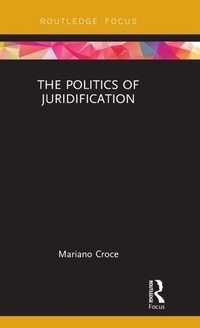
The Politics of Juridification
The Actor's Revenge
1st Edition
Published on 9. January 2018
Book
Hardback
94 pages
978-0-415-75013-4 (ISBN)
Description
The Politics of Juridification offers a timely contribution to debates about how politics is being affected by the increasing relevance of judicial bodies to the daily administration of Western political communities. While most critical analyses portray juridification as a depoliticizing, de-democratizing transferral of political authority to the courts (whether national or international), this book centres on the workable ambivalence of such a far-reaching phenomenon. While juridification certainly intensifies the power and competences of judicial bodies to the disadvantage of representative political institutions, it cannot be easily reduced to the demise of democratic politics. By focusing on the multiple ways in which social agents make use of the law, The Politics of Juridification teases out the agential and transformative aspects of the various negotiations social agents engage with legal institutions with a view to obtaining political visibility. In particular, the book homes in on two seemingly distinct phenomena: on one hand, the regulation of sexuality and emerging kinship formations; on the other, the fragmentation of legal settings due to the claims to legal autonomy advanced by sub-state cultural and religious groups. By doing so, the book makes the case for an unexpected convergence between the struggles for legal recognition of sexual minorities and religious and cultural minorities. The conclusion is that juridification does entail normalization and favour the infiltration of law into the social realm. But because of its ambivalent nature, it can and does serve as an alternative vehicle for social change - one that attaches more importance to how social agents produce law on a daily basis and how this law permeates official legal orders.
More details
Series
Language
English
Place of publication
London
United Kingdom
Publishing group
Taylor & Francis Ltd
Target group
College/higher education
Dimensions
Height: 222 mm
Width: 145 mm
Thickness: 9 mm
Weight
268 gr
ISBN-13
978-0-415-75013-4 (9780415750134)
Copyright in bibliographic data and cover images is held by Nielsen Book Services Limited or by the publishers or by their respective licensors: all rights reserved.
Schweitzer Classification
Other editions
Additional editions
Mariano Croce
The Politics of Juridification
Book
03/2019
1st Edition
Routledge
€30.60
Shipment within 15-20 days
E-Book
02/2018
1st Edition
Routledge
€25.99
Available for download
Person
Mariano Croce is Assistant Professor of Political Philosophy at Sapienza Universita di Roma, Italy. His research includes theory of the state, legal and political institutionalism, legal pluralism and LGBTQIA studies. Among his books are?The Legal Theory of Carl Schmitt?(Routledge, 2013, with A. Salvatore) and?Undoing Ties: Political Philosophy at the Waning of the State?(Bloomsbury Academic, 2015, with A. Salvatore).
Content
Introduction
1. The legal circuit and the process of conversion
2. Traditional politics and the politics of juridification
3. Juridification: within and without institutions
Chapter 1
Juridification within institutions: the law of sex and kinship
1.1. The legal boundaries of admissible sexuality
1.2. Remoulding kinship: subversion or assimilation?
1.3. Filtering social practices
Chapter 2
Juridification without institutions: fragmenting the law
2.1. The post-secular turn
2.2. Fragmented jurisdictions and legal pluralities
Conclusion
1. As law-users make law
2. Two modes of political juridification
3. The political potential of legal creativity
1. The legal circuit and the process of conversion
2. Traditional politics and the politics of juridification
3. Juridification: within and without institutions
Chapter 1
Juridification within institutions: the law of sex and kinship
1.1. The legal boundaries of admissible sexuality
1.2. Remoulding kinship: subversion or assimilation?
1.3. Filtering social practices
Chapter 2
Juridification without institutions: fragmenting the law
2.1. The post-secular turn
2.2. Fragmented jurisdictions and legal pluralities
Conclusion
1. As law-users make law
2. Two modes of political juridification
3. The political potential of legal creativity