

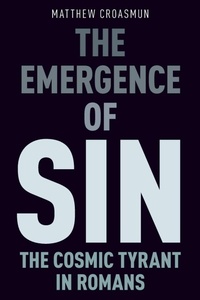
The Emergence of Sin
The Cosmic Tyrant in Romans
Published on 26. February 2020
Book
Paperback/Softback
296 pages
978-0-19-009694-6 (ISBN)
Description
We can have a sense that when we try to do right by one another, we aren't merely striving against ourselves. The feeling is that we are struggling against something--someone-else. As if there's a force-a person- that wishes us ill. In his letter to the Romans, the apostle Paul describes just such a person: Sin, a cosmic tyrant who constrains our moral freedom, confuses our moral judgment, and condemns us to slavery and to death.
Commentators have long argued about whether Paul literally means to say Sin is a person or is simply indulging in literary personification, but regardless of Paul's intentions, for modern readers it would seem clear enough: there is no such thing as a cosmic tyrant. Surely it is more reasonable to suppose "Sin" is merely a colorful way of describing individual misdeeds or, at most, a way of evoking the intractability of our social ills.
In The Emergence of Sin, Matthew Croasmun suggests we take another look. The vision of Sin he offers is at once scientific and theological, social and individual, corporeal and mythological. He argues both that the cosmic power Sin is nothing more than an emergent feature of a vast human network of transgression and that this power is nevertheless real, personal, and one whom we had better be ready to resist. Ultimately, what is on offer here is an account of the world re-mythologized at the hands of chemists, evolutionary biologists, sociologists, and entomologists. In this world, Paul's text is not a relic of a forgotten mythical past, but a field manual for modern living.
Commentators have long argued about whether Paul literally means to say Sin is a person or is simply indulging in literary personification, but regardless of Paul's intentions, for modern readers it would seem clear enough: there is no such thing as a cosmic tyrant. Surely it is more reasonable to suppose "Sin" is merely a colorful way of describing individual misdeeds or, at most, a way of evoking the intractability of our social ills.
In The Emergence of Sin, Matthew Croasmun suggests we take another look. The vision of Sin he offers is at once scientific and theological, social and individual, corporeal and mythological. He argues both that the cosmic power Sin is nothing more than an emergent feature of a vast human network of transgression and that this power is nevertheless real, personal, and one whom we had better be ready to resist. Ultimately, what is on offer here is an account of the world re-mythologized at the hands of chemists, evolutionary biologists, sociologists, and entomologists. In this world, Paul's text is not a relic of a forgotten mythical past, but a field manual for modern living.
Reviews / Votes
A striking study, then, and well worth reading for an original and stimulating exposition of Romans. Those interested in the philosophical questions of emergentism will find it fascinating and provocative and themselves, on closing the book, with many more questions that they wish to ask. * Euan Alexander Grant, The Emergence of Sin * ...highly theoretical... * Jeffrey S. Siker, The Catholic Biblical Quarterly * In one of the most innovative and compelling books on Paul to be published in years, The Emergence of Sin: The Cosmic Tyrant in Romans, Croasmun zeroes in on one of Paul's most puzzling and alienating concepts: his portrayal of sin-or, perhaps better, "Sin"-as a kind of mythic god, a personal force or energy that nefariously thwarts divine purposes and enslaves unsuspecting humans. * Wesley Hill , associate professor of New Testament at Trinity School for Ministry in Ambridge, Pennsylvania, Marginalia Review of Books * [A] fantastic new book The singular contribution of The Emergence of Sin is Croasmun's lengthy, accessible and paradigm-altering proposal that sin by the individual, Sin as a cosmological presence and Sin as a systemic can be explained best by emergence theory."-Scot McKnight, Patheos The book is replete with his assiduous engagements with several important figures in modern emergentism, including Philip Clayton and Andy Clark. The natural corollary to this is that Christian theological discourse (in this case what he calls 'an emergent hamartiology') can be a potentially fruitful interlocutor for many non-theological disciplines I have benefited much from Croasmun's work, and suspect that many others will find this book helpful as well."-Sang-il Kim, Reading Religion 'Sin emerges' * both scripture and experience attest to it. Yet no scholar has yet worked out an emergent hamartiology in so rigorous and convincing a fashion. Croasmun brilliantly summarizes recent theories of emergent selves and systems, drawing on science, anthropology, and political theory. Drawing then on a close reading of Paul on sin and justification, he offers a compelling account of the effects of sinon individuals, relations, and social structures.Philip Clayton, author of Mind and Emergence * Written with verve, clarity, and erudition, this book is a breath of fresh air for the guild of Pauline studies. Arguing that a fresh engagement with Paul's language about sin requires an interdisciplinary approach, Croasmun points the way to urgently needed new ways of reading Paul's letters in a twenty-first century context. Required reading for serious interpreters of Paul. * Susan Eastman, Associate Research Professor of New Testament, Duke Divinity School *More details
Language
English
Place of publication
New York
United States
Target group
Professional and scholarly
Dimensions
Height: 234 mm
Width: 156 mm
Thickness: 17 mm
Weight
501 gr
ISBN-13
978-0-19-009694-6 (9780190096946)
Copyright in bibliographic data and cover images is held by Nielsen Book Services Limited or by the publishers or by their respective licensors: all rights reserved.
Schweitzer Classification
Other editions
Additional editions
Book
07/2017
Oxford University Press Inc
€140.10
Shipment within 15-20 days
E-Book
06/2017
1st Edition
OUP eBook
€63.49
Available for download
E-Book
06/2017
1st Edition
OUP eBook
€49.99
Available for download
Person
Matthew Croasmun is Associate Research Scholar and Director of the Life Worth Living Program at the Yale Center for Faith & Culture and Lecturer of Divinity and Humanities at Yale University. He completed his Ph.D. in Religious Studies (New Testament) at Yale in 2014 and was a recipient of the 2015 Manfred Lautenschlaeger Award for Theological Promise for his dissertation, "The Body of Sin: An Emergent Account of Sin as a Cosmic Power in Romans 5-8."
Content
Introduction
Chapter 1. s/Sin: The Genealogy of a Person(ification)
Chapter 2. Emergence
Chapter 3. The Emergence of Persons Great and Small
Chapter 4. An Emergent Account of Sin in Romans
Chapter 5. Sin, Gender, and Empire
Chapter 6. Conclusions
Chapter 1. s/Sin: The Genealogy of a Person(ification)
Chapter 2. Emergence
Chapter 3. The Emergence of Persons Great and Small
Chapter 4. An Emergent Account of Sin in Romans
Chapter 5. Sin, Gender, and Empire
Chapter 6. Conclusions