

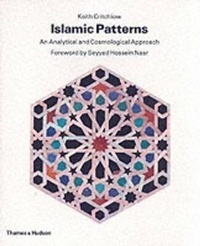
Islamic Patterns
An Analytical and Cosmological Approach
Published on 3. May 1983
Book
Paperback/Softback
192 pages
978-0-500-27071-4 (ISBN)
Description
For centuries the nature and meaning of Islamic art has been misunderstood in the West, being regarded as no more than decoration. But in fact the abstract art of Islam represents the sophisticated development of a supra-naturalistic tradition, since the portrayal of human and animal forms has always been discouraged by the Prophet Muhammad, so as to avoid idolatry. Hence, among the world's great artistic traditions, Islamic art has maintained its singular integrity and inner content with the least diversion from its aim: the affirmation of unity as expressed in diversity.
The Pythagorean/Platonic doctrines are easily recognizable in the body of Islamic geometric art, as the wisdom of this practice was exalted by Socrates, in Plato's Republic dialogue (527), when he specifically gave the reason for practising geometry. Its practice rekindled the inner organ (or eye of wisdom) by which alone we can see the truth. The geometrical patterns of Islamic art reveal to the eye of the sensitive onlooker the intrinsic cosmological laws affecting all Creation. The primary function of these patterns is to lead the mind from the literal and mundane world towards the underlying permanent reality.
The numerous sequential drawings show how the art of Islam is inseparable from the science of mathematics. Thus, we can see clearly how an Earth-centred - 'common-sense' - view of the cosmos gives renewed signficance to the number patterns produced by the orbits of the planets, correlating the cosmos as experienced by man with the patterns created in Islamic art, and thereby throwing new light on the perennial symbolic significance of number. The mathematical tessellations inherent in space-filling patterns are revealed as an essential practical and philosophical basis for the creation of each completed work of art - whether a tile, a carpet, a wall or an entire building - and thus affirm the underlying essential unity of all things.
The Pythagorean/Platonic doctrines are easily recognizable in the body of Islamic geometric art, as the wisdom of this practice was exalted by Socrates, in Plato's Republic dialogue (527), when he specifically gave the reason for practising geometry. Its practice rekindled the inner organ (or eye of wisdom) by which alone we can see the truth. The geometrical patterns of Islamic art reveal to the eye of the sensitive onlooker the intrinsic cosmological laws affecting all Creation. The primary function of these patterns is to lead the mind from the literal and mundane world towards the underlying permanent reality.
The numerous sequential drawings show how the art of Islam is inseparable from the science of mathematics. Thus, we can see clearly how an Earth-centred - 'common-sense' - view of the cosmos gives renewed signficance to the number patterns produced by the orbits of the planets, correlating the cosmos as experienced by man with the patterns created in Islamic art, and thereby throwing new light on the perennial symbolic significance of number. The mathematical tessellations inherent in space-filling patterns are revealed as an essential practical and philosophical basis for the creation of each completed work of art - whether a tile, a carpet, a wall or an entire building - and thus affirm the underlying essential unity of all things.
Reviews / Votes
'Will make intricate pattern-making much simpler to understand and create...highly recommended' - Tile & Stone JournalMore details
Language
English
Place of publication
London
United Kingdom
Target group
College/higher education
Illustrations
150 drawings, many in two colours
Dimensions
Height: 260 mm
Width: 210 mm
Weight
660 gr
ISBN-13
978-0-500-27071-4 (9780500270714)
Copyright in bibliographic data and cover images is held by Nielsen Book Services Limited or by the publishers or by their respective licensors: all rights reserved.
Schweitzer Classification
Person
Dr. Keith Critchlow is the co-founder of the journal Temenos, as well as the author of numerous books on sacred geometry. He is Professor Emeritus at The Prince's School of Traditional Arts in London, and a former professor of Islamic Art at the Royal College of Art.
Content
The point of departure; the manifestation of shape; magic squares; pattern and cosmology; the pentagon; the tetractys; the mathematics of two-dimensional space-filling; the circle and cosmic rhythms; specimen Islamic patterns.