

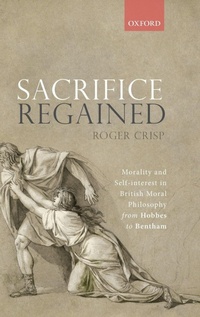
Sacrifice Regained
Morality and Self-Interest in British Moral Philosophy from Hobbes to Bentham
Published on 3. September 2019
Book
Hardback
256 pages
978-0-19-884047-3 (ISBN)
Description
Does being virtuous make you happy? In this book, Roger Crisp examines the answers to this ancient question provided by the so-called 'British Moralists', from Thomas Hobbes, around 1650, for the next two hundred years, until Jeremy Bentham. This involves elucidating their views on happiness (self-interest, or well-being) and on virtue (or morality), in order to bring out the relation of each to the other. Themes ran through many of these writers: psychological egoism, evaluative hedonism, and - after Hobbes - the acceptance of self-standing moral reasons. But there are exceptions, and even those taking the standard views adopt them for very different reasons and express them in various ways. As the ancients tended to believe that virtue and happiness largely coincide, so these modern authors are inclined to accept posthumous reward and punishment. Both positions sit uneasily with the common-sense idea that a person can truly sacrifice their own good for the sake of morality or for others. Roger Crisp shows that David Hume - a hedonist whose ethics made no appeal to the afterlife - was the first major British moralist to allow for, indeed to recommend, such self-sacrifice. Morality and well-being of course remain central to modern ethics, and Crisp demonstrates how much there is to learn from this remarkable group of philosophers.
More details
Language
English
Place of publication
Oxford
United Kingdom
Target group
Professional and scholarly
Dimensions
Height: 240 mm
Width: 161 mm
Thickness: 18 mm
Weight
534 gr
ISBN-13
978-0-19-884047-3 (9780198840473)
Copyright in bibliographic data and cover images is held by Nielsen Book Services Limited or by the publishers or by their respective licensors: all rights reserved.
Schweitzer Classification
Other editions
Additional editions
Roger Crisp
Sacrifice Regained
Morality and Self-Interest in British Moral Philosophy from Hobbes to Bentham
E-Book
09/2019
1st Edition
OUP eBook
€64.49
Available for download
Roger Crisp
Sacrifice Regained
Morality and Self-Interest in British Moral Philosophy from Hobbes to Bentham
E-Book
09/2019
1st Edition
OUP eBook
€64.49
Available for download
Person
Roger Crisp is Professor of Moral Philosophy at the University of Oxford and Uehiro Fellow and Tutor in Philosophy at St Anne's College, Oxford. He is the author of Reasons and the Good (Oxford 2006) and The Cosmos of Duty: Henry Sidgwick's Methods of Ethics (Oxford 2015), co-editor of Well-Being and Morality: Essays in Honour of James Griffin (with Brad Hooker; Clarendon Press 2000), and editor of The Oxford Handbook of the History of Ethics (Oxford 2013) and Griffin on Human Rights (Oxford 2014).
Content
1: Introduction: The Morality Question
2: Hobbes: The Return of Gyges
3: Cumberland: Divine Utilitarianism
4: More: An Enthusiasm for Virtue
5: Locke: The Sanctions of God
6: Mandeville: Morality after the Fall
7: Shaftesbury: Stoicism and the Art of Virtue
8: Hutcheson: Impartial Pleasures
9: Clarke: Virtue and the Life Hereafter
10: Butler: The Supremacy of Conscience
11: Reid: The Goodness of Virtue, and its Limits
12: Hume: The Utility of Morality
13: Smith: The Delusions of Self-love
14: Price: Morality as God
15: Gay, Tucker, Paley, and Bentham: Variations on the Theme of Happiness
2: Hobbes: The Return of Gyges
3: Cumberland: Divine Utilitarianism
4: More: An Enthusiasm for Virtue
5: Locke: The Sanctions of God
6: Mandeville: Morality after the Fall
7: Shaftesbury: Stoicism and the Art of Virtue
8: Hutcheson: Impartial Pleasures
9: Clarke: Virtue and the Life Hereafter
10: Butler: The Supremacy of Conscience
11: Reid: The Goodness of Virtue, and its Limits
12: Hume: The Utility of Morality
13: Smith: The Delusions of Self-love
14: Price: Morality as God
15: Gay, Tucker, Paley, and Bentham: Variations on the Theme of Happiness