

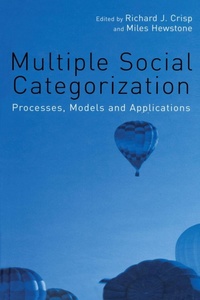
Multiple Social Categorization
Processes, Models and Applications
1st Edition
Published on 13. February 2014
Book
Paperback/Softback
344 pages
978-0-415-65567-5 (ISBN)
Description
'Ethnic cleansing', 'institutional racism', and 'social exclusion' are just some of the terms used to describe one of the most pressing social issues facing today's societies: prejudice and intergroup discrimination. Invariably, these pervasive social problems can be traced back to differences in religion, ethnicity, or countless other bases of group membership: the social categories to which people belong.
Social categorization, how we classify ourselves and others, exerts a profound influence on our thoughts, beliefs, feelings, and behaviors. In this volume, Richard Crisp and Miles Hewstone bring together a selection of leading figures in the social sciences to focus on a rapidly emerging, but critically important, new question: how, when, and why do people classify others along multiple dimensions of social categorization? The volume also explores what this means for social behavior, and what implications multiple and complex perceptions of category membership might have for reducing prejudice, discrimination, and social exclusion.
Topics covered include:
the cognitive, motivational, and affective implications of multiple categorization
the crossed categorization and common ingroup methods of reducing prejudice and intergroup discrimination
the nature of social categorization among multicultural, multiethnic, and multilingual individuals.
Multiple Social Categorization: Process, Models and Applications addresses issues that are central to social psychology and will be of particular interest to those studying or researching in the fields of Group Processes and Intergroup Relations.
Social categorization, how we classify ourselves and others, exerts a profound influence on our thoughts, beliefs, feelings, and behaviors. In this volume, Richard Crisp and Miles Hewstone bring together a selection of leading figures in the social sciences to focus on a rapidly emerging, but critically important, new question: how, when, and why do people classify others along multiple dimensions of social categorization? The volume also explores what this means for social behavior, and what implications multiple and complex perceptions of category membership might have for reducing prejudice, discrimination, and social exclusion.
Topics covered include:
the cognitive, motivational, and affective implications of multiple categorization
the crossed categorization and common ingroup methods of reducing prejudice and intergroup discrimination
the nature of social categorization among multicultural, multiethnic, and multilingual individuals.
Multiple Social Categorization: Process, Models and Applications addresses issues that are central to social psychology and will be of particular interest to those studying or researching in the fields of Group Processes and Intergroup Relations.
Reviews / Votes
'This book makes a compelling case that multiple categorization is the single most important question in the domain of social categorization. The 12 chapters in the book provide a comprehensive and scholarly review of the important literature in this field.' - Charles Stangor, University of Maryland. 'This book makes a compelling case that multiple categorization is the single most important question in the domain of social categorization. The 12 chapters in the book provide a comprehensive and scholarly review of the important literature in this field.' - Charles Stangor, University of Maryland."without hesitation, I recommend that this book should be found on the shelves of any library serving a department in which cognitive science is taken seriously." -PsycCritiques
More details
Language
English
Place of publication
Hove
United Kingdom
Publishing group
Taylor & Francis Ltd
Target group
College/higher education
Illustrations
25 s/w Zeichnungen, 8 s/w Tabellen
8 Tables, black and white; 25 Line drawings, black and white
Dimensions
Height: 234 mm
Width: 156 mm
Thickness: 19 mm
Weight
524 gr
ISBN-13
978-0-415-65567-5 (9780415655675)
Copyright in bibliographic data and cover images is held by Nielsen Book Services Limited or by the publishers or by their respective licensors: all rights reserved.
Schweitzer Classification
Other editions
Additional editions
E-Book
01/2007
1st Edition
Psychology Press Ltd
€77.99
Available for download
E-Book
01/2007
Psychology Press Ltd
€77.99
Available for download
Book
10/2006
1st Edition
Psychology Press Ltd
€233.80
Shipment within 3-4 weeks
Persons
Richard Crisp is a Reader in Social Psychology at the University of Birmingham. His research focuses on cognitive, motivational, and affective models of social categorization, group processes, and intergroup relations. He is a past winner of the British Psychology Society's award for Outstanding Doctoral Research Contribution to Psychology, and the Society for the Psychological Study of Social Issues Louise Kidder Early Career Award for his work on multiple social categorization.
Miles Hewstone is Professor of Social Psychology and Fellow of New College, Oxford. He has published widely on the topics of attribution theory, social cognition, stereotyping, social influence, and intergroup relations. He is co-founding editor of the European Review of Social Psychology, a former editor of the British Journal of Social Psychology and is a past winner of the British Psychology Society's Spearman Medal and Presidents' Award.
Miles Hewstone is Professor of Social Psychology and Fellow of New College, Oxford. He has published widely on the topics of attribution theory, social cognition, stereotyping, social influence, and intergroup relations. He is co-founding editor of the European Review of Social Psychology, a former editor of the British Journal of Social Psychology and is a past winner of the British Psychology Society's Spearman Medal and Presidents' Award.
Content
Part 1. Introduction. R.J. Crisp, M. Hewstone, Multiple social categorization: Context, process, and social consequences. Part 2. Multiple Category Representation. C. McGarthy, Hierarchies and minority groups: The roles of salience, overlap and background knowledge in selecting meaningful social categorizations from multiple alternatives. E.R. Smith, Multiply categorizable social objects: representational models and some potential determinants of category use. Part 3. Multiple Categorization and Social Judgement. J.F. Dovidio, S.L. Gaertner, G. Hodson, B.M. Riek, K.M. Johnson, M. Houlette, Recategorization and crossed categorization: The implications of group salience and representations for reducing bias. R.J. Crisp, Commitment and categorization in common ingroup contexts. M.A. Hogg, M.J. Hornsey, Self-concept threat and multiple categorization within groups. Part 4. Cross-Cutting Categorization and Evaluation. N. Miller, J. Kenworthy, C.J. Canales, D.M. Stenstrom, Explaining the effects of crossed categorization on ethnocentric bias. T.K. Vescio, C.M. Judd, P. Chua, The crossed categorization hypothesis: cognitive mechanisms and patterns of intergroup bias. R. Singh, Gender among multiple social categories: Social attraction in women but interpersonal attraction in men. Part 5. Broader Perspectives. J. Phinney, L.L. Alipuria, Multiple social categorization and identity among among multiracial, multiethnic, and multicultural individuals: Processes and implications. N.A. Carter, Political institutions and multiple social identities. Part 6. Conclusion. M. Hewstone, R. Turner, J. Kenworthy, R.J. Crisp, Multiple social categorization: Future directions.