

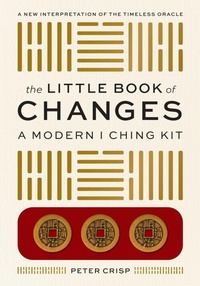
The Little Book of Changes
A Modern I Ching Kit
Will be published approx. on 12. November 2026
Book
Hardback
160 pages
979-8-88762-201-9 (ISBN)
Description
The Little Book of Changes is a contemporary translation of the ancient Chinese divination text the I Ching, among the oldest books in the world and a foundational text in Taoism, Confucianism, and Buddhism. Comprised of sixty-four hexagrams, readers may ask the book a question, toss three coins to determine the hexagram associated with its answer, and consult the book to find its ever-relevant insights. For centuries, users have delighted in its uncanny ability to respond with just the wisdom for the occasion. Peter Crisp's interpretation is poetic, approachable, and infinitely usable.
Crisp brings his over fifty years of experience with the text to this updated translation, reimagining the ancient text as a friendly and accessible modern oracle. With his insights on how to use the book, he invites readers to discover this time-tested and revelatory tool for navigating change and times of uncertainty. This beautiful edition includes three brass coins for casting so that readers have all they need to access the wisdom of the I Ching.
TIMELESS TOOL: The Little Book of Changes brings the timeless wisdom of the I Ching to readers today, providing insightful guidance and a meditative practice for spiritual growth and personal transformation.
INCLUDES COINS: With three brass divination coins for convenient use with the book, this kit provides everything you need to get started consulting the I Ching.
ACCESSIBLE TRANSLATION: While many translations of the I Ching can be cryptic and difficult for most readers to make sense of, Crisp's interpretation makes the text approachable for a modern seeker.
Crisp brings his over fifty years of experience with the text to this updated translation, reimagining the ancient text as a friendly and accessible modern oracle. With his insights on how to use the book, he invites readers to discover this time-tested and revelatory tool for navigating change and times of uncertainty. This beautiful edition includes three brass coins for casting so that readers have all they need to access the wisdom of the I Ching.
TIMELESS TOOL: The Little Book of Changes brings the timeless wisdom of the I Ching to readers today, providing insightful guidance and a meditative practice for spiritual growth and personal transformation.
INCLUDES COINS: With three brass divination coins for convenient use with the book, this kit provides everything you need to get started consulting the I Ching.
ACCESSIBLE TRANSLATION: While many translations of the I Ching can be cryptic and difficult for most readers to make sense of, Crisp's interpretation makes the text approachable for a modern seeker.
More details
Edition
No Edition
Language
English
Place of publication
United States
Publishing group
Insight Editions
Dimensions
Height: 210 mm
Width: 146 mm
Weight
301 gr
ISBN-13
979-8-88762-201-9 (9798887622019)
Copyright in bibliographic data and cover images is held by Nielsen Book Services Limited or by the publishers or by their respective licensors: all rights reserved.
Schweitzer Classification
Person
Dreamer, poet, lyricist, mystic, musician, and writer, Peter Crisp was born in South Africa. He was transported as a baby by ship to England, where he grew up on a free-range farm in East Anglia. Since leaving home at the age of sixteen, he has spent half his adult life on the West Coast of America and half in the UK. He considers himself to be, like Thomas Paine, "a citizen of the world." Having consulted the I Ching for more than forty years, he is still frequently surprised by its magical properties. Crisp currently resides on the dramatic Atlantic coast of North Cornwall, where he works under the banner of "Ghostwriter in the Sky." He is busy putting the finishing touches on The Adventures of the Rainbow Gypsies and The Halcyon Days of Peter White. These are true stories from the 1960s and early 1970s that are quite unbelievable. But "truth," as Lord Byron observed, "is always strange-stranger than fiction."