

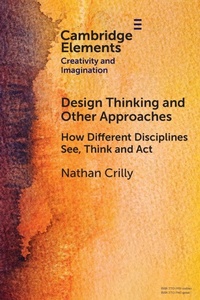
Design Thinking and Other Approaches
How Different Disciplines See, Think and Act
Published on 3. October 2024
Book
Paperback/Softback
100 pages
978-1-009-49866-1 (ISBN)
Description
Efforts to promote creativity often centre on encouraging people to engage in 'design thinking', 'systems thinking' and 'entrepreneurial thinking'. These different approaches are most often defined, taught and applied in mutual isolation, which has obscured what distinguishes them from each other, what they have in common and how they might be combined. These three approaches are also most often described in isolation from the approaches that characterize other disciplines, all of which are relevant to how problems are identified, framed and solved. These other approaches include 'computational thinking', 'engineering thinking', 'scientific thinking', 'evolutionary thinking', 'mathematical thinking', 'statistical thinking', 'geographical thinking', 'historical thinking', 'anthropological thinking' and many more. Examining these approaches as a set allows each of them to be better understood, and also reveals the connections and contrasts between them. Such comparisons provide the foundation for a more coordinated project to represent how different disciplinary approaches contribute to creative work.
More details
Series
Language
English
Place of publication
Cambridge
United Kingdom
Product notice
Paperback (trade)
Illustrations
Worked examples or Exercises
Dimensions
Height: 239 mm
Width: 150 mm
Thickness: 11 mm
Weight
484 gr
ISBN-13
978-1-009-49866-1 (9781009498661)
Copyright in bibliographic data and cover images is held by Nielsen Book Services Limited or by the publishers or by their respective licensors: all rights reserved.
Schweitzer Classification
Other editions
Additional editions
Book
10/2024
Cambridge University Press
€78.50
Shipment within 15-20 days
Person
Content
1. Considering disciplinary approaches; 2. Establishing terminology and scope; 3. Describing disciplinary approaches; 4. Collecting disciplinary approaches; 5. Reviewing components of disciplinary approaches; 6. Examining claims about disciplinary approaches; 7. Mapping disciplinary approaches to each other; 8. Reconsidering disciplinary approaches; References.