

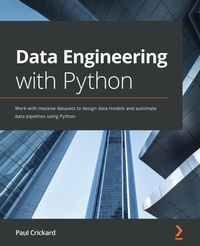
Data Engineering with Python
Work with massive datasets to design data models and automate data pipelines using Python
Published on 23. October 2020
Book
Paperback/Softback
356 pages
978-1-83921-418-9 (ISBN)
Description
Build, monitor, and manage real-time data pipelines to create data engineering infrastructure efficiently using open-source Apache projects
Key Features
Become well-versed in data architectures, data preparation, and data optimization skills with the help of practical examples
Design data models and learn how to extract, transform, and load (ETL) data using Python
Schedule, automate, and monitor complex data pipelines in production
Book DescriptionData engineering provides the foundation for data science and analytics, and forms an important part of all businesses. This book will help you to explore various tools and methods that are used for understanding the data engineering process using Python.
The book will show you how to tackle challenges commonly faced in different aspects of data engineering. You'll start with an introduction to the basics of data engineering, along with the technologies and frameworks required to build data pipelines to work with large datasets. You'll learn how to transform and clean data and perform analytics to get the most out of your data. As you advance, you'll discover how to work with big data of varying complexity and production databases, and build data pipelines. Using real-world examples, you'll build architectures on which you'll learn how to deploy data pipelines.
By the end of this Python book, you'll have gained a clear understanding of data modeling techniques, and will be able to confidently build data engineering pipelines for tracking data, running quality checks, and making necessary changes in production.What you will learn
Understand how data engineering supports data science workflows
Discover how to extract data from files and databases and then clean, transform, and enrich it
Configure processors for handling different file formats as well as both relational and NoSQL databases
Find out how to implement a data pipeline and dashboard to visualize results
Use staging and validation to check data before landing in the warehouse
Build real-time pipelines with staging areas that perform validation and handle failures
Get to grips with deploying pipelines in the production environment
Who this book is forThis book is for data analysts, ETL developers, and anyone looking to get started with or transition to the field of data engineering or refresh their knowledge of data engineering using Python. This book will also be useful for students planning to build a career in data engineering or IT professionals preparing for a transition. No previous knowledge of data engineering is required.
Key Features
Become well-versed in data architectures, data preparation, and data optimization skills with the help of practical examples
Design data models and learn how to extract, transform, and load (ETL) data using Python
Schedule, automate, and monitor complex data pipelines in production
Book DescriptionData engineering provides the foundation for data science and analytics, and forms an important part of all businesses. This book will help you to explore various tools and methods that are used for understanding the data engineering process using Python.
The book will show you how to tackle challenges commonly faced in different aspects of data engineering. You'll start with an introduction to the basics of data engineering, along with the technologies and frameworks required to build data pipelines to work with large datasets. You'll learn how to transform and clean data and perform analytics to get the most out of your data. As you advance, you'll discover how to work with big data of varying complexity and production databases, and build data pipelines. Using real-world examples, you'll build architectures on which you'll learn how to deploy data pipelines.
By the end of this Python book, you'll have gained a clear understanding of data modeling techniques, and will be able to confidently build data engineering pipelines for tracking data, running quality checks, and making necessary changes in production.What you will learn
Understand how data engineering supports data science workflows
Discover how to extract data from files and databases and then clean, transform, and enrich it
Configure processors for handling different file formats as well as both relational and NoSQL databases
Find out how to implement a data pipeline and dashboard to visualize results
Use staging and validation to check data before landing in the warehouse
Build real-time pipelines with staging areas that perform validation and handle failures
Get to grips with deploying pipelines in the production environment
Who this book is forThis book is for data analysts, ETL developers, and anyone looking to get started with or transition to the field of data engineering or refresh their knowledge of data engineering using Python. This book will also be useful for students planning to build a career in data engineering or IT professionals preparing for a transition. No previous knowledge of data engineering is required.
More details
Language
English
Place of publication
Birmingham
United Kingdom
Target group
Professional and scholarly
US School Grade: College Graduate Student
Dimensions
Height: 235 mm
Width: 191 mm
Thickness: 20 mm
Weight
665 gr
ISBN-13
978-1-83921-418-9 (9781839214189)
Copyright in bibliographic data and cover images is held by Nielsen Book Services Limited or by the publishers or by their respective licensors: all rights reserved.
Schweitzer Classification
Other editions
Additional editions
Paul Crickard
Data Engineering with Python
Work with massive datasets to design data models and automate data pipelines using Python
E-Book
09/2024
Packt Publishing
€25.49
Available for download
Person
Paul Crickard authored a book on the Leaflet JavaScript module. He has been programming for over 15 years and has focused on GIS and geospatial programming for 7 years. He spent 3 years working as a planner at an architecture firm, where he combined GIS with Building Information Modeling (BIM) and CAD. Currently, he is the CIO at the 2nd Judicial District Attorney's Office in New Mexico.
Content
Table of Contents
What is Data Engineering?
Building Our Data Engineering Infrastructure
Reading and Writing Files
Working with Databases
Cleaning, Transforming, and Enriching Data
Building a 311 Data Pipeline
Features of a Production Pipeline
Version Control Using the NiFi Registry
Monitoring and Logging Pipelines
Deploying Your Pipelines
Building a Production Data Pipeline
Building a Kafka Cluster
Streaming Data with Apache Kafka
Data Processing with Apache Spark
Real-Time Edge Data with MiNiFi, Kafka, and Spark
Appendix
What is Data Engineering?
Building Our Data Engineering Infrastructure
Reading and Writing Files
Working with Databases
Cleaning, Transforming, and Enriching Data
Building a 311 Data Pipeline
Features of a Production Pipeline
Version Control Using the NiFi Registry
Monitoring and Logging Pipelines
Deploying Your Pipelines
Building a Production Data Pipeline
Building a Kafka Cluster
Streaming Data with Apache Kafka
Data Processing with Apache Spark
Real-Time Edge Data with MiNiFi, Kafka, and Spark
Appendix