

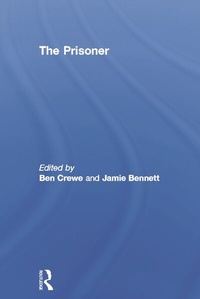
The Prisoner
Published on 16. November 2011
Book
Hardback
184 pages
978-0-415-66865-1 (ISBN)
Description
Little of what we know about prison comes from the mouths of prisoners, and very few academic accounts of prison life manage to convey some of its most profound and important features: its daily pressures and frustrations, the culture of the wings and landings, and the relationships which shape the everyday experience of being imprisoned.
The Prisoner aims to redress this by foregrounding prisoners' own accounts of prison life in what is an original and penetrating edited collection. Each of its chapters explores a particular prisoner sub-group or an important aspect of prisoners' lives, and each is divided into two sections: extended extracts from interviews with prisoners, followed by academic commentary and analysis written by a leading scholar or practitioner. This structure allows prisoners' voices to speak for themselves, while situating what they say in a wider discussion of research, policy and practice. The result is a rich and evocative portrayal of the lived reality of imprisonment and a poignant insight into prisoners' lives.
The book aims to bring to life key penological issues and to provide an accessible text for anyone interested in prisons, including students, practitioners and a general audience. It seeks to represent and humanize a group which is often silent in discussions of imprisonment, and to shine a light on a world which is generally hidden from view.
The Prisoner aims to redress this by foregrounding prisoners' own accounts of prison life in what is an original and penetrating edited collection. Each of its chapters explores a particular prisoner sub-group or an important aspect of prisoners' lives, and each is divided into two sections: extended extracts from interviews with prisoners, followed by academic commentary and analysis written by a leading scholar or practitioner. This structure allows prisoners' voices to speak for themselves, while situating what they say in a wider discussion of research, policy and practice. The result is a rich and evocative portrayal of the lived reality of imprisonment and a poignant insight into prisoners' lives.
The book aims to bring to life key penological issues and to provide an accessible text for anyone interested in prisons, including students, practitioners and a general audience. It seeks to represent and humanize a group which is often silent in discussions of imprisonment, and to shine a light on a world which is generally hidden from view.
Reviews / Votes
'The book throws light on the varied everyday experiences of people in prison, while confirming the huge challenges of minimizing the damage and dislocation of the carceral experience.''It is the right kind of introduction for those who know little about prison life, but probably even more useful for practitioners and academics more involved in prisons; it is all too easy for the latter to start thinking of themselves as semi-experts on imprisoned people, seeing patterns and commonalities where there may be none, all the while becoming more distanced from the worlds described here. The sources for the various interviews are not made clear, but they are well chosen to provide multi-layered insights.'-Hindpal Singh Bhui, Inspection Team Leader, HM Inspectorate of Prisons, in Probation Journal, vol 59 no 3
More details
Language
English
Place of publication
London
United Kingdom
Publishing group
Taylor & Francis Ltd
Target group
College/higher education
Illustrations
1 s/w Abbildung, 1 s/w Zeichnung
1 Line drawings, black and white; 1 Illustrations, black and white
Dimensions
Height: 234 mm
Width: 156 mm
Weight
680 gr
ISBN-13
978-0-415-66865-1 (9780415668651)
Copyright in bibliographic data and cover images is held by Nielsen Book Services Limited or by the publishers or by their respective licensors: all rights reserved.
Schweitzer Classification
Other editions
Additional editions
Ben Crewe | Jamie Bennett
The Prisoner
E-Book
03/2012
1st Edition
Routledge
€64.49
Available for download
Ben Crewe | Jamie Bennett
The Prisoner
E-Book
03/2012
1st Edition
Routledge
€64.49
Available for download
Persons
Ben Crewe is Deputy Director of the Prisons Research Centre at the Institute of Criminology, University of Cambridge. He has published on various aspects of prison life, including staff--prisoner relationships, the drugs economy within prison, the 'inmate code' and public--private sector comparisons. His most recent book, The Prisoner Society: Power, Adaptation and Social Life in an English Prison, was published in 2009.
Jamie Bennett has worked for 15 years as a prison manager and has held senior positions including Governor of HMP Morton Hall. He is also Editor of Prison Service Journal and has written widely on criminal justice matters including prison management, the media representation of prisons, and the relationship between crime and inequality. He has published two previous books: Understanding Prison Staff (with Ben Crewe and Azrini Wahidin 2008) and Dictionary of Prisons and Punishment (with Yvonne Jewkes 2008).
Jamie Bennett has worked for 15 years as a prison manager and has held senior positions including Governor of HMP Morton Hall. He is also Editor of Prison Service Journal and has written widely on criminal justice matters including prison management, the media representation of prisons, and the relationship between crime and inequality. He has published two previous books: Understanding Prison Staff (with Ben Crewe and Azrini Wahidin 2008) and Dictionary of Prisons and Punishment (with Yvonne Jewkes 2008).
Content
Foreword. Introduction 1. Prisoner Backgrounds and Biographies 2. Custody, Care and Staff-Prisoner Relationships 3. Prison Culture and the Prisoner Society 4. Identity and Adaptation in Prison 5. Prisoners and Their Families 6. Vulnerability, Struggling and Coping in Prison 7. Children and Young People in Custody 8. Ageing Prisoners 9. Women Prisoners 10. Cultural Diversity, Ethnicity and Race Relations in Prison 11. Rehabilitation, Generativity and Mutual Aid. Afterword