

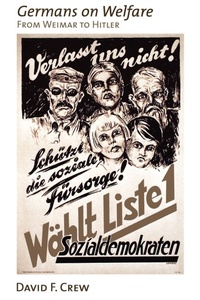
Germans on Welfare
From Weimar to Hitler
Published on 14. February 2002
Book
Paperback/Softback
304 pages
978-0-19-511878-0 (ISBN)
Description
The welfare state was one of the pillars of the Weimar Republic. The Weimar experiment in democracy depended to no small degree upon the welfare system's ability to give German citizens at least a fundamental level of material and mental security in the face of the new risks to which they had been exposed by the effects of the lost war, revolution, and inflation. But the problems of the postwar period meant that, even in its best years, the Weimar welfare state was dangerously overburdened. The onset of the Depression and the growth of mass unemployment after 1929 destroyed republican democracy and the welfare state upon which it was based. On the ruins of Weimars social republic, the Nazis built a murderous racial state.
Existing work on the Weimar welfare state concentrates largely on the discussions of social reformers, welfare experts, feminists, and the laws and institutions that their debates produced. Yet the Weimar welfare state was not simply the product of discourse and discursive struggles; it was also constructed and re-produced by the daily interactions of hard-pressed officials and impatient, often desperate clients. Adopting a "history of everyday life" perspective, Germans on Welfare: From Weimar to Hitler, 1919-1935 shows how welfare discourse and policy were translated into welfare practices by local officials and appropriated, contested, or re-negotiated by millions of welfare clients.
Existing work on the Weimar welfare state concentrates largely on the discussions of social reformers, welfare experts, feminists, and the laws and institutions that their debates produced. Yet the Weimar welfare state was not simply the product of discourse and discursive struggles; it was also constructed and re-produced by the daily interactions of hard-pressed officials and impatient, often desperate clients. Adopting a "history of everyday life" perspective, Germans on Welfare: From Weimar to Hitler, 1919-1935 shows how welfare discourse and policy were translated into welfare practices by local officials and appropriated, contested, or re-negotiated by millions of welfare clients.
Reviews / Votes
the latest and [one] of the most impressive contributions to the burgeoning field of the history of German social welfare. * Central European History * David Crew has produced an original and important contribution to the growing literature on welfare policy and politics in interwar Germany ... [His] rich reconstruction of individual experience shows the independence and agency of those dependent on the state, and it illustrates the complex relationship of political affiliation and welfare politics. * Journal of Modern History *More details
Language
English
Place of publication
New York
United States
Target group
Professional and scholarly
Product notice
Paperback (trade)
Dimensions
Height: 225 mm
Width: 165 mm
Thickness: 19 mm
Weight
408 gr
ISBN-13
978-0-19-511878-0 (9780195118780)
Copyright in bibliographic data and cover images is held by Nielsen Book Services Limited or by the publishers or by their respective licensors: all rights reserved.
Schweitzer Classification
Other editions
Additional editions
Book
05/1998
Oxford University Press Inc
€77.00
Shipment within 15-20 days
E-Book
04/1998
1st Edition
OUP USA
€26.49
Available for download