

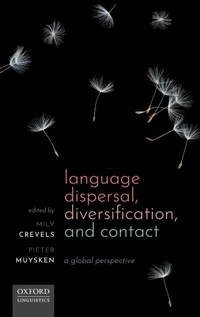
Language Dispersal, Diversification, and Contact
Published on 24. July 2020
Book
Hardback
378 pages
978-0-19-872381-3 (ISBN)
Description
This book addresses the complex question of how and why languages have spread across the globe: why do we find large language families distributed over a wide area in some regions, while elsewhere we find clusters of very small families or language isolates? What roles have agriculture, geography, climate, ethnic identity, and language ideologies played in language spread? In this volume, international experts in the field provide new answers to these and related questions, drawing on the increasingly large databases available and on novel analytical research techniques.
The first part of the volume outlines some general issues and approaches in the study of language dispersal, diversification, and contact. In the rest of the volume, chapters compare the language and population histories of three major regions - Island Southeast Asia/Oceania, Africa, and South America - which show particularly interesting contrasts in the distribution of languages and language families. The volume is interdisciplinary in approach, with insights from archaeology, genetics, anthropology, and geography, and will be of interest to a wide range of scholars interested in language diversity and contact.
The first part of the volume outlines some general issues and approaches in the study of language dispersal, diversification, and contact. In the rest of the volume, chapters compare the language and population histories of three major regions - Island Southeast Asia/Oceania, Africa, and South America - which show particularly interesting contrasts in the distribution of languages and language families. The volume is interdisciplinary in approach, with insights from archaeology, genetics, anthropology, and geography, and will be of interest to a wide range of scholars interested in language diversity and contact.
More details
Language
English
Place of publication
Oxford
United Kingdom
Target group
Professional and scholarly
Dimensions
Height: 240 mm
Width: 161 mm
Thickness: 25 mm
Weight
731 gr
ISBN-13
978-0-19-872381-3 (9780198723813)
Copyright in bibliographic data and cover images is held by Nielsen Book Services Limited or by the publishers or by their respective licensors: all rights reserved.
Schweitzer Classification
Other editions
Additional editions
Mily Crevels | Pieter Muysken
Language Dispersal, Diversification, and Contact
E-Book
07/2020
1st Edition
OUP eBook
€73.99
Available for download
Persons
Mily Crevels is Senior University Lecturer in Linguistics at Leiden University. Her main research interests are the indigenous languages of South America, especially in the Guapore-Mamore and Gran Chaco regions, language documentation, and linguistic typology. She is the co-founder and editor of the series 'Studies in the Indigenous Languages of the Americas' (Brill) and has edited multiple books on the native languages of South America
Pieter Muysken is Professor of Linguistics at Radboud University Nijmegen. His main research interests are Andean languages, Creole languages, and language contact, and his current work focuses on language contact and language history in South America. His books include Bilingual Speech: A Typology of Code-Mixing (CUP, 2000), The Languages of the Andes (with Willem Adelaar; CUP, 2004) and Functional Categories (CUP, 2008).
Mily Crevels and Pieter Muysken are the editors of the four-volume work Lenguas de Bolivia (Plural, 2009-2015) and of South American Indigenous Languages: Four Descriptive Studies (Brill, forthcoming).
Pieter Muysken is Professor of Linguistics at Radboud University Nijmegen. His main research interests are Andean languages, Creole languages, and language contact, and his current work focuses on language contact and language history in South America. His books include Bilingual Speech: A Typology of Code-Mixing (CUP, 2000), The Languages of the Andes (with Willem Adelaar; CUP, 2004) and Functional Categories (CUP, 2008).
Mily Crevels and Pieter Muysken are the editors of the four-volume work Lenguas de Bolivia (Plural, 2009-2015) and of South American Indigenous Languages: Four Descriptive Studies (Brill, forthcoming).
Content
1: Mily Crevels and Pieter Muysken: Patterns of diversification and contact: Re-examining dispersal hypotheses
Part I: General approaches
2: Johanna Nichols: Dispersal patterns shape areal typology
3: Peter Trudgill: Sociolinguistic typology and the uniformitarian hypothesis
4: Tom Gueldemann and Harald Hammarstroem: Geographical axis effects in large-scale linguistic distributions
5: Balthasar Bickel: Large and ancient linguistic areas
Part II: Southeast Asia and Oceania
6: Marian Klamer, Mily Crevels, and Pieter Muysken: Patterns of dispersal and diversification in Island Southeast Asia and Oceania
7: Nicholas Evans: Time, diversification, and dispersal on the Australian continent: Three enigmas of linguistic prehistory
8: William A. Foley: Language diversity, geomorphological change, and population movements in the Sepik-Ramu basin of Papua New Guinea
9: Jean-Christophe Galipaud: The dynamics of human expansion and cultural diversification in Southeast Asia and Oceania during the Neolithic: An archaeological perspective
10: Mark Donohue and Tim Denham: The role of contact and language shift in the spread of Austronesian languages across Island Southeast Asia
Part III: Africa
11: Gerrit J. Dimmendaal, Mily Crevels, and Pieter Muysken: Patterns of dispersal and diversification in Africa
12: Gerrit J. Dimmendaal: Language diversification and contact in Africa
13: Koen Bostoen: The Bantu expansion: Some facts and fiction
14: Maarten Mous: Language isolates and the spread of pastoralism in East Africa
Part IV: South America
15: Pieter Muysken and Mily Crevels: Patterns of dispersal and diversification in South America
16: Patience Epps: Amazonian linguistic diversity and its sociocultural correlates
17: Robert S. Walker: Cultural phylogenetics in lowland South America
Part I: General approaches
2: Johanna Nichols: Dispersal patterns shape areal typology
3: Peter Trudgill: Sociolinguistic typology and the uniformitarian hypothesis
4: Tom Gueldemann and Harald Hammarstroem: Geographical axis effects in large-scale linguistic distributions
5: Balthasar Bickel: Large and ancient linguistic areas
Part II: Southeast Asia and Oceania
6: Marian Klamer, Mily Crevels, and Pieter Muysken: Patterns of dispersal and diversification in Island Southeast Asia and Oceania
7: Nicholas Evans: Time, diversification, and dispersal on the Australian continent: Three enigmas of linguistic prehistory
8: William A. Foley: Language diversity, geomorphological change, and population movements in the Sepik-Ramu basin of Papua New Guinea
9: Jean-Christophe Galipaud: The dynamics of human expansion and cultural diversification in Southeast Asia and Oceania during the Neolithic: An archaeological perspective
10: Mark Donohue and Tim Denham: The role of contact and language shift in the spread of Austronesian languages across Island Southeast Asia
Part III: Africa
11: Gerrit J. Dimmendaal, Mily Crevels, and Pieter Muysken: Patterns of dispersal and diversification in Africa
12: Gerrit J. Dimmendaal: Language diversification and contact in Africa
13: Koen Bostoen: The Bantu expansion: Some facts and fiction
14: Maarten Mous: Language isolates and the spread of pastoralism in East Africa
Part IV: South America
15: Pieter Muysken and Mily Crevels: Patterns of dispersal and diversification in South America
16: Patience Epps: Amazonian linguistic diversity and its sociocultural correlates
17: Robert S. Walker: Cultural phylogenetics in lowland South America