

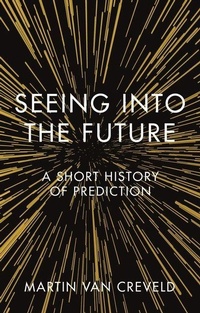
Seeing into the Future
A Short History of Prediction
Published on 10. August 2020
Book
Hardback
296 pages
978-1-78914-229-7 (ISBN)
Description
If there is anything that distinguishes us from animals, it is our ability to understand that such a thing as the future exists and our willingness to try and look into it.
But how have people through the ages gone about making predictions? What were their underlying assumptions, and what methods did they use? Have increased computer power and the newest algorithms improved our success in anticipating the future, or are we still only as good (or as bad) at it as our ancestors?
From the ancients watching the flight of birds to the murky activities of Google and Facebook today, Seeing into the Future gives us an insight into the past, present and future of prediction.
But how have people through the ages gone about making predictions? What were their underlying assumptions, and what methods did they use? Have increased computer power and the newest algorithms improved our success in anticipating the future, or are we still only as good (or as bad) at it as our ancestors?
From the ancients watching the flight of birds to the murky activities of Google and Facebook today, Seeing into the Future gives us an insight into the past, present and future of prediction.
Reviews / Votes
What will the weather be like tomorrow, next week, next year? Will there be another war, famine, global pandemic? Will the stock market rise or fall? In Seeing into the Future, military historian and theorist Martin van Creveld provides an overview of some of the myriad methods humans have devised over the millennia to foretell what is to come, from the ancients' use of prophecy and astrology to today's mathematical algorithms. In addition to delving into when, where, why, and how those techniques originated, he discusses such questions as why prediction is so difficult, whether modern humans are any better at making predictions than our ancestors were, and whether knowing the future is a good thing. * Physics Today * Creveld covers a broad range, from tribal shamans to Greek sibyls, Israeli prophets, the Prophet Muhammed, Hildegard of Bingen, Nostradamus, and contemporary mediums. In addition, Creveld describes such systematic approaches to prediction as omens, numerology, and the Bible and looks at the contemporary use of mathematical models, artificial intelligence, war games, algorithms, and the Delphi method, which solicits predictions from a number of people, all using their preferred methods for assessing the future . . . Recommended. * Choice * Martin Creveld's new book, Seeing into the Future, examines the principal methods that have been used for looking into the future throughout history . . . Creveld's original emphasis on the historical methods of prediction enriches previous scholarship. The book explores a number of predictive methods prevailing over time: speculation, deduction, extrapolation, polling, and modelling . . . Creveld's historical overview could have modified Abraham Lincoln's aphorism: the best way to predict your future is to engineer it. * Technology and Culture Journal * Van Creveld summarises this book by considering just how accurate these models can be, and indeed how accurate they should be. Any real ability to foresee the future is, he suggests, likely to be just as dangerous as past rulers thought they would be when they sentenced prophets and mystics to the flames or the axe! . . . This is an interesting book on a topic which we have all pondered at some time, and provides a great deal of food for thought. * Magonia Review of Books * Martin van Creveld's Seeing into the Future is a widely informed and deeply thoughtful examination of a critical area of human concern. Anyone seeking insight into the futurology and forecasting, with its manifold involvements in religion, sociology, science, and practical affairs will profit from this instructive and insightful work. * Dr Nicholas Rescher, Distinguished Professor of Philosophy, University of Pittsburgh *More details
Language
English
Place of publication
London
United Kingdom
Dimensions
Height: 223 mm
Width: 146 mm
Thickness: 35 mm
Weight
492 gr
ISBN-13
978-1-78914-229-7 (9781789142297)
Copyright in bibliographic data and cover images is held by Nielsen Book Services Limited or by the publishers or by their respective licensors: all rights reserved.
Schweitzer Classification
Other editions
Additional editions
E-Book
08/2020
Reaktion Books
€17.49
Available for download
Person
Martin van Creveld is Professor Emeritus at the Hebrew University, Jerusalem, and the author of many books including Conscience: A Biography (Reaktion, 2015), Wargames: From Gladiators to Gigabytes (2013) and The Privileged Sex (2013).
Content
Part I: A Mysterious Journey
1 A Villain of a Magician
2 In the Name of the Lord
3 Oracles, Pythias and Sibyls
4 A Dream to Remember
5 Consulting the Dead
Part II: Be Sober and Reasonable
6 Searching the Heavens
7 Clear and Manifest
8 On Birds, Livers and Sacrifices
9 The Magic of Numbers
10 Decoding the Bible
Part III: Enter Modernity
11 From Patterns to Cycles
12 With Hegel on the Brain
13 Ask, and You'll Be Answered
14 The Most Powerful Tools
15 War Games Here, War Games There
Part IV: The Lord of the Universe
16 Looking Backward
17 Why is Prediction So Difficult?
18 Is Our Game Improving?
19 A World Without Uncertainty?
References
Further Reading
Acknowledgements
1 A Villain of a Magician
2 In the Name of the Lord
3 Oracles, Pythias and Sibyls
4 A Dream to Remember
5 Consulting the Dead
Part II: Be Sober and Reasonable
6 Searching the Heavens
7 Clear and Manifest
8 On Birds, Livers and Sacrifices
9 The Magic of Numbers
10 Decoding the Bible
Part III: Enter Modernity
11 From Patterns to Cycles
12 With Hegel on the Brain
13 Ask, and You'll Be Answered
14 The Most Powerful Tools
15 War Games Here, War Games There
Part IV: The Lord of the Universe
16 Looking Backward
17 Why is Prediction So Difficult?
18 Is Our Game Improving?
19 A World Without Uncertainty?
References
Further Reading
Acknowledgements