

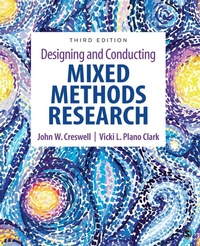
Designing and Conducting Mixed Methods Research
3rd Edition
Published on 22. September 2017
Book
Paperback/Softback
520 pages
978-1-4833-4437-9 (ISBN)
Description
Combining the latest thinking in the field with practical, step-by-step guidance, the Third Edition of John W. Creswell and Vicki L. Plano Clark's Designing and Conducting Mixed Methods Research now covers seven mixed methods designs with accompanying journal articles illustrating each design. The authors walk readers through the entire research process, and present updated examples from published mixed methods studies drawn from multiple disciplines. In addition, this new edition includes information about the dynamic and evolving nature of the field of mixed methods research, four additional methodological approaches, and coverage of new directions in mixed methods.
Reviews / Votes
"The go-to text for mixed methods research." -- Regardt Ferreira "Creswell and Plano Clark have captured recent changes within mixed methods research, and these are reflected in this dynamic, salient book!" -- Susan Sweat Gunby "An excellent guide for the design and conduct of mixed methods research!" -- Mansoo Yu "Readers of the book will understand the expanding breadth of multiple methods, the value of complex methods for sophisticated analysis of problems, and how to use and evaluate mixed methods in research." -- Joseph Drew "This updated edition provides thoughtful consideration to how the field of mixed methods research has changed, including how the authors' own definitions and typologies have refined. It also provides a discussion of a diverse array of empirical studies from prominent and emerging mixed methods scholars, highlighting the strength and potential of this field for social and behavioral sciences." -- Peggy Shannon-Baker "Creswell and Plano Clark do excellent work in showing the evolution of mixed-methods research. One of the highlights of this edition is the addition of scaffolds that guide writing sections of a mixed-methods study." -- Senay Purzer "Narrowing down the research methods to three primary types and then providing application methods and basic step-by-step instructions, along with great resources in the appendix and outside contributions, makes this a must have book in any academic study leading to research development." -- Natalie EllisMore details
Edition
3rd Revised edition
Language
English
Place of publication
Thousand Oaks
United States
Target group
College/higher education
Edition type
Revised edition
Dimensions
Height: 235 mm
Width: 191 mm
Thickness: 29 mm
Weight
964 gr
ISBN-13
978-1-4833-4437-9 (9781483344379)
Copyright in bibliographic data and cover images is held by Nielsen Book Services Limited or by the publishers or by their respective licensors: all rights reserved.
Schweitzer Classification
Other editions
Previous edition
John W. Creswell | Vicki L. Plano Clark
Designing and Conducting Mixed Methods Research
Book
08/2010
2nd Edition
SAGE Publications Inc
€99.23
Article exhausted; check for reprint
Persons
John W. Creswell, PhD, is a professor of family medicine and co-director of the Michigan Mixed Methods Research and Scholarship Program at the University of Michigan. He has authored numerous articles and 28 books on mixed methods research, qualitative research, and research design. While at the University of Nebraska-Lincoln, he held the Clifton Endowed Professor Chair, served as director of a mixed methods research office, founded SAGE's Journal of Mixed Methods Research, and was an adjunct professor of family medicine at the University of Michigan and a consultant to the Veterans Administration health services research center. He was a Senior Fulbright Scholar to South Africa in 2008 and to Thailand in 2012. In 2011, he co-led a national working group on mixed methods practices at the National Institutes of Health, served as a visiting professor at Harvard's School of Public Health, and received an honorary doctorate from the University of Pretoria, South Africa. In 2014, he was the president of the Mixed Methods International Research Association. In 2015, he joined the staff of Family Medicine at the University of Michigan. John has been teaching research methods courses for the past 40 years..
Vicki L. Plano Clark, Ph.D., is an associate professor in the Quantitative and Mixed Methods Research Methodologies area of the University of Cincinnati's School of Education. Her methodological scholarship aims to delineate useful designs for conducting mixed methods research, examine procedural issues associated with achieving meaningful integration within these designs, and consider larger questions about the personal, interpersonal, and social contexts for the adoption and use of mixed methods. She recently coauthored the book Mixed Methods Research: A Guide to the Field (2016; SAGE) with Nataliya V. Ivankova and has coauthored several books with John W. Creswell, including The Mixed Methods Reader (2008; SAGE) and Understanding Research: A Consumer's Guide (2010, 2015; Pearson Education). She is a founding coeditor of the Mixed Methods Research Series (SAGE Publishing). She also currently serves as an associate editor for the Journal of Mixed Methods Research (JMMR) and Program Chair for the Mixed Methods Research Special Interest Group of the American Educational Research Association. In 2011, she co-led the development of Best Practices for Mixed Methods in the Health Sciences for the National Institutes of Health Office of Behavioral and Social Sciences Research. Her teaching focuses on foundations of research methodologies and mixed methods research, including a two-semester mixed methods sequence and special topics courses. She also engages in research and evaluation projects on a wide array of topics such as the management of cancer pain, researchers' development of visual displays, the effectiveness of school reform initiatives, the quality of communication between attorneys and their clients, and the development of innovative curricular materials for undergraduate physics.
Vicki L. Plano Clark, Ph.D., is an associate professor in the Quantitative and Mixed Methods Research Methodologies area of the University of Cincinnati's School of Education. Her methodological scholarship aims to delineate useful designs for conducting mixed methods research, examine procedural issues associated with achieving meaningful integration within these designs, and consider larger questions about the personal, interpersonal, and social contexts for the adoption and use of mixed methods. She recently coauthored the book Mixed Methods Research: A Guide to the Field (2016; SAGE) with Nataliya V. Ivankova and has coauthored several books with John W. Creswell, including The Mixed Methods Reader (2008; SAGE) and Understanding Research: A Consumer's Guide (2010, 2015; Pearson Education). She is a founding coeditor of the Mixed Methods Research Series (SAGE Publishing). She also currently serves as an associate editor for the Journal of Mixed Methods Research (JMMR) and Program Chair for the Mixed Methods Research Special Interest Group of the American Educational Research Association. In 2011, she co-led the development of Best Practices for Mixed Methods in the Health Sciences for the National Institutes of Health Office of Behavioral and Social Sciences Research. Her teaching focuses on foundations of research methodologies and mixed methods research, including a two-semester mixed methods sequence and special topics courses. She also engages in research and evaluation projects on a wide array of topics such as the management of cancer pain, researchers' development of visual displays, the effectiveness of school reform initiatives, the quality of communication between attorneys and their clients, and the development of innovative curricular materials for undergraduate physics.
Content
List of Figures
List of Tables
Preface
Purpose of the Book
Audience for the Book
Book Features
New Features Added to the Third Edition
Acknowledgments
About the Authors
Chapter 1 * The Nature of Mixed Methods Research
Defining Mixed Methods Research
Examples of Mixed Methods Studies
What Research Problems Require Mixed Methods?
What Are the Advantages of Using Mixed Methods?
What Are the Challenges in Using Mixed Methods?
Summary
Activities
Additional Resources to Examine
Chapter 2 * The Foundations of Mixed Methods Research
Historical Foundations
Philosophical Foundations
Theoretical Foundations
Summary
Activities
Additional Resources to Examine
Chapter 3 * Core Mixed Methods Designs
Key Concepts That Inform Mixed Methods Designs
The Three Core Mixed Methods Designs
Additional Considerations in Choosing a Core Design
Describing a Design in a Written Report
Summary
Activities
Additional Resources to Examine
Chapter 4 * Complex Applications of Core Mixed Methods Designs
Intersecting Core Mixed Methods Designs With Other Research Approaches or Frameworks
Four Prominent Types of Complex Mixed Methods Designs
Drawing Diagrams of Complex Applications
Summary
Activities
Additional Resources to Examine
Chapter 5 * Introducing a Mixed Methods Study
Writing a Mixed Methods Title
Stating the Research Problem in the Introduction
Developing the Purpose Statement
Writing Research Questions and Hypotheses
Summary
Activities
Additional Resources to Examine
Chapter 6 * Collecting Data in Mixed Methods Research
Procedures in Collecting Qualitative and Quantitative Data
General Considerations for Data Collection in Mixed Methods
Data Collection Within the Mixed Methods Designs
Summary
Activities
Additional Resources to Examine
Chapter 7 * Analyzing and Interpreting Data in Mixed Methods Research
Procedures in Quantitative and Qualitative Data Analysis and Interpretation
Mixed Methods Data Analysis and Interpretation
Integrated Data Analysis and Interpretation Within the Mixed Methods Designs
Validity and Mixed Methods Designs
Software Applications and Mixed Methods Data Analysis
Summary
Activities
Additional Resources to Examine
Chapter 8 * Writing and Evaluating Mixed Methods Research
General Guidelines for Writing
Relate the Mixed Methods Structure to the Type of Writing
Evaluating a Mixed Methods Study
Summary
Activities
Additional Resources to Examine
Chapter 9 * Advances in Mixed Methods Research
Advances in Mining Data
Advances in the Insight Gained Through the Value of Mixed Methods Research
Advances in Mixed Methods Designs
Advances in Representations of Design Procedures
Advances in Integration
Advances in Creating Mixed Methods Questions and Study Aims
Advances in Representing Integration Through Joint Displays
Advances in Mixed Methods Validity
Advances in Understanding Skills Required for Mixed Methods
Advances in Publishing Mixed Methods Manuscripts
Summary
Activities
Additional Resources to Examine
Appendix A: Unwritten Rules of Talking to Doctors About Depression: Integrating Qualitative and Quantitative Methods
Appendix B: Students' Persistence in a Distributed Doctoral Program in Educational Leadership in Higher Education: A Mixed Methods Study
Appendix C: The Development of Client Violence Questionnaire (CVQ)
Appendix D: Evaluation of the Effectiveness of Robotic Gait Training and Gait-Focused Physical Therapy Programs for Children and Youth With Cerebral Palsy: A Mixed Methods RCT
Appendix E: Reconciling Data From Different Sources: Practical Realities of Using Mixed Methods to Identify Effective High School Practices
Appendix F: Understanding Transitions in Care From Hospital to Homeless Shelter: A Mixed-Methods, Community-Based Participatory Approach
Appendix G: Mixed Methods in Intervention Research: Theory to Adaptation
Glossary
References
Index
List of Tables
Preface
Purpose of the Book
Audience for the Book
Book Features
New Features Added to the Third Edition
Acknowledgments
About the Authors
Chapter 1 * The Nature of Mixed Methods Research
Defining Mixed Methods Research
Examples of Mixed Methods Studies
What Research Problems Require Mixed Methods?
What Are the Advantages of Using Mixed Methods?
What Are the Challenges in Using Mixed Methods?
Summary
Activities
Additional Resources to Examine
Chapter 2 * The Foundations of Mixed Methods Research
Historical Foundations
Philosophical Foundations
Theoretical Foundations
Summary
Activities
Additional Resources to Examine
Chapter 3 * Core Mixed Methods Designs
Key Concepts That Inform Mixed Methods Designs
The Three Core Mixed Methods Designs
Additional Considerations in Choosing a Core Design
Describing a Design in a Written Report
Summary
Activities
Additional Resources to Examine
Chapter 4 * Complex Applications of Core Mixed Methods Designs
Intersecting Core Mixed Methods Designs With Other Research Approaches or Frameworks
Four Prominent Types of Complex Mixed Methods Designs
Drawing Diagrams of Complex Applications
Summary
Activities
Additional Resources to Examine
Chapter 5 * Introducing a Mixed Methods Study
Writing a Mixed Methods Title
Stating the Research Problem in the Introduction
Developing the Purpose Statement
Writing Research Questions and Hypotheses
Summary
Activities
Additional Resources to Examine
Chapter 6 * Collecting Data in Mixed Methods Research
Procedures in Collecting Qualitative and Quantitative Data
General Considerations for Data Collection in Mixed Methods
Data Collection Within the Mixed Methods Designs
Summary
Activities
Additional Resources to Examine
Chapter 7 * Analyzing and Interpreting Data in Mixed Methods Research
Procedures in Quantitative and Qualitative Data Analysis and Interpretation
Mixed Methods Data Analysis and Interpretation
Integrated Data Analysis and Interpretation Within the Mixed Methods Designs
Validity and Mixed Methods Designs
Software Applications and Mixed Methods Data Analysis
Summary
Activities
Additional Resources to Examine
Chapter 8 * Writing and Evaluating Mixed Methods Research
General Guidelines for Writing
Relate the Mixed Methods Structure to the Type of Writing
Evaluating a Mixed Methods Study
Summary
Activities
Additional Resources to Examine
Chapter 9 * Advances in Mixed Methods Research
Advances in Mining Data
Advances in the Insight Gained Through the Value of Mixed Methods Research
Advances in Mixed Methods Designs
Advances in Representations of Design Procedures
Advances in Integration
Advances in Creating Mixed Methods Questions and Study Aims
Advances in Representing Integration Through Joint Displays
Advances in Mixed Methods Validity
Advances in Understanding Skills Required for Mixed Methods
Advances in Publishing Mixed Methods Manuscripts
Summary
Activities
Additional Resources to Examine
Appendix A: Unwritten Rules of Talking to Doctors About Depression: Integrating Qualitative and Quantitative Methods
Appendix B: Students' Persistence in a Distributed Doctoral Program in Educational Leadership in Higher Education: A Mixed Methods Study
Appendix C: The Development of Client Violence Questionnaire (CVQ)
Appendix D: Evaluation of the Effectiveness of Robotic Gait Training and Gait-Focused Physical Therapy Programs for Children and Youth With Cerebral Palsy: A Mixed Methods RCT
Appendix E: Reconciling Data From Different Sources: Practical Realities of Using Mixed Methods to Identify Effective High School Practices
Appendix F: Understanding Transitions in Care From Hospital to Homeless Shelter: A Mixed-Methods, Community-Based Participatory Approach
Appendix G: Mixed Methods in Intervention Research: Theory to Adaptation
Glossary
References
Index