

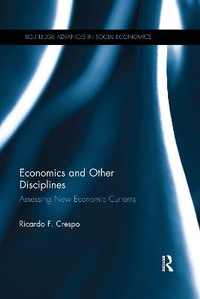
Economics and Other Disciplines
Assessing New Economic Currents
1st Edition
Published on 30. September 2020
Book
Paperback/Softback
172 pages
978-0-367-66781-8 (ISBN)
Description
During the second half of the twentieth century, economics exported its logic - utility maximization - to the analysis of several human activities or realities: a tendency that has been called "economic imperialism". This book explores the concept termed by John Davis as "reverse imperialism", whereby economics has been seen in recent years to have taken in elements from other disciplines.
Economics and Other Disciplines sheds light on the current state and possible future development of economics by focusing on it from a philosophical perspective, broadening the concept of rationality in economic theory. The beliefs that prevail in the world today make up a physicalist worldview. This book argues that this pervasive view is harmful for economics as a social science. Do new economic currents like behavioral economics, evolutionary economics, neuroeconomics, institutional economics, happiness economics, the capability approach and civil economy, escape this widespread mentality? What would be an adequate underlying economic ethos? Do these approaches fit into this ethos?
Ricardo F. Crespo appraises the contributions from a classical philosophy angle, emphasizing their implications regarding practical reason. This volume is of great importance to those who are interested in political economy, economic theory and philosophy, as well as philosophy of social science.
Economics and Other Disciplines sheds light on the current state and possible future development of economics by focusing on it from a philosophical perspective, broadening the concept of rationality in economic theory. The beliefs that prevail in the world today make up a physicalist worldview. This book argues that this pervasive view is harmful for economics as a social science. Do new economic currents like behavioral economics, evolutionary economics, neuroeconomics, institutional economics, happiness economics, the capability approach and civil economy, escape this widespread mentality? What would be an adequate underlying economic ethos? Do these approaches fit into this ethos?
Ricardo F. Crespo appraises the contributions from a classical philosophy angle, emphasizing their implications regarding practical reason. This volume is of great importance to those who are interested in political economy, economic theory and philosophy, as well as philosophy of social science.
More details
Series
Language
English
Place of publication
London
United Kingdom
Publishing group
Taylor & Francis Ltd
Target group
College/higher education
Postgraduate and Undergraduate
Dimensions
Height: 234 mm
Width: 156 mm
Weight
340 gr
ISBN-13
978-0-367-66781-8 (9780367667818)
Copyright in bibliographic data and cover images is held by Nielsen Book Services Limited or by the publishers or by their respective licensors: all rights reserved.
Schweitzer Classification
Other editions
Additional editions
Book
05/2017
1st Edition
Routledge
€215.41
Shipment within 10-20 days
E-Book
05/2017
Routledge
€59.49
Available for download
E-Book
05/2017
Routledge
€59.49
Available for download
Person
Ricardo F. Crespo is a Professor of Philosophy of Economics in IAE (Universidad Austral) and in Universidad Nacional de Cuyo, Argentina. He is a researcher at the National Council of Scientific Research (CONICET, Argentina) and has published extensively in his field.
Content
1 Introductory overview
2 The theoretical and metaphysical foundations of sciences
The metaphysical worldview
Physicalism, materialism and naturalism
Practical and instrumental reason
The evolution of economics
Conclusion
3 Economics and psychology
Herbert Simon and 'Bounded Rationality'
The 'Ecological Rationality' or 'Frugal Heuristics' approach
Modern Behavioral Economics (MBE)
Libertarian Paternalism
Conclusion
4 Evolutionary economics
Richard Nelson on 'Universal Darwinism'
Geoffrey Hodgson on 'Universal Darwinism'
Ulrich Witt, evolution and Darwinism
Conclusion: Evolutionary economics and practical reason
5 Neuroeconomics
The metaphysics of neurosciences
Types of physicalism and dualism
Looking for alternative explanations for non-physicalists
The metaphysics of neuroeconomics
Conclusion
6 Happiness economics
Happiness and economics
Different concepts of happiness
Flourish, calling and flow
Measuring flourishing
Conclusion
7 Institutional economics
Economics and institutions
Agency, habits and institutions in light of classical practical reason
Thorstein Veblen
Contemporary economic theories of institutions
Rule Theory
Equilibrium Theory
Constitutive Rules Theory
Conclusion
8 The Capability Approach
Introducing the Capability Approach
Some problems in Sen's CA
Identification of valuable capabilities: the debate over lists of capabilities
Heterogeneity and incommensurability
Conclusion
9 Civil Economy
Historical and intellectual roots of Civil Economy: from Aristotle to Genovesi and Dragonetti
From Aristotle to nowadays
Conclusion
10 Conclusion
2 The theoretical and metaphysical foundations of sciences
The metaphysical worldview
Physicalism, materialism and naturalism
Practical and instrumental reason
The evolution of economics
Conclusion
3 Economics and psychology
Herbert Simon and 'Bounded Rationality'
The 'Ecological Rationality' or 'Frugal Heuristics' approach
Modern Behavioral Economics (MBE)
Libertarian Paternalism
Conclusion
4 Evolutionary economics
Richard Nelson on 'Universal Darwinism'
Geoffrey Hodgson on 'Universal Darwinism'
Ulrich Witt, evolution and Darwinism
Conclusion: Evolutionary economics and practical reason
5 Neuroeconomics
The metaphysics of neurosciences
Types of physicalism and dualism
Looking for alternative explanations for non-physicalists
The metaphysics of neuroeconomics
Conclusion
6 Happiness economics
Happiness and economics
Different concepts of happiness
Flourish, calling and flow
Measuring flourishing
Conclusion
7 Institutional economics
Economics and institutions
Agency, habits and institutions in light of classical practical reason
Thorstein Veblen
Contemporary economic theories of institutions
Rule Theory
Equilibrium Theory
Constitutive Rules Theory
Conclusion
8 The Capability Approach
Introducing the Capability Approach
Some problems in Sen's CA
Identification of valuable capabilities: the debate over lists of capabilities
Heterogeneity and incommensurability
Conclusion
9 Civil Economy
Historical and intellectual roots of Civil Economy: from Aristotle to Genovesi and Dragonetti
From Aristotle to nowadays
Conclusion
10 Conclusion