

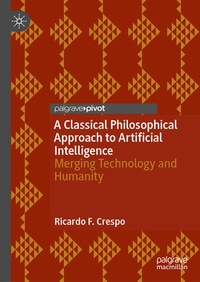
A Classical Philosophical Approach to Artificial Intelligence
Description
This book sheds philosophical light on the current and future scope of artificall inteligence. Artifical intelligence (AI) I is becoming increasingly relevant in today's world. However, 'AI' is a very generic label that encompasses a multitude of realities and fuels very dissimilar reactions. Some share a positive view on it, stressing the important services provided by its applications to everyday life and in specific fields. Others grimly focus on possible biases of AI utilization outcomes and damaging consequence, and there are even apocalyptic visions of the terrible future impact of AI developments (Artificial General Intelligence - AGI) on humanity.
Ricardo Crespo uses a classical philosophical approach to look at the nature of technology and of AI, including the ontology of AI and its potential abilities to think and act freely. This analysis reveals some of the current and upcoming perils of AI, calling for an appraisal of its actual pros and cons to determine the position and actions that should be adopted in its regard. Classical philosophical notions of metaphysics, epistemology, anthropology and ethics come in handy to gain a better understanding of this technological breakthrough. This approach challenges the notion that AI will eventually share human traits in the future. On the flip side, it will highlight the useful contributions that AI provides and will provide in the years to come.
Reviews / Votes
"This book provides a very pluralistic and balanced view of the current debates about AI. It also demonstrates how classical philosophy can shed light on them. It is extremely clear and informative." (Alfredo Marcos, University of Valladolid, Spain)
"I found in this book an impressive intersection between Aristotelian philosophy and Artificial Intelligence. The author also mentions that, in economics, questions have been raised about why we should
build multidisciplinary
paths
between Aristotle and economics. However, moving toward interdisciplinary fields and crossing previously unimagined barriers is a great way to
generate truly original ideas
. Regarding the chapters, I felt particularly connected with Chapter 5:
'Do AI Really Think?'
and I found a rigorous explanation of deduction, induction (possible for artificial neural networks-ANNs), and abduction (not possible for ANNs). It was also very interested to reflect on Chapter 8:
'Moral Machines?'
where the author incorporates an incompatibilist point of view on these issues-whether AI has free will or not. Apparently, it does not, but it certainly has moral implications. A book not to miss." (Mariana Olezza, University of Buenos Aires, Argentina)
"A lucid philosophical exploration of artificial intelligence through Aristotelian thought. It examines AI as a human artefact that must be shaped by responsibility, and ethics." (Jaime Nubiola, University of Navarra, Spain)
More details
Other editions
Additional editions
Person
Ricardo F. Crespo is Professor of Philosophy of Economics at IAE Business School, Universidad Austral, and Researcher at Argentina's National Scientific and Technical Research Council (CONICET). His latest book, The Nature of the Economy-Essays on the Philosophy and Epistemology of Economics, was published by Palgrave in 2022.
Content
Ch 1: Introduction.- Ch 2: Technics and Technology.- Ch 3: AI Definitions and Key Milestones.- Ch 4: The Ontology of AI.- Ch 5: Does AI Really Think?.- Ch 6: The Impact of AI on our Identity, Society, Culture, Economy, and Politics.- Ch 7: Remedies.- Ch 8: 'Moral Machines'?.- Ch 9: Strengthening the Remedies.- Ch 10: Conclusion.