

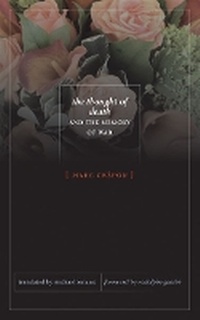
The Thought of Death and the Memory of War
Published on 10. October 2013
Book
Hardback
184 pages
978-0-8166-8005-4 (ISBN)
Description
War lays bare death and our relation to it. And in the wars-or more precisely the memories of war-of the twentieth century, images of the deaths of countless faceless or nameless others eclipse the singularity of each victim's death as well as the end of the world as such that each death signifies.
Marc Crepon's The Thought of Death and the Memory of War is a call to resist such images in which death is no longer actual death since it happens to anonymous others, and to seek instead a world in which mourning the other whose mortality we always already share points us toward a cosmopolitics. Crepon pursues this path toward a cosmopolitics of mourning through readings of works by Freud, Heidegger, Sartre, Patocka, Levinas, Derrida, and Ricoeur, and others. The movement among these writers, Crepon shows, marks a way through-and against-twentieth-century interpretation to argue that no war, genocide, or neglect of people is possible without suspending how one relates to the death of another human being.
A history of a critical strain in contemporary thought, this book is, as Rodolphe Gasche says in the Foreword, "a profound meditation on what constitutes evil and a rigorous and illuminating reflection on death, community, and world."
The translation of this work received financial support from the French Ministry of Foreign Affairs.
Marc Crepon's The Thought of Death and the Memory of War is a call to resist such images in which death is no longer actual death since it happens to anonymous others, and to seek instead a world in which mourning the other whose mortality we always already share points us toward a cosmopolitics. Crepon pursues this path toward a cosmopolitics of mourning through readings of works by Freud, Heidegger, Sartre, Patocka, Levinas, Derrida, and Ricoeur, and others. The movement among these writers, Crepon shows, marks a way through-and against-twentieth-century interpretation to argue that no war, genocide, or neglect of people is possible without suspending how one relates to the death of another human being.
A history of a critical strain in contemporary thought, this book is, as Rodolphe Gasche says in the Foreword, "a profound meditation on what constitutes evil and a rigorous and illuminating reflection on death, community, and world."
The translation of this work received financial support from the French Ministry of Foreign Affairs.
More details
Language
English
Place of publication
Minnesota
United States
Target group
Professional and scholarly
Dimensions
Height: 203 mm
Width: 127 mm
Thickness: 25 mm
ISBN-13
978-0-8166-8005-4 (9780816680054)
Copyright in bibliographic data and cover images is held by Nielsen Book Services Limited or by the publishers or by their respective licensors: all rights reserved.
Schweitzer Classification
Persons
Marc Crepon is the chair of philosophy at Ecole Normale Superieure and director of research at the Archives Husserl. He is the author of sixteen books in French.
Content
Contents
PrefaceRodolphe GascheIntroduction. War and the Death Drive: Sigmund Freud
1. Being-toward-Death and Dasein's Solitude: Martin Heidegger2. Dying-for: Jean-Paul Sartre3. Vanquishing Death: Emmanuel Levinas4. Unrelenting War: Jan Patocka5. The Imaginary of Death: Paul Ricoeur6. Fraternity and Absolute Evil7. Hospitality and Mortality: Jacques Derrida8. The Thought of Death and the Image of the Dead
NotesIndex
PrefaceRodolphe GascheIntroduction. War and the Death Drive: Sigmund Freud
1. Being-toward-Death and Dasein's Solitude: Martin Heidegger2. Dying-for: Jean-Paul Sartre3. Vanquishing Death: Emmanuel Levinas4. Unrelenting War: Jan Patocka5. The Imaginary of Death: Paul Ricoeur6. Fraternity and Absolute Evil7. Hospitality and Mortality: Jacques Derrida8. The Thought of Death and the Image of the Dead
NotesIndex