

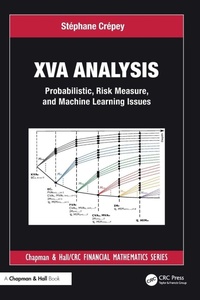
XVA Analysis
Probabilistic, Risk Measure, and Machine Learning Issues
1st Edition
Will be published approx. on 31. December 2025
Book
Hardback
456 pages
978-1-041-01420-1 (ISBN)
Description
XVA Analysis: Probabilistic, Risk Measure, and Machine Learning Issues offers readers an up-to-date and comprehensive exploration of the X-Value Adjustment (XVA) universe and of the embedded risk measure issues inherent within it. The book tackles this subject through the triple lens of ?nance (wealth transfers), stochastic analysis (enlargement of ?ltration and BSDEs), and numerical computations.
The traditional Credit Valuation Adjustment (CVA) desk compensates the trading desks for the cash flows that they lose in case of defaults of their counterparties. The Treasury of the bank funds the activity of the trading desks and of the CVA desk at the risk-free rate. The CVA desk and the Treasury charge their costs to the clients of the bank at a valuation level ensuring corresponding PnL processes that are martingales relative to a fininsurance probability measure calibrated to the market and consistent with the physical probability measure given the market. The management of the bank charges to the clients of the bank an additional risk premium, turning the overall dividend process of the bank shareholders into a submartingale in line with a target hurdle rate on their capital at risk within the bank.
This is the essence of the cost-of-capital XVA approach, which can also be used in reverse engineering mode, for determining the price range of a new deal that improves the implied hurdle rate of the bank shareholders. The advent of XVAs reflects a shift of paradigm regarding the pricing and risk management of financial derivatives, from hedging to balance sheet optimization. It is this approach which this book shall explore.
Features
? Numerous illustrative figures and examples
? Unprecedented coverage of neural network regression methodologies
? Suitable as supplementary reading for graduate students and as a practical reference for professional quantitative analysts and risk managers.
The traditional Credit Valuation Adjustment (CVA) desk compensates the trading desks for the cash flows that they lose in case of defaults of their counterparties. The Treasury of the bank funds the activity of the trading desks and of the CVA desk at the risk-free rate. The CVA desk and the Treasury charge their costs to the clients of the bank at a valuation level ensuring corresponding PnL processes that are martingales relative to a fininsurance probability measure calibrated to the market and consistent with the physical probability measure given the market. The management of the bank charges to the clients of the bank an additional risk premium, turning the overall dividend process of the bank shareholders into a submartingale in line with a target hurdle rate on their capital at risk within the bank.
This is the essence of the cost-of-capital XVA approach, which can also be used in reverse engineering mode, for determining the price range of a new deal that improves the implied hurdle rate of the bank shareholders. The advent of XVAs reflects a shift of paradigm regarding the pricing and risk management of financial derivatives, from hedging to balance sheet optimization. It is this approach which this book shall explore.
Features
? Numerous illustrative figures and examples
? Unprecedented coverage of neural network regression methodologies
? Suitable as supplementary reading for graduate students and as a practical reference for professional quantitative analysts and risk managers.
More details
Series
Language
English
Place of publication
London
United Kingdom
Publishing group
Taylor & Francis Ltd
Target group
College/higher education
Professional and scholarly
Postgraduate
Illustrations
70 farbige Abbildungen, 70 s/w Zeichnungen, 52 s/w Tabellen
52 Tables, black and white; 70 Line drawings, black and white; 70 Illustrations, black and white
Dimensions
Height: 260 mm
Width: 183 mm
Thickness: 27 mm
Weight
977 gr
ISBN-13
978-1-041-01420-1 (9781041014201)
Copyright in bibliographic data and cover images is held by Nielsen Book Services Limited or by the publishers or by their respective licensors: all rights reserved.
Schweitzer Classification
Other editions
Additional editions
E-Book
12/2025
1st Edition
Chapman and Hall
€138.99
Available for download
E-Book
12/2025
1st Edition
Chapman and Hall
€138.99
Available for download
Person
Stephane Crepey is a professor at the mathematics department of Univ Evry, Universite Paris-Saclay, in charge of the probability and finance group and of the quantitative finance master 2 program.
Content
Foreword List of Figures List of Tables List of Algorithms Preface Part INTRODUCTION Chapter 0 The Sustainable Black-Scholes Equations Part PRICING Chapter I XVA Analysis From the Balance Sheet Chapter II The Cost-of-Capital XVA Approach in Continuous Time Chapter III Cash Flows Arithmetics Part NUMERICAL METHODS Chapter IV Generalities Chapter V Pathwise CVA Regressions With Oversimulated Defaults Chapter VI CVA Sensitivities, Hedging and Risk Chapter VII Regressing Pathwise FVA, Economic Capital, and KVA Part RISK Chapter VIII Derivatives' Risks as Costs in a One-Period Setup Chapter IX Resolving a Clearing Member's Default by Equilibrium Chapter X Quantitative Reverse Stress Testing, Bottom Up Part HVA IS WORTH A DETOUR Chapter XI Hedging Valuation Adjustment and Model Risk Bibliography Index Acknowledgments Author Bio