


Downsizing Democracy
How America Sidelined Its Citizens and Privatized Its Public
Published on 26. November 2002
Book
Hardback
310 pages
978-0-8018-7150-4 (ISBN)
Description
In the 19th century, America was exceptional for the vitality of its democratic institutions, particularly political parties. When citizens wanted change, they mobilized as political groups to pressure their congressional representatives or they made their power felt at the ballot box. Government, in turn, depended on the citizenry to staff public agencies, serve in the armed services, and provide funds in time of war through the purchase of bonds. Over the course of the 20th century, however, the nature of American democracy transformed so thoroughly that in the aftermath of the terrorist attacks on September 11th, President George W. Bush - elected by less than a quarter of eligible voters - told Americans that the best way they could help their country was to shop and travel while the government conducted a remote war. In this text, Matthew A. Crenson and Benjamin Ginsberg describe how the powerful idea of a collective citizenry has given way to a concept of personal, autonomous democracy, in which political change is effected through litigation, lobbying, and term limits, rather than active participation in the political process.
Mandatory taxes have replaced bonds as a means to fund military operations, career civil servants have replaced volunteers in the allocation of public services, and an elite, professional soldier has replaced the citizen-soldier. With citizens pushed to the periphery of political life, narrow special interest groups from across the political spectrum - largely composed of faceless members drawn from extended mailing lists - have come to dominate state and federal decision-making. In the closing decade of the last century, this trend only intensified as the federal government, taking a cue from business management practices, rethought its relationship to its citizens as one of a provider of goods and services to individual "customers".
Mandatory taxes have replaced bonds as a means to fund military operations, career civil servants have replaced volunteers in the allocation of public services, and an elite, professional soldier has replaced the citizen-soldier. With citizens pushed to the periphery of political life, narrow special interest groups from across the political spectrum - largely composed of faceless members drawn from extended mailing lists - have come to dominate state and federal decision-making. In the closing decade of the last century, this trend only intensified as the federal government, taking a cue from business management practices, rethought its relationship to its citizens as one of a provider of goods and services to individual "customers".
Reviews / Votes
A welcome corrective to what has been a stampede in recent years toward blaming citizens . . . How we act is affected by how our government treats us, the processes for influencing decision-making that are available to us and the societal structures that provide us with more or less time, resources, incentive and opportunity to venture into the public sphere . . . But I don't think this book lets citizens off the hook . . . Crenson and Ginsberg have taken an important step in identifying and describing that relationship [between formal democracy and everyday democracy], and their work calls us to pay attention to whether institutional processes today support or undermine everyday democracy.-Palma J. Strand, The Nation A thoughtful and useful analysis of present-day democratic decline.
-Kerry Lauerman, Washington Post Book World Downsizing Democracy has the marks of a book that will be remembered. It applies a master thesis to many different facets of American political life, inviting the reader to see a vast array of previously familiar material as if for the first time and as a whole. In the authors' view, we have come to the end of a centuries-long epoch during which government and political elites needed publicly engaged citizenry . . . The authors prosecute their thesis . . . with admirable insight and persuasiveness.
-Hugh Heclo, Political Science Quarterly This fascinating book surveys the changing relationship between the U.S. government and the populace that constitutes its whole . . . Highly recommended.
-Choice
More details
Language
English
Place of publication
Baltimore, MD
United States
Target group
College/higher education
Professional and scholarly
Dimensions
Height: 229 mm
Width: 152 mm
Weight
612 gr
ISBN-13
978-0-8018-7150-4 (9780801871504)
DOI
10.1353/book.72712
Copyright in bibliographic data is held by Nielsen Book Services Limited or its licensors: all rights reserved.
Schweitzer Classification
Other editions
Additional editions
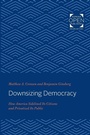
Matthew A. Crenson | Benjamin Ginsberg
Downsizing Democracy
How America Sidelined Its Citizens and Privatized Its Public
Book
04/2020
Johns Hopkins University Press
€52.40
Article not available at the moment
Matthew A. Crenson | Benjamin Ginsberg
Downsizing Democracy
How America Sidelined Its Citizens and Privatized Its Public
E-Book
04/2020
Johns Hopkins University Press
€34.49
Available for download
Matthew A. Crenson | Benjamin Ginsberg
Downsizing Democracy
How America Sidelined Its Citizens and Privatized Its Public
Book
05/2004
Johns Hopkins University Press
€39.81
Article exhausted; check different version
Persons
Matthew A. Crenson is a professor of political science at the Johns Hopkins University whose books include Building the Invisible Orphanage and Neighborhood Politics. Benjamin Ginsberg is the David Bernstein Professor of Political Science and director of the Center for the Study of American Government at the Johns Hopkins University. His books include Politics by Other Means and American Government: Freedom and Power.
Content
Preface
Chapter 1. From Popular to Personal Democracy
Chapter 2. The Rise and Fall of the Citizen
Chapter 3. Elections Without Voters
Chapter 4. The Old Patronage and the New
Chapter 5. Disunited We Stand
Chapter 6. From Masses to Mailing Lists
Chapter 7. The Jurisprudence of Personal Democracy
Chapter 8. Movements without Members
Chapter 9. Privatizing the Public
Chapter 10. Does Anyone Need Citizens?
Notes
Index
Chapter 1. From Popular to Personal Democracy
Chapter 2. The Rise and Fall of the Citizen
Chapter 3. Elections Without Voters
Chapter 4. The Old Patronage and the New
Chapter 5. Disunited We Stand
Chapter 6. From Masses to Mailing Lists
Chapter 7. The Jurisprudence of Personal Democracy
Chapter 8. Movements without Members
Chapter 9. Privatizing the Public
Chapter 10. Does Anyone Need Citizens?
Notes
Index